
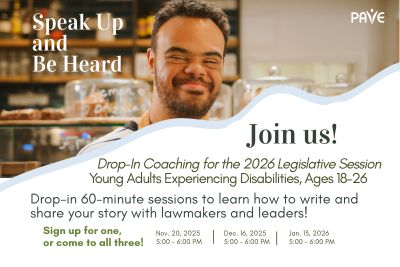
Online – PAVE’s Pierce County Speak Up and Be Heard!

November 20 @ 5:00 pm 6:00 pm PST

A drop-in hour with peers. Listen, share, how are you speaking up? Support others to do so.

Register today!

The Washington Legislative Session is just around the corner. Get ready for ARC Advocacy Days.

  •  Not sure what to say? Join your peers for support.
  • Have an issue important to you? Join us to get feedback.
  • Want to make a difference? Join your peers to see how they did it!


What’s it about?
A supportive space from 5 pm – 6pm with Pierce County peers who experience an intellectual and/or developmental disability. To share, listen, learn, and offer your wisdom. 

First 3 peer-to-peer options:

  • November 20, 2025, from 5:00 – 6:00 p.m.
  • December 16, 2025, from 5:00 – 6:00 p.m.
  • January 13, 2026, from 5:00 – 6:00 p.m.

Our time can include…

  • Inspiring videos of real self-advocates sharing their stories
  • How to build your advocacy story
  • Time to identify issues important to you
  • Listen to each other’s story
  • Ask for feedback
  • Give feedback to those that ask
  • Ongoing discussion and feedback throughout the session 

Where can you use what you learn?

  • Speaking with legislators and decision-makers 
  • Participating in advocacy events or rallies 
  • Sharing your story with community groups or on social media 
  • Building confidence to speak up and take part in important decisions in your community 
  • Learning how to stand up for yourself and others in ways that help make change 

What’s next?

Register for one, two, or all three to save your spot. Then drop in, hang out with peers, and leave with ideas of how you may want to share your story and speak up for yourself!

Questions? Help to register?

Call (253) 565-2266 or email us at p2p@wapave.org. 

Register today!

Quick Start Your Advocacy in Two Steps

Asking for something you want or need for yourself or someone you love can take courage and inner strength. The ask is easier when you have basic advocacy tools. This short video provides a two-step process to help advocates step into their role with more confidence.

Here are the words that go with the video:

Being an advocate means speaking up to request something and pressing onward until the goal is met. The best advocates are really clear about two steps you cannot skip:

  1. Know what you want, and;
  2. Know who has the power to make that possible.  

This may sound obvious, but it’s not always easy. Let’s break it down with an example.

This is Julia—she’s a mom. Her 7-year-old son, Jose, isn’t learning to read like other kids his age. Julia wonders if Jose might have a learning disability. She mentions this to the attendance secretary one morning. Nobody contacts her. She assumes her worries are wrong or not important.

Hmmm, that doesn’t sound quite right, does it?

If she applies our two-step guide to advocacy, Julia can try again. She starts here:

  1. What does she want?
  2. Who has the power to make that happen?

First, she wants her son to get more reading help at school. Second, a classroom teacher or a special education teacher might help, but the attendance secretary is not the right person to ask.

It will take some work to press onward. Julia may need an appointment to formally talk with Jose’s teacher or a school administrator to get her advocacy project started. Here are some questions she might ask:

  • What do I do if I think my son might have a learning disability?
  • Is there a form for me to request a special education evaluation?
  • Who should I send my request to?
  • When will I get a response?
  • What’s the process for getting services to help my son?
  • What are my options if I disagree with the school’s decision?

Making a list of questions is an advocate’s homework. Taking careful notes helps with planning and often leads to faster results.

Remember, Julia wants her son to get more help learning to read. Her questions will help her figure out who to work with and what to do next.

Advocacy requires persistence. Don’t give up, and keep your eye on these two questions:

  1. What do I want?
  2. Who has the power to work with me and make that happen?