Self-Care is Critical for Caregivers with Unique Challenges

Caring for individuals with disabilities or complex medical needs can be emotionally and physically draining, making intentional self-care essential for long-term well-being.  Simple practices like mindfulness, getting enough sleep, going for a walk, or taking a few deep breaths can help reduce stress and build resilience. Talking to others who understand and finding time to rest can also help caregivers stay strong and healthy.

A Brief Overview

  • Self-care is not selfish. Self-care is any activity or strategy that helps you survive and thrive in your life. Without regular self-care, it can become impossible to keep up with work, support and care for others, and manage daily activities.
  • PAVE knows that self-care can be particularly challenging for family members caring for someone with a disability or complex medical condition. This article includes tips and guidance especially for you.
  • PAVE provides a library with more strategies to cultivate resilience, create calm through organization, improve sleep, and more: Self-Care Videos for Families Series.

Introduction

Raising children requires patience, creativity, problem-solving skills and infinite energy. Think about that last word—energy. A car doesn’t keep going if it runs out of gas, right? The same is true for parents and other caregivers. If we don’t refill our tanks regularly we cannot keep going. We humans refuel with self-care, which is a broad term to describe any activity or strategy that gives us a boost.

Self-care is not selfish! Without ways to refresh, we cannot maintain our jobs, manage our homes, or take care of people who need us to keep showing up. Because the demands of caring for someone with a disability or complex medical condition can require even more energy, refueling through self-care is especially critical for caregivers.

Two Feet, One Breath

Before you read anymore, try this simple self-care tool called Two Feet, One Breath. Doctors use this one in between seeing patients.
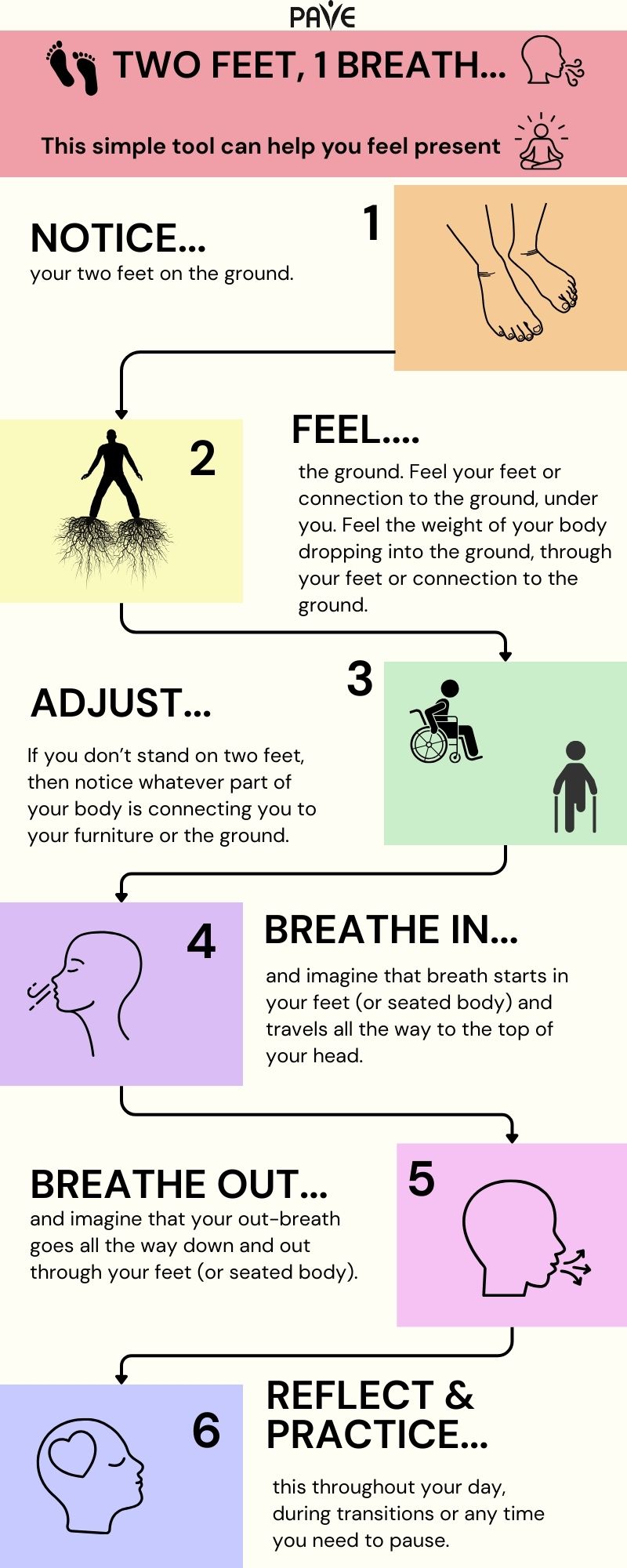
Two Feet, One Breath infographic. Calming practice that can help your mental health.

Download this infographic, Two Feet 1 Breath:
English | Chinese (Simplified) 中文 (Zhōngwén) | Korean 한국어 (Hangugeo) | Russian Русский (Russkiy) | Spanish Español | Tagalog | Vietnamese Tiếng Việt

Two Feet, One Breath can become part of every transition in your day: when you get out of bed or the car, before you start a task, after you finish something, or any time you go into a different space or prepare to talk with someone. This simple practice highlights how self-care can become integrated into your day.

Although a day at the spa might be an excellent idea, self-care doesn’t have to be fancy or expensive to have a big impact!

Almost everyone knows or cares for someone with special needs. According to the Centers for Disease Control (CDC), at least 28% of the American population experiences a disability. The result is widespread compassion fatigue, which is a way to talk about burnout from giving more than you get.

Below are some ways to use self-care to avoid burnout!

Connect with others

Building a support network with others who share similar life experiences can be incredibly valuable. When you’re going through a challenging or unique situation—like parenting a child with special needs or managing a family health issue—it can feel isolating. These connections offer emotional validation and a sense of understanding that can be hard to find elsewhere—you don’t have to explain everything because others simply get it. Research shows that social support can significantly reduce stress, anxiety, and depression, enhancing overall well-being and resilience. Beyond emotional comfort, support networks empower individuals by helping them build confidence, understand their rights, and even engage in advocacy efforts that benefit their families and communities.

Here are some communities and resources to help you get connected:

Parent-to-Parent Connections
The Parent-to-Parent network can help by matching parents with similar interests or by providing regular events and group meetings.

Support for Families of Youth Who Are Blind or Low Vision

Washington State Department of Services for the Blind (DSB) offers resources and support for families. You can also hear directly from youth about their experiences in the PAVE story: My story: The Benefits of Working with Agencies like the Washington State Department of Services for the Blind.

Support for Families of Youth Who Are Deaf or Hard of Hearing
Washington Hands and Voices offers opportunities for caregivers of youth who are Deaf or Hard of Hearing (DHH) to connect, share experiences, and find community.

Resources for Families Navigating Behavioral Health Challenges
Several family-serving organizations provide support, education, and advocacy for caregivers of children and youth with behavioral health conditions: 

  • Family, Youth, and System Partner Round Table (FYSPRT). Regional groups are a hub for family networking and emotional support. Some have groups for young people.
  • Washington State Community Connectors (WSCC). WSCC sponsors an annual family training weekend, manages a Substance Use Disorder (SUD) Family Navigator training, and offers ways for families to share their experiences and support one another.
  • COPE (Center of Parent Excellence) offers support group meetings and direct help from lead parent support specialists as part of a statewide program called A Common Voice.
  • Dads Move ​works to strengthen the father’s role in raising children with behavioral health needs through education, peer support and advocacy.
  • Healthy Minds Healthy Futures is an informal network on Facebook.

PAVE provides a comprehensive toolkit for families navigating behavioral health systems, including guidance on crisis response, medical care, education, and family support networks.

Get Enough Sleep

The body uses sleep to recover, heal, and process stress. If anxiety or intrusive thinking consistently interrupts sleep, self-care starts with some sleeping preparations:

Move Your Body

Moving releases feel-good chemicals into the body, improves mood, and reduces the body’s stress response. Walk or hike, practice yoga, swim, wrestle with the kids, chop wood, work in the yard, or start a spontaneous living-room dance party.

The Mayo Clinic has this to say about exercise:

  • It pumps up endorphins. Physical activity may help bump up the production of your brain’s feel-good neurotransmitters, called endorphins. Although this function is often referred to as a runner’s high, any aerobic activity, such as a rousing game of tennis or a nature hike, can contribute to this same feeling.
  • It reduces the negative effects of stress. Exercise can provide stress relief for your body while imitating effects of stress, such as the flight or fight response, and helping your body and its systems practice working together through those effects. This can also lead to positive effects in your body—including your cardiovascular, digestive and immune systems—by helping protect your body from harmful effects of stress.
  • It’s meditation in motion. After a fast-paced game of racquetball, a long walk or run, or several laps in the pool, you may often find that you’ve forgotten the day’s irritations and concentrated only on your body’s movements. Exercise can also improve your sleep, which is often disrupted by stress, depression and anxiety.

Be Mindful

Mindfulness can be as simple as the Two Feet, One Breath practice described at the top of this article. Mindfulness means paying attention or putting your full attention into something. Focusing the mind can be fun and simple and doesn’t have to be quiet, but it should be something that you find at least somewhat enjoyable that requires some concentration.  Some possibilities are working on artwork, cleaning the house or car, crafting, working on a puzzle, cooking or baking, taking a nature walk, or building something.

For more mindfulness ideas, check out PAVE’s Mindfulness Video Series. From this playlist, Get Calm by Getting Organized, explores how getting organized provides satisfaction that releases happiness chemicals and hormones.

Schedule Time

A day can disappear into unscheduled chaos without some intentional planning. A carefully organized calendar, with realistic boundaries, can help make sure there’s breathing room.

Set personal appointments on the calendar for fun activities, dates with kids, healthcare routines, and personal “me time.” If the calendar is full, be courageous about saying no and setting boundaries. If someone needs your help, find a day and time where you might be able to say yes without compromising your self-care. Remember that self-care is how you refuel; schedule it so you won’t run out of gas!

Time management is a key part of stress management! This article, “Stress Management: Managing Your Time” from Kaiser Permanente, gives tips for managing your time well, so you can reduce the pressure of last-minute tasks and make space for the things that matter most to you.

Seek Temporary Relief

Respite care provides temporary relief for a primary caregiver. In Washington State, a resource to find respite providers is Lifespan Respite. PAVE provides an article with more information: Respite Offers a Break for Caregivers and Those They Support.

Parents and caregivers of children with developmental disabilities can seek in-home personal care services and request a waiver for respite care from the Developmental Disabilities Administration (DDA). PAVE provides two training videos about eligibility and assessments for DDA. For more information about the application process, Informing Families provides a detailed article and video.

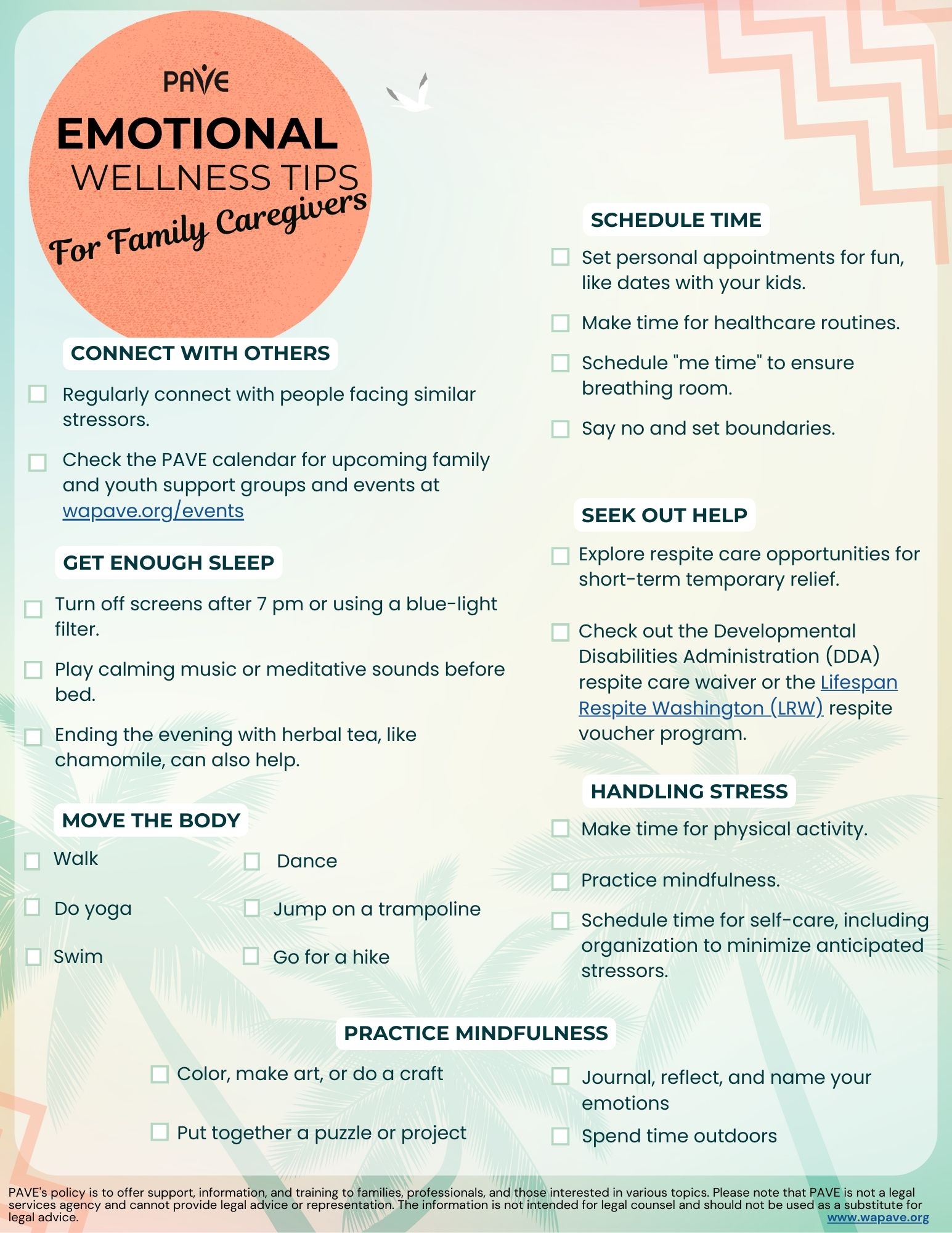
Download the Emotional Wellness Tips for Caregivers
Childcare-What to Know When Your Child has a Disability 

When a parent or family caregiver needs care for their child with a disability, finding safe, appropriate, and affordable care will be a priority. There are resources for children with disabilities and their families in Washington State to find safe and affordable childcare. For providers which take federal funds, civil rights laws protect access and appropriate services for children with disabilities and their families. 

A Brief Overview 

  • Two reliable sites with lists of childcare providers in Washington State are WA State Department of Children, Youth, and Families at findchildcarewa.org, and Childcare Aware of Washington Family Center, which is also by phone at 1-800-446-1114. 
  • Childcare takes place in many different settings, licensed and unlicensed. A state license for childcare can help you decide if a childcare setting is safe. This article tells you how to find out if a provider is licensed. 
  • It’s good to ask certain questions before enrolling a child with a childcare provider. This article offers a sample list. 
  • Three laws protect the rights of children with disabilities in childcare settings that accept federal funding: Americans with Disabilities Act (ADA), Individuals with Disabilities Education Act (IDEA) Part C (Birth to Age 3) and Part B (Age 3 through high school graduation) and Section 504 of the Rehabilitation Act of 1972. 
  • Childcare can be expensive. This article explains about tax credits and state programs that help working families, free early learning programs and preschool, and financial help when family, friends, or neighbors provide childcare for your child. 

How can I find listings for childcare in WA State?

 Use this link for listings on the Washington State Department of Children, Youth, and Families (DCYF): findchildcarewa.org 

Washington State partners with Child Care Aware of Washington Family Center. The phone number for individual assistance with your childcare search is 1-800-446-1114 

How can I find out if a childcare center, program, or family home childcare is safe? 

By law, Washington State licenses certain childcare settings. Licensing sets standards that childcare programs and providers must meet. State inspections help ensure that licensed programs and providers meet the standards, which cover a wide range of topics, from the safety and cleanliness of the physical setting through number of staff per child, staff training, and age-and-ability appropriateness of activities and education. 
Links to Washington’s licensing rules are on DCYF’s page on Becoming a Licensed Child Care and Early Learning Provider. 

Licenses are required for: 

  • Family home early learning programs: 
    An early learning program licensed by the department where a family home licensee provides childcare or education services for 12 or fewer children in the family living quarters where the licensee lives. 
  • Childcare center early learning programs: 
    A facility providing regularly scheduled care for a group of children aged from birth through 12-years-old for periods of less than 24 hours a day. 
  • School-age programs (might provide before and after-school childcare and school vacation care): 
    A facility providing regularly scheduled care for a group of children 5 through 12-years-old for periods less than 24 hours a day, when children are not attending school. 
  • Outdoor Nature-Based program: 
    An early learning program that offers regularly scheduled care for preschool-age children, school-age children, or mixed-age children for periods less than 24 hours a day, when children are not attending school. 

What types of childcare don’t need a license? 

  • A nanny or babysitter in your family’s home 
  • Informal parent cooperatives (example: “babysitting exchange”) 
  • Play groups 
  • Educational preschools that operate less than four hours a day 
  • Parks and Recreation programs run by cities and towns 
  • Family members, friends, and neighbors who provide occasional care (If friends or neighbors are providing childcare for multiple children on a regular basis, they are required to have a state license.) 

Programs operated by cities and towns may have standards set by the local government. Contact your local Parks and Recreation Departments to find out what standards their facilities need to meet, how staff are chosen and background checked, and any other questions you have about whether a program will be safe and appropriate for your child. 

Programs that operate on federal or state funding must meet Washington State licensing requirements, such as Head Start and Early Childhood Education and Assistance Program 
(ECEAP). 

More on Head Start and ECEAP under “How to pay for childcare.” 

Find out if a program or provider is licensed by: 

This search tool lets you search for licensing history (has the home or center ever lost its license?), state monitoring reports (did the inspectors find anything to worry about?) status of staff background checks (are they being done?) and more. The tool finds information in Washington State’s database of all licensed childcare facilities and home childcare providers. 

Here is a downloadable, printable checklist of questions to ask when you visit a childcare setting. It’s from ChildCare Aware of Washington: Child Care Quality Checklist 

Questions to ask a provider:  

Questions to ask a provider when enrolling a child with disabilities into a childcare program. It’s important for parents to ask questions to ensure the provider can meet their child’s unique needs.  

  • What experience do you have caring for children with disabilities? 
  • Do you have staff trained in special education or disability support? 
  • What is your adult-to-child ratio, and how flexible is it for children needing more support? 
  • Are staff trained in administering medications or managing medical devices (e.g., feeding tubes, EpiPens, inhalers)? 
  • How do you support children with behavioral challenges? 
  • What is your approach to discipline, and how is it adapted for children with developmental or emotional disabilities? 
  • Can you create or follow an Individualized Care Plan or IEP? 
  • Are you willing to make reasonable modifications to activities, routines, or environments? 
  • Do you allow assistive technology or support items (e.g., communication devices, wheelchairs, noise-canceling headphones)? 

Are there laws that support my child with disability and protect their rights in a childcare setting? 

There are three laws that may apply to childcare settings: 

  • Americans with Disabilities Act (ADA)  
  • Individuals with Disabilities Education Act (IDEA), Part C (Birth to Age 3) and Part B (Age 3 through high school graduation) 
  • Section 504 of the Rehabilitation Act of 1972, usually referred to as “Section 504” or “504” 

Title III of the Americans with Disabilities Act (ADA) applies to: 

  • Federal, state, and local government-agency programs. Examples of this are Head Start, ECEAP (preschools operated by local school districts), summer programs, and extended day school programs. 
  • Privately run childcare centers such as those licensed by Washington State. “Even small, home-based centers are covered by title III of ADA”  
  • Private childcare centers that operate on the property of a religious organization, leasing or renting space on that property. 

ADA does NOT apply to childcare centers that are RUN by religious organizations, such as a church, temple, mosque, or synagogue. 

ADA requires childcare providers to give both children and parents with disabilities an equal opportunity to participate in the provider’s programs and services. 

  • Centers cannot exclude children with disabilities from their programs unless their presence poses a direct threat to the health or safety of others or requires a fundamental alteration of the program. 
  • Centers must make reasonable modifications to their policies and practices to integrate children, parents, and guardians with disabilities into their programs unless doing so would constitute a fundamental alteration
  • Centers must provide appropriate auxiliary aids and services needed for effective communication with children or adults with disabilities, when doing so would not constitute an undue burden
  • Centers must generally make their facilities accessible to persons with disabilities. Existing facilities are subject to the readily achievable standard for barrier removal, while newly constructed facilities and any altered portions of existing facilities must be fully accessible

This website has many examples of situations to help parents and childcare providers understand what the law requires: Commonly Asked Questions about Child Care Centers and the Americans with Disabilities Act. 

Individuals with Disabilities Education Act (IDEA), Part C (Birth to Age 3): 

Children aged birth to 3 who have a disability or are at risk for certain disabilities may be eligible for services under IDEA. For children who qualify, Part C of IDEA authorizes services to support and promote a child’s development “in their natural environment.” This usually means the family home and often, the child’s childcare setting.  
 
Parents can request their child be evaluated (tested) to see if they are reaching expected developmental stages. If evaluators find that a child needs support, a Family Resource Coordinator (FRC) will help the family create an Individualized Family Services Plan (IFSP). Family members have important roles in that plan, and professional staff provide services and help the family to use natural learning opportunities like playtime, meals, or baths to create opportunities for a child to practice and develop delayed skills. 

Services in an IFSP may include, but are not limited to:  

  • Specialized instruction 
  • Speech therapy 
  • Occupational therapy 
  • Physical therapy 

If childcare is a part of your child’s regular schedule, services may be able to be provided in the childcare setting, such as a scheduled time for a speech therapist to work with your child during childcare hours, and for childcare staff to include your family’s daily “practice time” to help your child meet their development goals. 

 If you are just beginning to look for childcare, your FRC may be a good resource to advise you on things to look for and questions to ask to find a childcare setting that can support your family’s IFSP. 

You can check out these resources for much more information on Birth-to-3 programs: 
 
Disability Rights for Littles: Key Information for Families of Babies, Preschoolers, and Primary-School Children (videos) -all the basics you need to know 

PAVE: From Birth to Three Toolkit Basics and beyond! Read online or download, includes FAQ sheet and “cheat sheets”, summaries of important information at-a-glance.  

WA State Department of Children, Youth and Families (DCYF) Early Intervention Services page: Includes contact information and links to apply for an evaluation for ESIT services to find out if your child qualifies. 

Individuals with Disabilities Education Act (IDEA), Part B (Age 3 through high school graduation): 

IDEA Part B applies to preschool and school-age children, and exists to ensure schools, preschools, and kindergartens provide eligible children with disabilities a Free, Appropriate Public Education (FAPE). When disabilities affect how a child is doing in preschool or school, IDEA Part B states that schools and preschools are required to evaluate the child to see if they qualify for special education and related services and supports. This article from PAVE has important background on this law: IDEA: The Foundation of Special Education. 

If a child is eligible for special education, a team is brought together that includes parents, and an Individualized Education Program (IEP) is created for the child, listing the goals, education, and other supports the school or preschool will provide to meet the child’s learning needs. 

For childcare settings, IDEA Part B will apply for these types of childcare settings: 

This PAVE resource explains the differences in services between Part B and Part C of IDEA. 

Section 504 of the Rehabilitation Act of 1973 

Often called “Section 504” for short, this federal law administered by the Office of Civil Rights prohibits discrimination based on disability. To be protected under Section 504, a child must have a physical or mental impairment that substantially limits one or more major life activities, have a record of such an impairment, or be regarded as having such an impairment. 

Section 504 applies to individuals 3-22 years of age. The law requires childcare centers, camps, and any other recreational programs that receive federal funding to provide preschool children with disabilities equal access to the program, with reasonable accommodations and modifications. 

It also includes programs like Head Start, summer programs, and extended school day programs.  

Requirements for childcare centers: 

  • Non-discrimination: Childcare centers cannot refuse to admit a child with a disability.  
  • Reasonable Accommodations: They must provide reasonable accommodations to enable children with disabilities to participate in the program.  
  • Individualized Assessments: Childcare providers must make an individualized assessment of a child’s needs.  
  • Modifications to Policies and Practices: They must make reasonable modifications to their policies and practices.  
  • Accessible Facilities: Childcare centers must ensure that physical spaces are accessible.  

Help paying for childcare:  

Federal Tax Credit: The child and dependent care credit is a tax credit that may help you pay for the care of eligible children or dependents. This credit is based on your income and the cost of caring for your children or eligible dependents to work, look for work, or attend school.  

Seattle has a Child Care Assistance Program

Washington State offers a program through the Department of Children, Youth, and Families (DCYF): 

Working Connections Child Care (WWCC) helps working families pay for childcare. If a family qualifies and chooses an eligible provider, Washington State will pay part of childcare costs. Parents are responsible for any copayment of childcare fees not covered by the state, and those are payable to the provider every month. 

  • The child or children must live in Washington State 
  • The family with whom the child lives must live in Washington State 
  • The family’s income must be at or below 60% of the State Median Income 
  • The family must have less than $1 million in resources 
  • Parent or parents must be participating in an approved activity, such as self-employment, employment, or being in high school or post-secondary education or taking part in the WorkFirst or BFET program. 
  • Families experiencing homelessness are eligible. 
  • If a parent or parents are seasonal agricultural (farm) workers, and live in certain counties, they may be eligible for the Working Connections program. 

An additional up-to-date online resource is MomsRising.org. This site has brief, helpful information about the Working Families Child Care Program, especially when your child or children have a disability. It goes over issues such as: 

  • How families and family size are defined for this program 
  • Children with physical, intellectual and/or developmental disabilities 
  • Children and families experiencing homelessness 
  • Families where the parent or parents are high school or college students 
  • What types of childcare are available 
  • Getting financial assistance when a family member, friend, or neighbor can take care of your child or children 
  • You can check details of your eligibility, including income requirements, on DCYF’s Working Connections Child Care website page.  
  • Apply by calling the Child Care Subsidy Contact Center 1-844-26-8687 or online at Washington Connection.  
  • Get help applying for this program and help finding childcare that meets your family’s needs through ChildCare Aware of WA

Free state-licensed early learning childcare or preschool: 

Head Start programs are federally funded and Early Childhood Education and Assistance Program (ECEAP) is a Washington State-funded program for children aged three and four, and in some locations, infants and toddlers younger than age three. Head Start offers services to pregnant women in some locations.  

Your local school district will have an ECEAP program available. 

Children are eligible for these programs based on their age and family incomes, with some children able to attend these free programs if they have multiple support needs. Visit the ECEAP & Head Start programs page on the DCYF website for more detail and contact information in English and Spanish. 

Financial help for childcare by family, friends, or neighbors

In Washington, this category is called Family, Friend and Neighbor Care. These settings are not required to have a license and are very common arrangements.  
Informal care for children in your home or the family’s home may involve some expenses, and Washington State recognizes this with financial assistance (subsidies). Visit the Family, Friend and Neighbor Care page on DCYF’s website for contact information to apply for subsidies. 

Tips to Help Parents Reinforce Positive Behaviors at Home

Changes in routine, especially during school breaks, can be challenging for families, but using Positive Behavioral Interventions and Supports (PBIS) at home can help create calm, structure, and stronger relationships. PBIS focuses on teaching expected behaviors, using clear communication, and reinforcing positive actions instead of relying on punishment. Families can build supportive routines, model emotional regulation, and use simple strategies to guide behavior at home.

A Brief Overview

  • Positive Behavioral Interventions and Supports (PBIS) is a strategy schools use to teach children about expected behavior.
  • A key PBIS principle is that punishment fails to teach what to do instead. Adults can model calm responses and self-regulation with tools like self-care and mindfulness.
  • Behavior is a form of communication. When children act out, they may be trying to express a need, feeling, or frustration they don’t yet have the words for.
  • The easiest way to change a behavior is to point out what a person does right. Remember this catchy phrase, “5-and-1 gets it done,” to ensure five positive interactions for each negative interaction.
  • Families can use school-based PBIS strategies at home to create safe, consistent, and predictable environments.
  • PAVE provides a video with key information to help families and schools analyze a child’s behavior and develop a positive behavior support plan: Behavior and School: How to Participate in the FBA/BIP Process.
  • If you come up with some great behavior support strategies this summer, be sure to share them with the school in the fall!

Introduction

Changes in routine and seasonal transitions can cause emotional upheaval for families. A few strategies, described below, might help families keep things chill this summer and beyond.

These ideas come from education, where research has helped teachers see the benefits from using Positive Behavioral Interventions and Supports (PBIS). PBIS has been implemented in more than 26,000 U.S. schools. The PBIS framework has been shown to decrease disciplinary removals and improve student outcomes, including grades and graduation rates. When done well, PBIS provides positive social skills, communication strategies and “restorative justice,” (working it out instead of punishing) and may prevent 80-90 percent of problem behaviors.

PBIS is often part of a broader approach called Multi-Tiered System of Supports (MTSS), which helps schools and families work together to meet academic, behavioral, and emotional needs through different levels of support.

Positive support makes learning easier

PBIS research highlights problems with punishments, which are called “aversive interventions.” Research shows that a punished child is likely to go into an emotionally dysregulated state (fight/flight/freeze) that actually blocks learning. Chances are low that the child will know what to do next time because the punishment didn’t provide a learning opportunity.

PBIS teaches what to do instead – and how to do it. Adults who calmly guide children and youth toward a new way of problem-solving can interrupt or prevent an escalation and help the child make better and better choices moving forward.

Keep in mind that adults need to stay regulated to help children. PAVE provides resources to help adults work on their own self-control and support their children:

Behavior is a child’s attempt to communicate

Simple, consistent, predictable language is critical for teaching and reinforcing behavior, says Kelcey Schmitz, who works for the University of Washington School Mental Health Assessment, Research, and Training (SMART) Center.

“PBIS is a game changer for children and youth with behavior challenges and their teachers and caregivers,” Schmitz says. “In fact, everyone can benefit from PBIS. Behavior is a form of communication, and PBIS aims to reduce problem behavior by increasing appropriate behavior and ultimately improving quality of life for everyone. The same approaches used by schools to prevent problem behaviors and create positive, safe, consistent and predictable environments can be used by families at home.”

Schmitz, an MTSS training and technical assistance specialist, provides the following specific tips for creating a successful PBIS home environment.

Support Positive Behavior before there is a problem

PBIS is set up with three layers – called tiers – of support. The parent-child relationship is strengthened by loving and positive interactions at each level.

Tier 1 support is about getting busy before there is a problem. Much like learning to wash hands to prevent getting sick, expected behavior is taught and modeled to prevent unexpected behaviors.  Parents can look at their own actions and choices and consider what children will see as examples of being respectful, responsible, and safe.

Tiers 2 and 3 are where adults provide more support for specific behaviors that are getting in the way of relationships or how the child or youth functions. In a school setting, Tier 2 is for students who need a social group or some extra teaching, practice, and reinforcement.

Tier 3 support includes a Functional Behavioral Assessment (FBA) to find out why the behavior is occurring, and an individualized Behavior Intervention Plan (BIP). PAVE provides a video: Behavior and School: How to Participate in the FBA/BIP Process.

Any student may access supports that include aspects of Social Emotional Learning at all three Tiers. At home, Tiers 2 and 3 naturally will be more blended and may include support from a community provider. Note that targeted interventions in Tiers 2-3 work best when Tier 1 is already well established.

Define, teach, and routinely acknowledge family expectations

Discuss how you want to live as a family and identify some “pillars” (important, building-block concepts) that represent what you value. Talk about what those pillars look, and sound like in everyday routines. To help the family remember and be consistent, choose only 3-5 and create positive statements about them. Here are a few examples:

  • Speak in a respectful voice.
  • Be responsible for your actions.
  • Be safe; keep hands, feet, and objects to self.

Identify a couple of “hot spots” to begin. Challenging behaviors often occur within routines. Perhaps mornings or mealtimes create hot spots for the family. After discussing 1-2 ways to be respectful, responsible, and safe in the morning, teach what each looks like. Have fun with it! Set up “expectation stations” for practicing the plan and assign each family member one pillar to teach to the rest.

Behaviors that get attention get repeated. Notice when a child does the right thing and say something about each success: “I noticed you stopped to pick up your shoes in the hallway. Thanks for putting them away and keeping the walkway safe for others.” The easiest way to change a behavior is to point out what a person does right!

Remember this catchy phrase, “5-and-1 gets it done” to ensure five positive interactions for each negative interaction. When the expected behavior becomes routine, the reinforcement can fade away.

Create engaging and predictable routines

Children crave structure and routine. Adults may look forward to a relaxing evening or weekend, but kids often need regular activity and engagement. Consider that either the kids are busy, or the adults are busy managing bored kids!

Use visuals to create predictability. A visual schedule can display major routines of the day with pictures that are drawn, real photos, or cut-outs from magazines. Create a schedule together, if possible.  Parents can ask a child to check the schedule – especially when moving from a preferred to non-preferred activity. It’s hard to argue with a picture!

Set the stage for positive behavior

Teach, pre-teach, and re-teach. Children need to learn behavior just like they learn colors and shapes. A quick reminder can help reinforce a developing skill: “When we get in the car, sit up, buckle up, and smile!”

Give transition warnings or cues to signal the end of one activity and the beginning of another: “In five minutes, it will be bath time.”

First/then statements set up a child for delayed gratification: “First take your bath; then we can play dolls.”

Focus on Go instead of Stop. Children often tune out words like NoDon’t and Stop and only hear the word that comes next, which is what an adult is trying to avoid. Tell a child what to do instead of what not to do: “Take your plate and put it in the sink.” Save Stop and No for dangerous circumstances that need a quick reaction.

Choices prevent power struggles: “Would you rather play for five more minutes or get in the bath now?”  “Feel free to choose the pink pajamas or the green ones.”

While these strategies may not eliminate all problem behaviors, they create consistency, predictability, and a more positive atmosphere. They teach new skills to help children get their needs met. The solid foundation will help even if challenging behaviors persist by creating a bedrock for additional layers of support.

Final Thoughts

Supporting positive behavior at home doesn’t require perfection—just patience, consistency, and a willingness to learn alongside your child. By using clear communication, setting routines, and teaching expected behaviors, families can create a calm and connected environment where everyone thrives. These strategies not only make summer smoother but also build skills that carry into the school year. If you come up with some great behavior support strategies this summer, be sure to share them with the school in the fall! Working together, families and schools can create strong, supportive systems that help every child succeed.

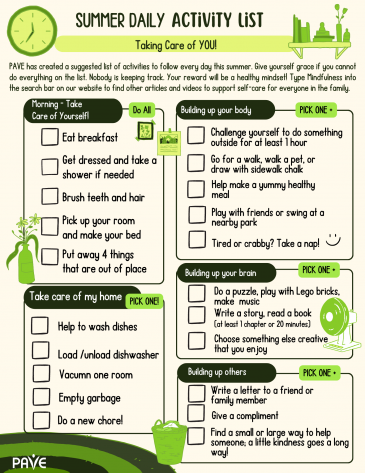
Summer Daily Activity List – Taking care of YOU!

PAVE has created a suggested list of activities to follow every day this summer. Give yourself grace if you cannot do everything on the list. Nobody is keeping track. Your reward will be a healthy mindset! Type Mindfulness into the search bar on our website to find other articles and videos to support self-care for everyone in the family. 

List of Daily Activities for the Summer Print list on wapave.org

Click to view this list in PDF form

Start the day with a self-care routine – Do all!

  • Eat breakfast
  • Get dressed and take a shower if needed
  • Brush teeth and hair
  • Pick up your room and make your bed
  • Put away four things that are out of place

Take care of your home – Pick one!

  • Help to wash dishes
  • Load /unload the dishwasher
  • Vacuum one room
  • Empty the garbage
  • Do a new chore!

Build your body – Pick one or more!

  • Challenge yourself to do something outside for at least one hour
  • Go for a walk, walk a pet, or draw with sidewalk chalk
  • Help make a yummy healthy meal
  • Play with friends or swing at a nearby park
  • Tired or crabby? Take a nap!

Build your brain

Build your brain – Pick one or more!

  • Do a puzzle, play with Lego bricks, make music
  • Write a story, read a book (at least 1 chapter or 20 minutes)
  • Choose something else creative that you enjoy

Build up others – Pick one or more!

  • Write a letter to a friend or family member
  • Give a compliment
  • Find a small or large way to help someone: a little kindness goes a long way!

Self-Care Videos for Mindfulness – Families Series

Take a Mindful Walk in Nature

Mindfulness can mean anything that helps you slow down and show up for what’s happening in a moment. This video demonstrates how to notice all of the body’s senses on a nature walk. Once it’s familiar, the concept could be useful in any environment, including indoors. Get creative and if it’s developmentally appropriate, you can encourage children to make up their own journey through their senses.

Get Calm by Getting Organized

When overwhelm is happening, it’s hard to imagine that getting organized will help. But here’s why it’s worth it: When you feel satisfied that you’ve done something, your brain releases happiness chemicals and hormones. This video provides information about how that works and how families can tap into happy by getting organized and taking time each day to celebrate everyone’s accomplishments.

How to Cultivate Resilience like a Starfish

Starfish are masters at letting turmoil wash around them. They are also excellent models of resilience. This short video uses imagery from the sea and provides a strategy to get grounded, steady the breath, and cultivate four key aspects of resilience: purpose, connection, adaptability, and hope.

Become present and let thinking float away as you treat yourself to this opportunity to take a few minutes to care for yourself.

Breathe Mindfully and Give Your Favorite Stuffy a Ride

Even young children can become grounded and calm if breathing with intention is fun and accessible to them. This short video features two young models showing how they give their stuffed animals a ride while they breathe into and out of their tummies.

Have your child choose a comfortable place to lie down and place their stuffed animal on their tummy. Help them to notice what it’s like to breathe and watch the stuffy go up and down. Ask them what it feels like to notice their breathing and their stuffy taking a ride.

Our five-year-old model says, “I loved it and felt like I could fall asleep.”