

Sample Letter to Request an IEP Meeting

Families can request an IEP (Individualized Education Program) meeting at any time—not just during the annual review. A sample letter is available to help parents and guardians formally make this request. Guidance is also provided on who must attend IEP meetings, common reasons for requesting one, and tips for organizing communication and documentation.

A Brief Overview:

  • Families can request an IEP meeting at any time—not just during the annual review.
  • Washington state law (WAC 392-172A-03095) requires that the IEP team include specific people and roles.
  • Common reasons to request a meeting include academic struggles, behavior concerns, new diagnoses, or transition planning.
  • Students can also request meetings to advocate for themselves or adjust goals and supports.
  • PAVE offers helpful tools to support families in preparing for IEP meetings, including a fillable Who’s Who on the IEP Team contact form and sample letter to formally request a meeting—both available for download in multiple languages within this article.

Introduction

When a student has an Individualized Education Program (IEP), their IEP team is required to meet and review the program at least every year. The annual review date is listed on the cover page of the IEP document. Family caregivers can request additional meetings, and this article includes a sample letter families can use to formally request an IEP meeting.

Keep in mind that parents have the right to participate in meetings where decisions are made about eligibility or changes to a student’s special education services. A court decision in 2013 further affirmed those rights. More information about that case, Doug C. Versus Hawaii, is included in the PAVE article, Parent Participation in Special Education Process is a Priority Under Federal Law.

An IEP meeting request letter can be submitted to school staff and to district staff. Family participants have the right to invite guests to the meeting for support and to provide additional expertise about the student.

Required Members of the IEP Team

The best practice is for the school and parents to communicate about who will attend the meeting. If required school staff are unable to attend a meeting, parents must sign consent for their absence. Under Washington Administrative Code (WAC 392-172A-03095), a school district must ensure that each IEP team includes:

  • Parent/legal guardian
  • At least one general education teacher
  • At least one special education teacher of the student
  • District staff qualified in the provision of specially designed instruction (SDI), knowledgeable about the district’s general education curriculum, and knowledgeable about the district’s available resources
  • Someone (usually a school psychologist) qualified to interpret the instructional implications of evaluation results
  • At the discretion of the parent or the school district, other individuals who have knowledge or special expertise regarding the student, including related services personnel
  • Whenever appropriate, the student (required to be invited once a transition plan is added, by age 16 or earlier)

According to Washington state law (WAC 392-172A-03095), the IEP team includes an individual who is knowledgeable about district resources. Sometimes a school principal or other staff member fulfills that role, but families or school staff can request attendance by someone who works in the district’s special education department. If a school administrator says during a meeting, “We’ll have to check with the district and get back to you,” it may mean that a key decision-maker isn’t present. In that case, families or students can request another meeting with all required team members. This is especially important if the team is discussing services that might cost more or involve a change in the student’s educational placement.

The school’s meeting invitation lists attendees and can clarify when the meeting will start and end and the purpose or agenda for the meeting. PAVE provides an article about how students and families can prepare for a meeting by creating a handout for the team, including a Student Input Form.

Who’s Who on the IEP Team

PAVE offers a fillable Who’s Who on the IEP Team contact form to help you organize contact information and roles of the IEP team members.
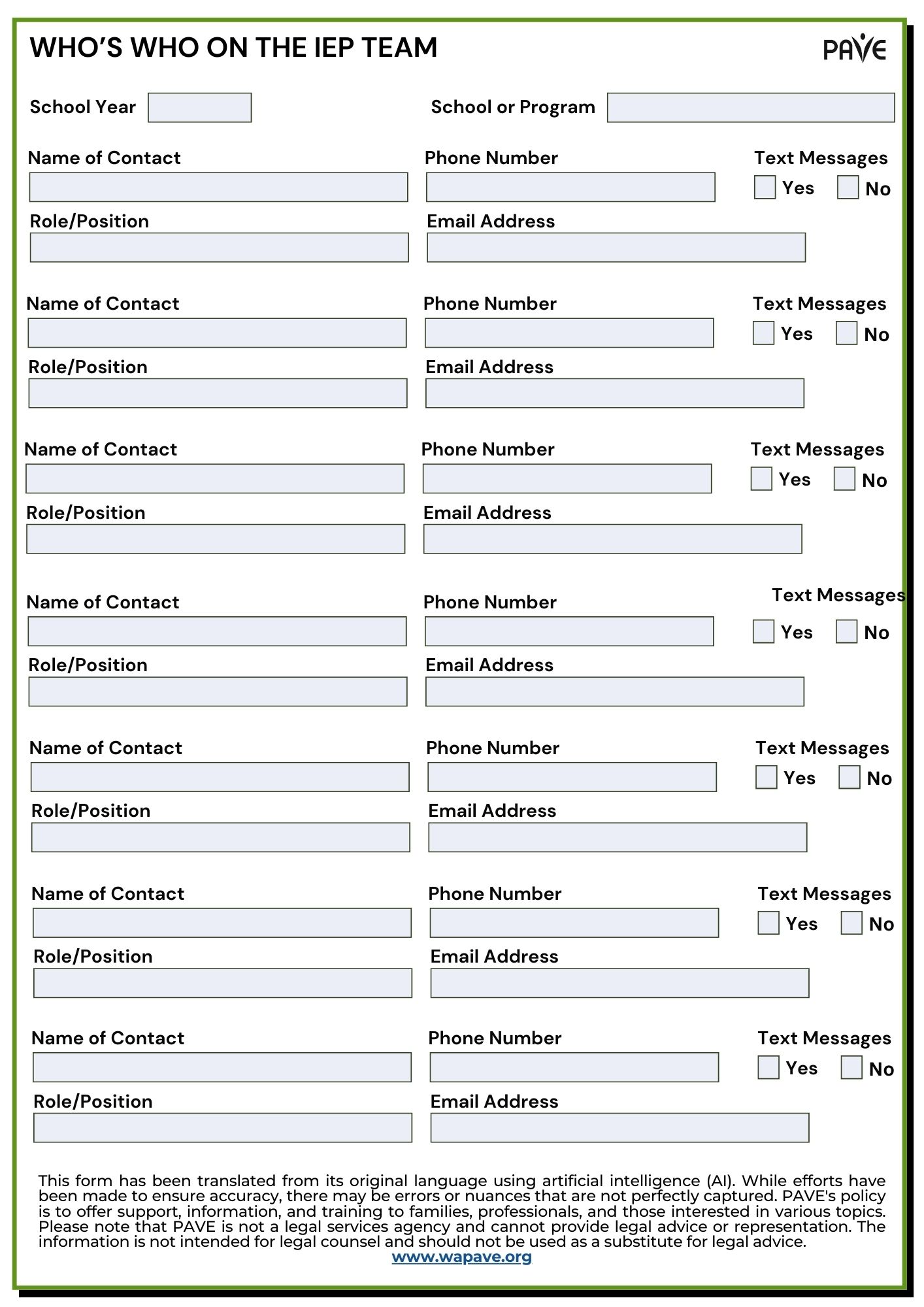
Who's Who on the IEP Team

Download the Who’s Who on the IEP Team contact form in:
English | Chinese (Simplified) 中文 (Zhōngwén) | Korean 한국어 (Hangugeo) | Russian Русский (Russkiy) | Somali Soomaali | Spanish Español | Tagalog | Ukrainian українська | Vietnamese Tiếng Việt

Common Reasons to Request an IEP Meeting

Parents, guardians, and students have the right to request an IEP team meeting at any time during the school year—not just during the annual review. If there are concerns about a student’s progress, changes in needs, or questions about services and supports, it’s appropriate to ask for the team to come together. IEP meetings can be used to problem-solve, update goals, adjust services, or simply ensure everyone is on the same page. Regular communication helps keep the plan relevant and responsive to the student’s needs.

Here are a few examples of reasons parents or guardians might request an IEP meeting:

  • New diagnosis or information about a student’s disability
  • Frequent disciplinary actions
  • Student is refusing to go to school
  • Academic struggles
  • Lack of meaningful progress toward IEP goals (PAVE provides an article with a handout about SMART goals and progress monitoring
  • Behavior plan isn’t working
  • Placement isn’t working
  • Parent or guardian wants to discuss further evaluation by the school or an independent agency

Here are a few examples of reasons parents or guardians might request an IEP meeting:

  • Feeling unsupported in class
  • Academic struggles
  • Trouble with peers or behavior plan
  • Goals don’t feel meaningful or realistic
  • Preparing for life after high school (transition planning is required by age 16)
  • New diagnosis or change in personal circumstances
  • Practicing self-advocacy or wanting a more active role in the IEP process

PAVE provides a sample letter to request an IEP meeting. You can copy and paste the text of this sample letter into your word processor to build your own letter. If sending through email, the format can be adjusted to exclude street addresses.

Sample Letter to Request an IEP Meeting

PAVE provides a sample letter to request an IEP meeting. You can copy and paste the text of this sample letter into your word processor to build your own letter. If sending through email, the format can be adjusted to exclude street addresses.

Download the Sample Letter to Request an IEP Meeting in:
English | Chinese (Simplified) 中文 (Zhōngwén) | Korean 한국어 (Hangugeo) | Russian Русский (Russkiy) | Somali Soomaali | Spanish Español | Tagalog | Ukrainian українська | Vietnamese Tiếng Việt

You can email this letter or send it by certified mail (keep your receipt), or hand carry it to the district office and get a date/time receipt. Remember to keep a copy of this letter and all school-related correspondence for your records. Get organized with a binder or a filing system that will help you keep track of all letters, meetings, conversations, etc. These documents will be important for you and your child for many years to come, including when your child transitions out of school.

Sample Letter to Request Evaluation

Anyone with knowledge of a student may request a special education evaluation, and Washington State law requires that referrals be made in writing. Schools must respond within specific timelines and provide language access and support throughout the process. Families have the right to participate in all decisions and may dispute outcomes if they disagree. Special education is a service designed to meet individual needs, not a predetermined placement.

A Brief Overview

  • Washington State requires special education referrals to be in writing (WAC 392-172A-03005). Schools must assist individuals who cannot write.
  • Anyone with knowledge of a student can write a referral.
  • The state provides a Referral for Special Education Evaluation form for making a special education referral, available for download in multiple languages from the Office of Superintendent of Public Instruction (OSPI) website. The form is not required—any written request is valid.
  • Another option is to write a referral using the sample letter at the end of this article.
  • Schools are responsible to provide families with a referral form in their native language and to provide qualified interpreters so families can participate in all meetings to discuss their student’s special education eligibility and services.
  • Schools must respond to a referral within 25 school days and provide a Prior Written Notice (PWN) explaining their decision.
  • If the school agrees to evaluate, parent consent is required before the process begins. The evaluation must be completed within 35 school days, and an IEP developed within 30 calendar days if the student qualifies.
  • If a student is found ineligible for an IEP or the school refuses to evaluate, families may dispute the decision using procedural safeguards, request an Independent Educational Evaluation (IEE), or pursue evaluation for a Section 504 Plan.

Introduction

When a student is struggling in school and there is reason to suspect the challenges are disability related, anyone can refer the student for an educational evaluation. If the evaluation shows that the student is eligible, services are provided through an Individualized Education Program (IEP). Washington State requires special education referrals to be in writing, as specified in Washington Administrative Code (WAC 392-172A-03005).

What Schools Must Do After a Referral

If someone who knows the student asks for an evaluation, the school is responsible for:

  • Documenting the request
  • Recording the date the referral was made
  • Providing a referral form in the person’s native language
  • Responding to the request within 25 school days

If the person asking for the evaluation cannot write, the school is responsible for supporting them to complete the referral.

The school must provide a referral form in the native language of the person making the request. Schools are required to provide qualified interpreters to support parent participation in the referral process and for all meetings where a student’s eligibility and/or educational services are discussed. The Office of Superintendent of Public Instruction (OSPI) provides Parent Rights Information Sheets, downloadable in many languages on the Interpretation and Translation Services webpage.

Evaluation Process and Timelines

When a student is referred for a special education evaluation, the school has 25 school days to decide if they will do the evaluation. These are days when students are actually in school. The school must tell the family their decision in writing. This letter is called a Prior Written Notice (PWN), and it follows rules from WAC 392-172A-05010.

Usually, the school and family meet to talk about the referral and how the student is doing. If everyone agrees to move forward, the parents or caregivers sign a form giving permission for the evaluation to begin. Families can ask questions about what the evaluation will include. The school will look at all areas where the student might need help. This helps them understand the student’s strengths and challenges. If the student qualifies for special education, the results will help create a plan called an Individualized Education Program (IEP).

If the school decides not to evaluate and the family disagrees, the family has the right to take steps to solve the disagreement. These steps are explained in the procedural safeguards.

When the school agrees to evaluate the student, staff must promptly seek parent consent to begin the evaluation process (WAC 392-172A-03005).

Generally, parents sign a form that lists what the school will include in its evaluation. Parents can ask for additional areas to be evaluated to make sure the school gets data for all areas of concern. Families can ask for more information about what the evaluation will look like, where it will take place, how long it will take, and who will participate. The school and family can creatively plan the evaluation process if accommodations are needed. For example, if a student isn’t able to attend in-person school, the evaluation can be done in alternative locations.

After a parent signs consent, the school has 35 school days to finish the evaluation and meet with the family to talk about the results. The deadline may be extended if the family agrees, particularly to accommodate needs of the family or student.

The 35-day deadline does not apply if the student is unavailable for the evaluation or enrolls in another school district before the evaluation is finished (WAC 392-172A-03005).

For students found eligible for services, the school develops an IEP within 30 calendar days and requests parent consent for services to begin. The school and family meet to review a DRAFT version of the IEP and write a final version together before consent is signed. School staff provide a Prior Written Notice (PWN) with a summary of the meeting, agreements, and timelines before services start. PWN requirements are described in WAC 392-172A-05010.

How to Refer a Student for Evaluation for Special Education

The Office of Superintendent of Public Instruction (OSPI) is the guidance agency for Washington State. OSPI provides a Referral for Special Education Evaluation form, downloadable in multiple languages from a website page titled, Model Forms for Services to Students in Special Education. Families may use OSPI’s form, a form provided by their school, or their own choice of format to write their request for a student to be evaluated.

Further explanation of the referral and evaluation process is provided on the OSPI website page, Making a Referral for Special Education.

A non-discriminatory evaluation is part of the protections for a student with a known or suspected disability that may significantly impact their access to education (Child Find Mandate). Child Find protections are part of the federal Individuals with Disabilities Education Act (IDEA). Child Find applies whether there are academic and/or non-academic school impacts.

PAVE provides more detail about IEP eligibility and evaluation process: Evaluations Part 1: Where to Start When a Student Needs Special Help at School.

Sample Letter to Request an Evaluation

Below is a sample letter to write a request for a special education evaluation. You can copy and paste the text of this sample letter into your word processor to build your own letter.

Download the Sample Letter to Request an Evaluation in:
English | Chinese (Simplified) 中文 (Zhōngwén) | Korean 한국어 (Hangugeo) | Russian Русский (Russkiy) | Somali Soomaali | Spanish Español | Tagalog | Ukrainian українська | Vietnamese Tiếng Việt

The state provides an alternative form, downloadable from OSPI’s website page titled, Making a Referral for Special Education. Your school district is responsible to provide a form, in your language, for you to submit your written request. These formats are your choice—any written request is valid. If you cannot write, you can ask for an evaluation by telling the school and they can write the request with you.

Submit your written request through email, by mail, or by hand delivery, to the special education/special services manager at your school’s district office. You may submit additional copies to school administrators and/or a school psychologist—the person who manages evaluations for your school. Be sure to keep copies of all of your communications with the school in an organized, safe place.

Special Education is a Service, Not a Location

A request for a special education evaluation is NOT a recommendation to remove a student from the regular classroom and move them into an exclusive learning environment. Federal and state laws require that students receive education and services in the Least Restrictive Environment (LRE) to the maximum extent possible to meet their needs. Special Education is a service, while LRE refers to placement. You can read more about this in the PAVE article, Special Education is a Service, Not a Place. Decisions about placement are made by the IEP team, which includes the family. The IEP team is responsible to consider the child’s circumstances and capacities as its top priority—not pre-built programs or district resources. The PAVE article, Parent Participation in Special Education Process is a Priority Under Federal Law, provides detail about parent participation in special education process.

Parents Can Appeal Decisions and/or Seek a 504 Plan

If a student is evaluated and found not eligible for an IEP (or if the school refuses to do an evaluation), the family has the right to dispute the decision using Procedural Safeguards.

If they disagree with the district’s evaluation or its findings, the family may seek an Independent Educational Evaluation (IEE), which is done by an agency outside of the school district. The district must pay for an IEE or deny the request using Due Process. See PAVE’s article: Evaluations Part 2: Next Steps if the School Says ‘No’ to Your RequestThe article includes a sample letter to request an IEE.

Another option if a student doesn’t get an IEP is to develop a Section 504 Plan, which accommodates a person with a disability that impacts a major life activity (learning, walking, speaking, writing, socializing…). Section 504 is part of the Rehabilitation Act of 1973, which protects the civil rights of individuals with disabilities against discrimination throughout their lives. See PAVE’s article about Section 504 rights, which also protect students who qualify for an IEP: Section 504: A Plan for Equity, Access and Accommodations.

Final Thoughts

Requesting a special education evaluation is a straightforward process that begins with a written referral. By following the required steps and understanding your rights, you can help ensure your student receives the support they need. Whether you use a formal form or write your own letter, the request must be clear and submitted in writing. This step initiates the evaluation process and ensures the school is legally obligated to respond.

Learn More

Traumatic Brain Injury in Youth

A Brief Overview

  • A traumatic brain injury (TBI) is an injury that affects how the brain works.
  • Approximately 1.7 million people receive traumatic brain injuries every year. Of children 0-19 years old, TBI results in 631,146 trips to the emergency room annually, 35,994 hospitalizations, and nearly 6,169 deaths.
  • Children have the highest rate of emergency department visits for traumatic brain (TBI) injury of all age groups. TBI affects children differently than adults.
  • Although TBI is quite common, many medical and education professionals may not realize that some difficulties can be caused by a childhood TBI. Often, students with TBI are thought to have a learning disability, emotional disturbance, or an intellectual disability. As a result, they may not receive the type of educational help and support really needed.
  • Students with TBI who are not eligible for special education might be eligible for a Section 504 plan.
  • TBI is a category of eligibility for special education under the Individuals with Disabilities Education Act (IDEA) and the Washington State Administrative Code (WAC)
  • Washington law requires evaluation referrals in writing. The state provides a form for referrals, downloadable from a website page titled, Making a Referral for Special Education. The person making the referral can use the form or any other format for their written request.
  • PAVE provides a Sample Letter to Request Evaluation.

Full Article

A traumatic brain injury (TBI) is an injury that affects how the brain works. TBI can affect people of all ages and backgrounds. The exact definition of TBI, according to special education law, is referenced later. This injury can change how the person thinks, behaves, and moves. A traumatic brain injury can also change how a student learns and behaves in school. The term TBI is used for head injuries that can cause changes in one or more areas, such as:

  • thinking and reasoning,
  • understanding words,
  • remembering things,
  • paying attention,
  • solving problems,
  • thinking abstractly,
  • talking,
  • behaving,
  • walking and other physical activities,
  • seeing and/or hearing, and
  • learning.

The term TBI is not used for a person who is born with a brain injury or for brain injuries that happen during birth.

How is TBI Defined?

The definition of TBI below comes from the Individuals with Disabilities Education Act (IDEA). The IDEA is the federal law that guides how schools provide special education and related services to children and youth with disabilities.

IDEA’s Definition of TBI

The Individuals with Disabilities Education Act (IDEA) defines traumatic brain injury as

“…an acquired injury to the brain caused by an external physical force, resulting in total or partial functional disability or psychosocial impairment, or both, that adversely affects a student’s educational performance. The term applies to open or closed head injuries resulting in impairments in one or more areas, such as cognition; language; memory; attention; reasoning; abstract thinking; judgment; problem-solving; sensory, perceptual, and motor abilities; psycho-social behavior; physical functions; information processing; and speech. The term does not apply to brain injuries that are congenital or degenerative, or to brain injuries induced by birth trauma.” [34 Code of Federal Regulations §300.8(c)(12)]

Washington State’s Definition of TBI

“Traumatic brain injury means an acquired injury to the brain caused by an external physical force, resulting in total or partial functional disability or psychosocial impairment, or both, that adversely affects a student’s educational performance. Traumatic brain injury applies to open or closed head injuries resulting in impairments in one or more areas, such as cognition; language; memory; attention; reasoning; abstract thinking; judgment; problem solving; sensory, perceptual, and motor abilities; psychosocial behavior; physical functions; information processing; and speech. Traumatic brain injury does not apply to brain injuries that are congenital or degenerative, or to brain injuries induced by birth trauma.” (WAC 392-172A-01035)

What Are the Signs of Traumatic Brain Injury?

The signs of brain injury can be quite different depending on where the brain is injured and how severely. Students with TBI may have one or more difficulties, including:

Physical disabilities: Individuals with TBI may have problems speaking, seeing, hearing, and using their other senses. They may have headaches and feel tired a lot. They may also have trouble with skills such as writing or drawing. Their muscles may suddenly contract or tighten (this is called spasticity). They may also have seizures. Their balance and walking may also be affected. They may be partly or completely paralyzed on one side of the body, or both sides.

Difficulties with thinking: Because the brain has been injured, it is common that the person’s ability to use the brain changes. For example, students with TBI may have trouble with short-term memory (being able to remember something from one minute to the next, like what the teacher just said). They may also have trouble with their long-term memory (being able to remember information from a while ago, like facts learned last month). People with TBI may have trouble concentrating and only be able to focus their attention for a brief time. They may think slowly. They may have trouble talking and listening to others. They may also have difficulty with reading and writing, planning, understanding the order in which events happen (called sequencing), and judgment.

Social, behavioral, or emotional problemsThese difficulties may include sudden changes in mood, anxiety, and depression. Students with TBI may have trouble relating to others. They may be restless and may laugh or cry a lot. They may not have much motivation or much control over their emotions.

A student with TBI may not have all the above difficulties. Brain injuries can range from mild to severe, and so can the changes that result from the injury. This means that it is hard to predict how an individual will recover from the injury. Early and ongoing help can make an enormous difference in how the student recovers. This help can include physical or occupational therapy, counseling, and special education.

It is also important to know that, as children and youth grow and develop, parents and teachers may notice new problems. This is because, as young people grow, they are expected to use their brain in new and different ways. The damage to the brain from the earlier injury can make it hard for them to learn new skills that come with getting older. Sometimes families and teachers may not even realize that the student’s difficulty comes from the earlier injury.

How to Access Support

If a student is having a tough time at school and has a known or suspected disability, the school evaluates to see if the student qualifies for special education. A student is protected in their right to be evaluated by the Child Find Mandate, which is part of the federal Individuals with Disabilities Education Act (IDEA). if they do have a disability and, because of the disability, need special services under IDEA. These services can include:

Early Supports for Infants and Toddlers (ESIT): A system of family centered services to support infants and toddlers with disabilities (before their 3rd birthday).

Special education and related services: Services available through the public school system for school-aged children and youth, including preschoolers (ages 3-21). It is important to remember that the IEP is intended to be flexible. It can be changed as the family, school, and the student learns more about what support and services are needed at school.

If the student is not eligible for special education, a Section 504 Plan may help. Under Section 504, students with disabilities can access the accommodations, aids, and services they need to access and benefit from education. It also protects students from discrimination based on disability.

When students with TBI return to school, their educational and emotional needs are often quite different than before the injury. Their disability has happened suddenly and traumatically. They can often remember how they were before the brain injury. This can bring on many emotional and social changes which may result in mental and/or behavioral health needs. The student’s family, friends, and teachers also recall what the student was like before the injury. These and other people in the student’s life may have trouble changing or adjusting their expectations of the student. Therefore, it is important to plan carefully for the return to school.

Tips for Families and Caregivers

  • Learn about TBI. The more you know, the more you can help yourself and your student.
  • Work with the medical team to understand your loved one’s injury and treatment plan. Ask questions. Share what you know or think. Make suggestions.
  • Keep track of your loved one’s treatment. A 3-ring binder or a box can help you store this history. As your youth recovers, you may meet with many doctors, nurses, and others. Write down what they say. Put any paperwork they give you in the notebook or place it in a box.
  • Plan for your student’s return to school after the injury. Contact the school. Ask the principal about an evaluation for special education or a Section 504 plan. You may also consider asking the medical team to share information with the school.
  • Talk to other families whose loved ones have TBI.
  • Stay connected with your student’s teacher. Tell the teacher about how your student is doing at home. Ask how your student is doing in school.
  • Sometimes students who do not qualify for the IEP will qualify for accommodations and other support through a Section 504 Plan. PAVE has an article about Section 504, which provides an individual with protections throughout the lifespan.
  • Protections against bullying and discriminatory discipline are aspects of Section 504. Watch PAVE’s video, Behavioral Health and School: Key Information for Families.

Help from PAVE

PAVE’s Parent Training and Information (PTI) team provides 1:1 support and additional resources. Click Get Help or Call 1-800-5PARENT (572-7368) and select extension 115, English or Spanish available, to leave a dedicated message.

For information, help during a crisis, emotional support, and referrals:  

  • Suicide Prevention Lifeline (1-800-273-TALK): After July 16, 2022, call 988.
  • Text “HEAL” to 741741 to reach a trained Crisis Text Line counselor.
  • TeenLink (1-866-833-6546; 6pm-10pm PST)
  • Seattle Children’s Hospital has a referral helpline. Families can call 833-303-5437, Monday-Friday, 8-5, to connect with a referral specialist. The service is free for families statewide.

Further information on TBI:  

Family Support

  • PAVE’s Family-to-Family Health Information Center provides technical assistance to families navigating health systems related to disability. Click Get Help at wapave.org or call 800-572-7368 for individualized assistance. Family Voices of Washington provides further information and resources.
  • Department of Health and Human Services (DSHS) has a link to Washington TBI Support Groups.
  • Brain Injury Association of America works to create a better future through brain injury prevention, research, education, and advocacy.