

Disability History Month Provides Opportunities for Reflection

The history of disability rights shows how people with disabilities have worked hard to get equitable access, fair treatment, and meaningful inclusion. Key laws and strong community voices have helped shape education and civil rights. Today, it is as crucial as ever to learn, speak up, and work together to build a more inclusive society.

A Brief Overview

  • October is Disability History and Awareness Month in Washington State (RCW 28A.230.158). This month helps people learn about disabilities, raise awareness, promote respect and acceptance, and build pride among individuals with disabilities.
  • Federal and state laws, along with court decisions, have helped students with disabilities go to public school, get the services they need, and be included in general education whenever possible.
  • State law requires public schools to teach students about disability history and help them understand what it means to live with a disability.
  • Parent Centers like PAVE help families and individuals understand disability rights. To find a Parent Center outside of Washington State, visit Find My Center on the Center for Parent Information and Resources (CPIR) website.

Celebrating the History of Disability Rights

Disability History and Awareness Month in October is a time for students, families, teachers, and community leaders to remember and learn about the disability rights movement. Equity and access are protected by law, but there is still work to be done to make sure that laws are followed so that everyone has fair access to opportunities.

Organizations like PAVE help families and individuals understand disability rights. They also explain how history has shaped today’s laws, including the words we use when we talk about disability rights.

Below is a timeline of key actions at the state and federal level.

Please note that this article is an overview and does not include every law or court case from the long history of disability rights.

1954​: Brown v. Board of Education​ of Topeka

This landmark Supreme Court case was brought by families who challenged racial segregation in public schools. In Brown v. Board of Education of Topeka (1954), the Court ruled that separating students by race was unfair and violated the 14th Amendment’s promise of equal protection under the law.

‘Separate but equal’was outlawed, and equal educational opportunities became a right of all citizens. ​

The decision helped establish the principle that all students deserve equal educational opportunities. It became a foundation for future disability rights cases. Advocates used this ruling to argue that students with disabilities also have the right to attend public schools and receive a fair education.

1964​: Civil Rights Act​

The Civil Rights Act of 1964 was a major law that helped protect people from discrimination. It made it illegal for state and local governments to deny access to public places, like schools, parks, and libraries. This law confirmed that equality is a legal right, and that discrimination is against the law.

It also helped desegregate public schools and gave the U.S. Attorney General the power to take legal action against schools or other public agencies suspected of breaking the law. It also stated that agencies that didn’t follow the law could lose their federal funding.

1971: Washington guarantees special education rights

In 1971, the small but fierce Education for All Committee — Evelyn Chapman, Katie Dolan, Janet Taggart, Cecile Lindquist — worked with two law students to craft and advocate for passage of legislation (House Bill 90) to mandate public education for all children with disabilities age 3–21. HB 90 became Chapter 66 of the Laws of 1971, entitled Educational Opportunities for Handicapped Children, generally referred to as the Education for All Act. Washington’s special education law is now codified at RCW 28A.155

1972: Key precedents are established in other states

In P.A.R.C. v. Commonwealth of Pennsylvania (1971)*, a group of parents went to court to fight for their children’s right to go to public school. At the time, some schools didn’t allow children with disabilities to attend. The court decided that all children, no matter their abilities, have the right to a free public education.

A few months later, Mills v. Board of Education of the District of Columbia (1972) built on the P.A.R.C. decision. In Mills, the court found that education should not only be free and accessible to all students, but also suitable for each child’s needs. These two cases helped establish the principle that all children, regardless of ability, have the right to attend public school and receive an education suited to their individual needs.

To learn more about how individuals with intellectual disabilities gained education rights through these landmark cases, visit Disability Justice.

*Note: PAVE recognizes that past terminology has contributed to stigma. We are committed to using inclusive, disability-affirming language that reflects the preferences of individuals and communities, including identity-first and person-first approaches.

1973: The Rehabilitation Act

The rights of people with disabilities to get the help they need in order to be successful in school, at work, and in any public place or program was firmly established by the federal Rehabilitation Act of 1973. This federal law that is still active today and enforced by the Office for Civil Rights at the U.S. Department of Education. Part of it, Section 504, defines a disability as any condition that seriously affects a major life activity. If a student has a physical or mental condition that meets this definition, the school must follow the law and provide support to help the student access their education and participate in school activities.

1975: The Education for All Handicapped Children Act

In 1975, the U.S. passed the Education for All Handicapped Children Act, the first federal law focused on the education of children with disabilities. It required public schools to give students with disabilities equal access to free educational programming, along with evaluations, a specific learning plan, and input from parents. The law said that special education should emulate the learning experiences of students without disabilities as closely as possible. This means that students with disabilities have the right to a school experience that looks as much like a typical student’s program as possible. It also introduced the idea of the Least Restrictive Environment (LRE), encouraging schools to work harder to include students of many abilities in general education classrooms. To help families resolve disagreements with the school, the law outlined required dispute resolution procedures. Parents are given information about their rights through Procedural Safeguards that are shared at IEP and other official meetings.

1979: PAVE began as one of the country’s first six parent centers

Pierce County was among six locations across the country to receive training in Special Education rights. In 1979, thirty Washington parents received training on Special Education law. The goal was for those parents to share information throughout the state. To help this movement, a clearinghouse named Closer Look provided intense training for these pioneering parents about the laws. Closer Look evolved in the National Information Center for Children and Youth with Disabilities (NICHCY), and much of that work has been updated and preserved by the Center for Parent Information and Resources (CPIR), the current technical assistance center for PAVE and other parent centers across the country. CPIR continues to provide free information to professionals and parents about education rights under federal law.

To connect with a Parent Center outside Washington State, visit Find My Center on the Center for Parent Information and Resources (CPIR) website.

1981: Federal waiver program enables more children to get help at home

The federal government created a system through Medicaid to provide a new way to care for children and adults with disabilities in their homes. This system introduced a funding option called a waiver, which helps pay for in-home support. Once the first state Medicaid agency applied for and received a waiver from the federal government, other states began to apply. As a result, thousands of children who might have lived in hospitals or institutions in the past are now able to live at home. PAVE’s Family to Family Health Information Center is part of a nationwide Family Voices community that helps families understand and apply for these waivers and manage other aspects of care for their loved ones with disabilities and complex medical needs.

1988: Washington State recognizes the capacity of all persons

The Washington legislature passed RCW 71A.10.015 to recognize “the capacity of all persons, including those with developmental disabilities, to be personally and socially productive.

“The legislature further recognizes the state’s obligation to provide aid to persons with developmental disabilities through a uniform, coordinated system of services to enable them to achieve a greater measure of independence and fulfillment and to enjoy all rights and privileges under the Constitution and laws of the United States and the state of Washington.”

1990: Americans with Disabilities Act (ADA)

The Americans with Disabilities Act (ADA) protects people from disability discrimination by the federal and state governments, including public schools. It also applies to all schools, workplaces, and any public or private place that offers goods or services to the public. The law covers people of all ages, including those who are treated unfairly because they are perceived to have a disability, even if they don’t have one.

Many ADA protections are like those found in Section 504 of the Rehabilitation Act of 1973. Both laws focus on equity and access, and they protect people with disabilities throughout their lifespan.

Understood.org offers resources for parents to learn about ADA protections in schools, including printable fact sheets. The U.S. Department of Justice provides an ADA Information Line to answer questions and help people report possible violations of the law. The Office for Civil Rights also provides guidance for students with disabilities as they plan for post-high school education programs.

1990: Individuals with Disabilities Education Act (IDEA)

The Education for All Handicapped Children Act was renamed and enacted as the Individuals with Disabilities Education Act (IDEA) in 1990. Free Appropriate Public Education (FAPE)came into being, which is still key to how schools support students with disabilities. FAPE means that every child with a disability has the right to an education that helps prepare them for further learning, work, and life. The law also protects the rights of students and their parents or guardians. Schools are required to check if a student’s program is working and make sure the student is making progress.

IDEA is an entitlement law, which means students with unique needs must get support based on their individual situation—not just what’s already available. This federal law guides how each state creates its own special education rules. In Washington State, those rules are found in the Washington Administrative Code (WAC), specifically in chapter 392-172A. Title 34, Part 104, is a federal rule that protects people from discrimination and is enforced by the Office for Civil Rights. 

1992: Rehabilitation Act Amendments

Amendments to the 1973 Rehabilitation Act focus on the abilities and choices of persons with disabilities. These changes challenge service systems and communities to support individuals as they work, live, and participate in the community. The Amendments are guided by the idea of a presumption of ability. This means that every person with a disability, regardless of the severity of the disability, can achieve employment and other rehabilitation goals, if they have the right services and support.

The primary responsibilities of the vocational rehabilitation system include:

  • Help individuals with disabilities make informed choices about jobs that lead to integration and inclusion in the community.
  • Develop an individualized rehabilitation program with the full participation of the person with a disability.
  • Match a person’s needs and interests with appropriate services and supports.
  • Work closely with other agencies and programs, including school districts, to build a strong and unified support system.
  • Focus on quality services and ensure service representatives honor the dignity, participation, and growth of each person as they explore employment options.

2000: Settlegoode v. Portland Public Schools

In 2000, the case of Settlegoode v. Portland Public Schools helped bring attention to the rights of teachers who work in special education. A former special education PE teacher filed the lawsuit after being fired for speaking up about problems with how IEPs were being followed. The court ruled that appropriate staff training is an important part of FAPE and that school staff have the right to stand up for students without being punished.

2004: IDEA Amendments

Congress updated IDEA by passing the Individuals with Disabilities Education Improvement Act (IDEIA) in 2004. Some parts of the law were changed to match the goals of the 2001 No Child Left Behind Act. Here are a few examples of updates:

  • IDEIA allowed 15 states to try out 3-year IEPs when parents agreed every year as a pilot program.
  • Based on a report of the President’s Commission on Excellence in Special Education, the law changed the requirements for evaluating children with learning disabilities.
  • New rules were added about how schools handle discipline for students in special education. These updates continue to shape discipline policies in Washington State.
  • The law strengthened the idea of Least Restrictive Environment (LRE), saying students should learn in regular classrooms with extra help and services, “to the maximum extent appropriate.”

2008: Washington schools are required to celebrate disability history each October

Washington State passed a law to create Disability History and Awareness Month (RCW 28A.230.158), which takes place every October. The legislature explained that: “annually recognizing disability history throughout our entire public educational system, from kindergarten through grade twelve and at our colleges and universities, during the month of October will help to increase awareness and understanding of the contributions that people with disabilities in our state, nation, and the world have made to our society. The legislature further finds that recognizing disability history will increase respect and promote acceptance and inclusion of people with disabilities. The legislature further finds that recognizing disability history will inspire students with disabilities to feel a greater sense of pride, reduce harassment and bullying, and help keep students with disabilities in school.”

2012: Employment First in Washington State

The Washington legislature passed Senate Bill 6384 to create Employment First requirements people age 21 and older who receive services through the Developmental Disabilities Administration (DDA). The law states, “The program should emphasize support for the clients so that they are able to participate in activities that integrate them into their community and support independent living and skills.”

The legislation:

  • Supports employment as the first choice for adults of working age.
  • Incorporates the right to transition to a community access program after nine months in an employment service.
  • Clarifies that a client receive only one service option at a time (employment or community access).

DDA Policy Document describes the history behind the law and the rules for how it would be implemented.

2013: Doug C. v Hawaii

In Doug C. v. Hawaii (2013), the court ruled that parents must be included in the IEP. The lawsuit was filed in behalf of a parent who was not included in a school meeting at which important decisions were made about their child’s IEP. The decision confirmed that families have a legal right to be part of planning their child’s education and that schools must make sure parents and guardians are involved.

2015: Every Student Succeeds Act (ESSA)

In 2015, Congress passed the Every Student Succeeds Act (ESSA) to update the Elementary and Secondary Education Act (ESEA), which had been the nation’s main education law for over 50 years. ESSA says that every child in the United States has the right to a free public education “to ensure that every child achieves.”

The law:

  • Protects the rights of disadvantaged and high-need students.
  • Requires for the first time that all students be taught to high academic standards that prepare them for college and careers.
  • Provides important information to families, educators, and communities through yearly statewide tests that show student progress toward high standards.
  • Encourages schools to use evidence-based strategies to support learning.
  • Expands access to high-quality preschool.
  • Keeps schools accountable when student groups are not making progress or graduation rates are low.

2017: Endrew F v. Douglas County School District

In Endrew F., the Court ruled that schools must offer an IEP that is reasonably calculated to enable a child to make progress, based on their individual circumstances of disability. The decision rejected the old “de minimis standard,” which allowed schools to offer only minimal progress. Trivial progress is no longer enough.

The ruling emphasized:

  • Grade-level goals for students who can learn in the general education classroom.
  • Parent participation in the IEP process.
  • Higher expectations for student growth under IDEA.

Writing for the Court, Chief Justice John G. Roberts explained that a child making only small gains would be like “sitting idly… awaiting the time when they were old enough to drop out.” The case continues to influence how schools and agencies support students with disabilities, and many professionals encourage families to hold schools accountable to these higher standards.

PAVE provides more information about parent and guardian rights to participate in their child’s education in this article: Parent Participation in Special Education Process is a Priority Under Federal Law .

Download the Disability Rights Timeline

A visual version of the timeline is available as a downloadable infographic to support learning and reflection.
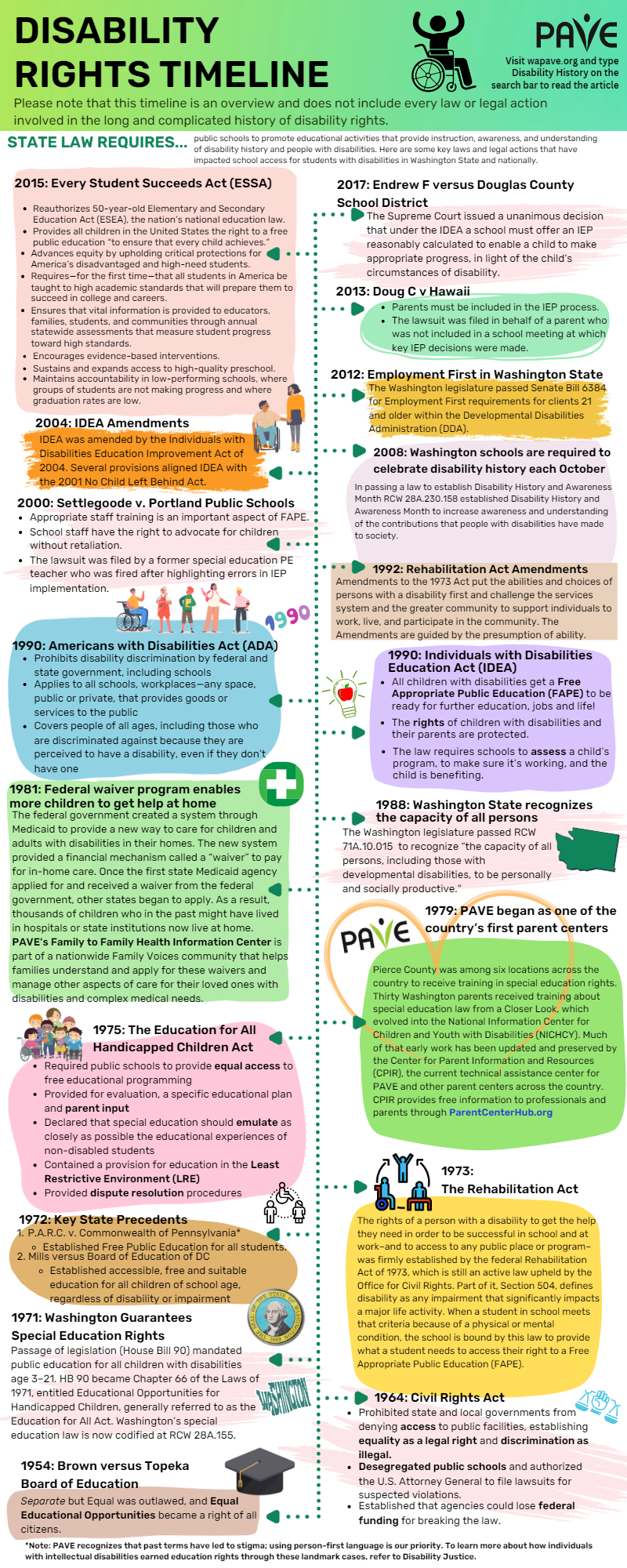
Infographic of the Disability Rights Timeline. Visit wapave.org and type disability History on the search bar to read the article and receive accessible information included  in this infographic

View this infographic in PDF form

Sample Letter to Request an IEP Meeting

Families can request an IEP (Individualized Education Program) meeting at any time—not just during the annual review. A sample letter is available to help parents and guardians formally make this request. Guidance is also provided on who must attend IEP meetings, common reasons for requesting one, and tips for organizing communication and documentation.

A Brief Overview:

  • Families can request an IEP meeting at any time—not just during the annual review.
  • Washington state law (WAC 392-172A-03095) requires that the IEP team include specific people and roles.
  • Common reasons to request a meeting include academic struggles, behavior concerns, new diagnoses, or transition planning.
  • Students can also request meetings to advocate for themselves or adjust goals and supports.
  • PAVE offers helpful tools to support families in preparing for IEP meetings, including a fillable Who’s Who on the IEP Team contact form and sample letter to formally request a meeting—both available for download in multiple languages within this article.

Introduction

When a student has an Individualized Education Program (IEP), their IEP team is required to meet and review the program at least every year. The annual review date is listed on the cover page of the IEP document. Family caregivers can request additional meetings, and this article includes a sample letter families can use to formally request an IEP meeting.

Keep in mind that parents have the right to participate in meetings where decisions are made about eligibility or changes to a student’s special education services. A court decision in 2013 further affirmed those rights. More information about that case, Doug C. Versus Hawaii, is included in the PAVE article, Parent Participation in Special Education Process is a Priority Under Federal Law.

An IEP meeting request letter can be submitted to school staff and to district staff. Family participants have the right to invite guests to the meeting for support and to provide additional expertise about the student.

Required Members of the IEP Team

The best practice is for the school and parents to communicate about who will attend the meeting. If required school staff are unable to attend a meeting, parents must sign consent for their absence. Under Washington Administrative Code (WAC 392-172A-03095), a school district must ensure that each IEP team includes:

  • Parent/legal guardian
  • At least one general education teacher
  • At least one special education teacher of the student
  • District staff qualified in the provision of specially designed instruction (SDI), knowledgeable about the district’s general education curriculum, and knowledgeable about the district’s available resources
  • Someone (usually a school psychologist) qualified to interpret the instructional implications of evaluation results
  • At the discretion of the parent or the school district, other individuals who have knowledge or special expertise regarding the student, including related services personnel
  • Whenever appropriate, the student (required to be invited once a transition plan is added, by age 16 or earlier)

According to Washington state law (WAC 392-172A-03095), the IEP team includes an individual who is knowledgeable about district resources. Sometimes a school principal or other staff member fulfills that role, but families or school staff can request attendance by someone who works in the district’s special education department. If a school administrator says during a meeting, “We’ll have to check with the district and get back to you,” it may mean that a key decision-maker isn’t present. In that case, families or students can request another meeting with all required team members. This is especially important if the team is discussing services that might cost more or involve a change in the student’s educational placement.

The school’s meeting invitation lists attendees and can clarify when the meeting will start and end and the purpose or agenda for the meeting. PAVE provides an article about how students and families can prepare for a meeting by creating a handout for the team, including a Student Input Form.

Who’s Who on the IEP Team

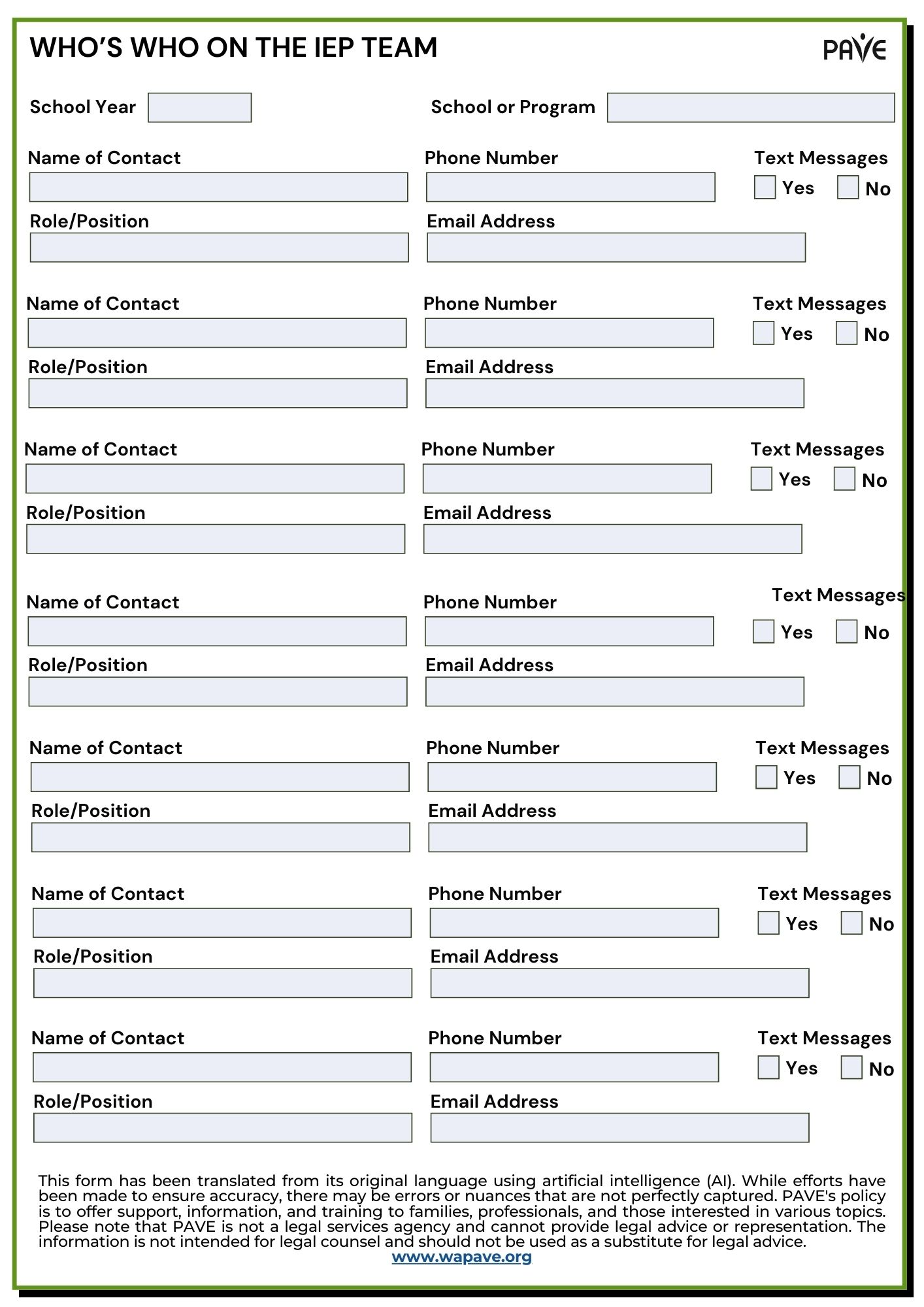
PAVE offers a fillable Who’s Who on the IEP Team contact form to help you organize contact information and roles of the IEP team members.

Who's Who on the IEP Team

Download the Who’s Who on the IEP Team contact form in:
English | Chinese (Simplified) 中文 (Zhōngwén) | Korean 한국어 (Hangugeo) | Russian Русский (Russkiy) | Somali Soomaali | Spanish Español | Tagalog | Ukrainian українська | Vietnamese Tiếng Việt

Common Reasons to Request an IEP Meeting

Parents, guardians, and students have the right to request an IEP team meeting at any time during the school year—not just during the annual review. If there are concerns about a student’s progress, changes in needs, or questions about services and supports, it’s appropriate to ask for the team to come together. IEP meetings can be used to problem-solve, update goals, adjust services, or simply ensure everyone is on the same page. Regular communication helps keep the plan relevant and responsive to the student’s needs.

Here are a few examples of reasons parents or guardians might request an IEP meeting:

  • New diagnosis or information about a student’s disability
  • Frequent disciplinary actions
  • Student is refusing to go to school
  • Academic struggles
  • Lack of meaningful progress toward IEP goals (PAVE provides an article with a handout about SMART goals and progress monitoring
  • Behavior plan isn’t working
  • Placement isn’t working
  • Parent or guardian wants to discuss further evaluation by the school or an independent agency

Here are a few examples of reasons parents or guardians might request an IEP meeting:

  • Feeling unsupported in class
  • Academic struggles
  • Trouble with peers or behavior plan
  • Goals don’t feel meaningful or realistic
  • Preparing for life after high school (transition planning is required by age 16)
  • New diagnosis or change in personal circumstances
  • Practicing self-advocacy or wanting a more active role in the IEP process

PAVE provides a sample letter to request an IEP meeting. You can copy and paste the text of this sample letter into your word processor to build your own letter. If sending through email, the format can be adjusted to exclude street addresses.

Sample Letter to Request an IEP Meeting

PAVE provides a sample letter to request an IEP meeting. You can copy and paste the text of this sample letter into your word processor to build your own letter. If sending through email, the format can be adjusted to exclude street addresses.

Download the Sample Letter to Request an IEP Meeting in:
English | Chinese (Simplified) 中文 (Zhōngwén) | Korean 한국어 (Hangugeo) | Russian Русский (Russkiy) | Somali Soomaali | Spanish Español | Tagalog | Ukrainian українська | Vietnamese Tiếng Việt

You can email this letter or send it by certified mail (keep your receipt), or hand carry it to the district office and get a date/time receipt. Remember to keep a copy of this letter and all school-related correspondence for your records. Get organized with a binder or a filing system that will help you keep track of all letters, meetings, conversations, etc. These documents will be important for you and your child for many years to come, including when your child transitions out of school.

Sample Letter to Request Evaluation

Anyone with knowledge of a student may request a special education evaluation, and Washington State law requires that referrals be made in writing. Schools must respond within specific timelines and provide language access and support throughout the process. Families have the right to participate in all decisions and may dispute outcomes if they disagree. Special education is a service designed to meet individual needs, not a predetermined placement.

A Brief Overview

  • Washington State requires special education referrals to be in writing (WAC 392-172A-03005). Schools must assist individuals who cannot write.
  • Anyone with knowledge of a student can write a referral.
  • The state provides a Referral for Special Education Evaluation form for making a special education referral, available for download in multiple languages from the Office of Superintendent of Public Instruction (OSPI) website. The form is not required—any written request is valid.
  • Another option is to write a referral using the sample letter at the end of this article.
  • Schools are responsible to provide families with a referral form in their native language and to provide qualified interpreters so families can participate in all meetings to discuss their student’s special education eligibility and services.
  • Schools must respond to a referral within 25 school days and provide a Prior Written Notice (PWN) explaining their decision.
  • If the school agrees to evaluate, parent consent is required before the process begins. The evaluation must be completed within 35 school days, and an IEP developed within 30 calendar days if the student qualifies.
  • If a student is found ineligible for an IEP or the school refuses to evaluate, families may dispute the decision using procedural safeguards, request an Independent Educational Evaluation (IEE), or pursue evaluation for a Section 504 Plan.

Introduction

When a student is struggling in school and there is reason to suspect the challenges are disability related, anyone can refer the student for an educational evaluation. If the evaluation shows that the student is eligible, services are provided through an Individualized Education Program (IEP). Washington State requires special education referrals to be in writing, as specified in Washington Administrative Code (WAC 392-172A-03005).

What Schools Must Do After a Referral

If someone who knows the student asks for an evaluation, the school is responsible for:

  • Documenting the request
  • Recording the date the referral was made
  • Providing a referral form in the person’s native language
  • Responding to the request within 25 school days

If the person asking for the evaluation cannot write, the school is responsible for supporting them to complete the referral.

The school must provide a referral form in the native language of the person making the request. Schools are required to provide qualified interpreters to support parent participation in the referral process and for all meetings where a student’s eligibility and/or educational services are discussed. The Office of Superintendent of Public Instruction (OSPI) provides Parent Rights Information Sheets, downloadable in many languages on the Interpretation and Translation Services webpage.

Evaluation Process and Timelines

When a student is referred for a special education evaluation, the school has 25 school days to decide if they will do the evaluation. These are days when students are actually in school. The school must tell the family their decision in writing. This letter is called a Prior Written Notice (PWN), and it follows rules from WAC 392-172A-05010.

Usually, the school and family meet to talk about the referral and how the student is doing. If everyone agrees to move forward, the parents or caregivers sign a form giving permission for the evaluation to begin. Families can ask questions about what the evaluation will include. The school will look at all areas where the student might need help. This helps them understand the student’s strengths and challenges. If the student qualifies for special education, the results will help create a plan called an Individualized Education Program (IEP).

If the school decides not to evaluate and the family disagrees, the family has the right to take steps to solve the disagreement. These steps are explained in the procedural safeguards.

When the school agrees to evaluate the student, staff must promptly seek parent consent to begin the evaluation process (WAC 392-172A-03005).

Generally, parents sign a form that lists what the school will include in its evaluation. Parents can ask for additional areas to be evaluated to make sure the school gets data for all areas of concern. Families can ask for more information about what the evaluation will look like, where it will take place, how long it will take, and who will participate. The school and family can creatively plan the evaluation process if accommodations are needed. For example, if a student isn’t able to attend in-person school, the evaluation can be done in alternative locations.

After a parent signs consent, the school has 35 school days to finish the evaluation and meet with the family to talk about the results. The deadline may be extended if the family agrees, particularly to accommodate needs of the family or student.

The 35-day deadline does not apply if the student is unavailable for the evaluation or enrolls in another school district before the evaluation is finished (WAC 392-172A-03005).

For students found eligible for services, the school develops an IEP within 30 calendar days and requests parent consent for services to begin. The school and family meet to review a DRAFT version of the IEP and write a final version together before consent is signed. School staff provide a Prior Written Notice (PWN) with a summary of the meeting, agreements, and timelines before services start. PWN requirements are described in WAC 392-172A-05010.

How to Refer a Student for Evaluation for Special Education

The Office of Superintendent of Public Instruction (OSPI) is the guidance agency for Washington State. OSPI provides a Referral for Special Education Evaluation form, downloadable in multiple languages from a website page titled, Model Forms for Services to Students in Special Education. Families may use OSPI’s form, a form provided by their school, or their own choice of format to write their request for a student to be evaluated.

Further explanation of the referral and evaluation process is provided on the OSPI website page, Making a Referral for Special Education.

A non-discriminatory evaluation is part of the protections for a student with a known or suspected disability that may significantly impact their access to education (Child Find Mandate). Child Find protections are part of the federal Individuals with Disabilities Education Act (IDEA). Child Find applies whether there are academic and/or non-academic school impacts.

PAVE provides more detail about IEP eligibility and evaluation process: Evaluations Part 1: Where to Start When a Student Needs Special Help at School.

Sample Letter to Request an Evaluation

Below is a sample letter to write a request for a special education evaluation. You can copy and paste the text of this sample letter into your word processor to build your own letter.

Download the Sample Letter to Request an Evaluation in:
English | Chinese (Simplified) 中文 (Zhōngwén) | Korean 한국어 (Hangugeo) | Russian Русский (Russkiy) | Somali Soomaali | Spanish Español | Tagalog | Ukrainian українська | Vietnamese Tiếng Việt

The state provides an alternative form, downloadable from OSPI’s website page titled, Making a Referral for Special Education. Your school district is responsible to provide a form, in your language, for you to submit your written request. These formats are your choice—any written request is valid. If you cannot write, you can ask for an evaluation by telling the school and they can write the request with you.

Submit your written request through email, by mail, or by hand delivery, to the special education/special services manager at your school’s district office. You may submit additional copies to school administrators and/or a school psychologist—the person who manages evaluations for your school. Be sure to keep copies of all of your communications with the school in an organized, safe place.

Special Education is a Service, Not a Location

A request for a special education evaluation is NOT a recommendation to remove a student from the regular classroom and move them into an exclusive learning environment. Federal and state laws require that students receive education and services in the Least Restrictive Environment (LRE) to the maximum extent possible to meet their needs. Special Education is a service, while LRE refers to placement. You can read more about this in the PAVE article, Special Education is a Service, Not a Place. Decisions about placement are made by the IEP team, which includes the family. The IEP team is responsible to consider the child’s circumstances and capacities as its top priority—not pre-built programs or district resources. The PAVE article, Parent Participation in Special Education Process is a Priority Under Federal Law, provides detail about parent participation in special education process.

Parents Can Appeal Decisions and/or Seek a 504 Plan

If a student is evaluated and found not eligible for an IEP (or if the school refuses to do an evaluation), the family has the right to dispute the decision using Procedural Safeguards.

If they disagree with the district’s evaluation or its findings, the family may seek an Independent Educational Evaluation (IEE), which is done by an agency outside of the school district. The district must pay for an IEE or deny the request using Due Process. See PAVE’s article: Evaluations Part 2: Next Steps if the School Says ‘No’ to Your RequestThe article includes a sample letter to request an IEE.

Another option if a student doesn’t get an IEP is to develop a Section 504 Plan, which accommodates a person with a disability that impacts a major life activity (learning, walking, speaking, writing, socializing…). Section 504 is part of the Rehabilitation Act of 1973, which protects the civil rights of individuals with disabilities against discrimination throughout their lives. See PAVE’s article about Section 504 rights, which also protect students who qualify for an IEP: Section 504: A Plan for Equity, Access and Accommodations.

Final Thoughts

Requesting a special education evaluation is a straightforward process that begins with a written referral. By following the required steps and understanding your rights, you can help ensure your student receives the support they need. Whether you use a formal form or write your own letter, the request must be clear and submitted in writing. This step initiates the evaluation process and ensures the school is legally obligated to respond.

Learn More