

Disability History Month Provides Opportunities for Reflection

The history of disability rights shows how people with disabilities have worked hard to get equitable access, fair treatment, and meaningful inclusion. Key laws and strong community voices have helped shape education and civil rights. Today, it is as crucial as ever to learn, speak up, and work together to build a more inclusive society.

A Brief Overview

  • October is Disability History and Awareness Month in Washington State (RCW 28A.230.158). This month helps people learn about disabilities, raise awareness, promote respect and acceptance, and build pride among individuals with disabilities.
  • Federal and state laws, along with court decisions, have helped students with disabilities go to public school, get the services they need, and be included in general education whenever possible.
  • State law requires public schools to teach students about disability history and help them understand what it means to live with a disability.
  • Parent Centers like PAVE help families and individuals understand disability rights. To find a Parent Center outside of Washington State, visit Find My Center on the Center for Parent Information and Resources (CPIR) website.

Celebrating the History of Disability Rights

Disability History and Awareness Month in October is a time for students, families, teachers, and community leaders to remember and learn about the disability rights movement. Equity and access are protected by law, but there is still work to be done to make sure that laws are followed so that everyone has fair access to opportunities.

Organizations like PAVE help families and individuals understand disability rights. They also explain how history has shaped today’s laws, including the words we use when we talk about disability rights.

Below is a timeline of key actions at the state and federal level.

Please note that this article is an overview and does not include every law or court case from the long history of disability rights.

1954​: Brown v. Board of Education​ of Topeka

This landmark Supreme Court case was brought by families who challenged racial segregation in public schools. In Brown v. Board of Education of Topeka (1954), the Court ruled that separating students by race was unfair and violated the 14th Amendment’s promise of equal protection under the law.

‘Separate but equal’was outlawed, and equal educational opportunities became a right of all citizens. ​

The decision helped establish the principle that all students deserve equal educational opportunities. It became a foundation for future disability rights cases. Advocates used this ruling to argue that students with disabilities also have the right to attend public schools and receive a fair education.

1964​: Civil Rights Act​

The Civil Rights Act of 1964 was a major law that helped protect people from discrimination. It made it illegal for state and local governments to deny access to public places, like schools, parks, and libraries. This law confirmed that equality is a legal right, and that discrimination is against the law.

It also helped desegregate public schools and gave the U.S. Attorney General the power to take legal action against schools or other public agencies suspected of breaking the law. It also stated that agencies that didn’t follow the law could lose their federal funding.

1971: Washington guarantees special education rights

In 1971, the small but fierce Education for All Committee — Evelyn Chapman, Katie Dolan, Janet Taggart, Cecile Lindquist — worked with two law students to craft and advocate for passage of legislation (House Bill 90) to mandate public education for all children with disabilities age 3–21. HB 90 became Chapter 66 of the Laws of 1971, entitled Educational Opportunities for Handicapped Children, generally referred to as the Education for All Act. Washington’s special education law is now codified at RCW 28A.155

1972: Key precedents are established in other states

In P.A.R.C. v. Commonwealth of Pennsylvania (1971)*, a group of parents went to court to fight for their children’s right to go to public school. At the time, some schools didn’t allow children with disabilities to attend. The court decided that all children, no matter their abilities, have the right to a free public education.

A few months later, Mills v. Board of Education of the District of Columbia (1972) built on the P.A.R.C. decision. In Mills, the court found that education should not only be free and accessible to all students, but also suitable for each child’s needs. These two cases helped establish the principle that all children, regardless of ability, have the right to attend public school and receive an education suited to their individual needs.

To learn more about how individuals with intellectual disabilities gained education rights through these landmark cases, visit Disability Justice.

*Note: PAVE recognizes that past terminology has contributed to stigma. We are committed to using inclusive, disability-affirming language that reflects the preferences of individuals and communities, including identity-first and person-first approaches.

1973: The Rehabilitation Act

The rights of people with disabilities to get the help they need in order to be successful in school, at work, and in any public place or program was firmly established by the federal Rehabilitation Act of 1973. This federal law that is still active today and enforced by the Office for Civil Rights at the U.S. Department of Education. Part of it, Section 504, defines a disability as any condition that seriously affects a major life activity. If a student has a physical or mental condition that meets this definition, the school must follow the law and provide support to help the student access their education and participate in school activities.

1975: The Education for All Handicapped Children Act

In 1975, the U.S. passed the Education for All Handicapped Children Act, the first federal law focused on the education of children with disabilities. It required public schools to give students with disabilities equal access to free educational programming, along with evaluations, a specific learning plan, and input from parents. The law said that special education should emulate the learning experiences of students without disabilities as closely as possible. This means that students with disabilities have the right to a school experience that looks as much like a typical student’s program as possible. It also introduced the idea of the Least Restrictive Environment (LRE), encouraging schools to work harder to include students of many abilities in general education classrooms. To help families resolve disagreements with the school, the law outlined required dispute resolution procedures. Parents are given information about their rights through Procedural Safeguards that are shared at IEP and other official meetings.

1979: PAVE began as one of the country’s first six parent centers

Pierce County was among six locations across the country to receive training in Special Education rights. In 1979, thirty Washington parents received training on Special Education law. The goal was for those parents to share information throughout the state. To help this movement, a clearinghouse named Closer Look provided intense training for these pioneering parents about the laws. Closer Look evolved in the National Information Center for Children and Youth with Disabilities (NICHCY), and much of that work has been updated and preserved by the Center for Parent Information and Resources (CPIR), the current technical assistance center for PAVE and other parent centers across the country. CPIR continues to provide free information to professionals and parents about education rights under federal law.

To connect with a Parent Center outside Washington State, visit Find My Center on the Center for Parent Information and Resources (CPIR) website.

1981: Federal waiver program enables more children to get help at home

The federal government created a system through Medicaid to provide a new way to care for children and adults with disabilities in their homes. This system introduced a funding option called a waiver, which helps pay for in-home support. Once the first state Medicaid agency applied for and received a waiver from the federal government, other states began to apply. As a result, thousands of children who might have lived in hospitals or institutions in the past are now able to live at home. PAVE’s Family to Family Health Information Center is part of a nationwide Family Voices community that helps families understand and apply for these waivers and manage other aspects of care for their loved ones with disabilities and complex medical needs.

1988: Washington State recognizes the capacity of all persons

The Washington legislature passed RCW 71A.10.015 to recognize “the capacity of all persons, including those with developmental disabilities, to be personally and socially productive.

“The legislature further recognizes the state’s obligation to provide aid to persons with developmental disabilities through a uniform, coordinated system of services to enable them to achieve a greater measure of independence and fulfillment and to enjoy all rights and privileges under the Constitution and laws of the United States and the state of Washington.”

1990: Americans with Disabilities Act (ADA)

The Americans with Disabilities Act (ADA) protects people from disability discrimination by the federal and state governments, including public schools. It also applies to all schools, workplaces, and any public or private place that offers goods or services to the public. The law covers people of all ages, including those who are treated unfairly because they are perceived to have a disability, even if they don’t have one.

Many ADA protections are like those found in Section 504 of the Rehabilitation Act of 1973. Both laws focus on equity and access, and they protect people with disabilities throughout their lifespan.

Understood.org offers resources for parents to learn about ADA protections in schools, including printable fact sheets. The U.S. Department of Justice provides an ADA Information Line to answer questions and help people report possible violations of the law. The Office for Civil Rights also provides guidance for students with disabilities as they plan for post-high school education programs.

1990: Individuals with Disabilities Education Act (IDEA)

The Education for All Handicapped Children Act was renamed and enacted as the Individuals with Disabilities Education Act (IDEA) in 1990. Free Appropriate Public Education (FAPE)came into being, which is still key to how schools support students with disabilities. FAPE means that every child with a disability has the right to an education that helps prepare them for further learning, work, and life. The law also protects the rights of students and their parents or guardians. Schools are required to check if a student’s program is working and make sure the student is making progress.

IDEA is an entitlement law, which means students with unique needs must get support based on their individual situation—not just what’s already available. This federal law guides how each state creates its own special education rules. In Washington State, those rules are found in the Washington Administrative Code (WAC), specifically in chapter 392-172A. Title 34, Part 104, is a federal rule that protects people from discrimination and is enforced by the Office for Civil Rights. 

1992: Rehabilitation Act Amendments

Amendments to the 1973 Rehabilitation Act focus on the abilities and choices of persons with disabilities. These changes challenge service systems and communities to support individuals as they work, live, and participate in the community. The Amendments are guided by the idea of a presumption of ability. This means that every person with a disability, regardless of the severity of the disability, can achieve employment and other rehabilitation goals, if they have the right services and support.

The primary responsibilities of the vocational rehabilitation system include:

  • Help individuals with disabilities make informed choices about jobs that lead to integration and inclusion in the community.
  • Develop an individualized rehabilitation program with the full participation of the person with a disability.
  • Match a person’s needs and interests with appropriate services and supports.
  • Work closely with other agencies and programs, including school districts, to build a strong and unified support system.
  • Focus on quality services and ensure service representatives honor the dignity, participation, and growth of each person as they explore employment options.

2000: Settlegoode v. Portland Public Schools

In 2000, the case of Settlegoode v. Portland Public Schools helped bring attention to the rights of teachers who work in special education. A former special education PE teacher filed the lawsuit after being fired for speaking up about problems with how IEPs were being followed. The court ruled that appropriate staff training is an important part of FAPE and that school staff have the right to stand up for students without being punished.

2004: IDEA Amendments

Congress updated IDEA by passing the Individuals with Disabilities Education Improvement Act (IDEIA) in 2004. Some parts of the law were changed to match the goals of the 2001 No Child Left Behind Act. Here are a few examples of updates:

  • IDEIA allowed 15 states to try out 3-year IEPs when parents agreed every year as a pilot program.
  • Based on a report of the President’s Commission on Excellence in Special Education, the law changed the requirements for evaluating children with learning disabilities.
  • New rules were added about how schools handle discipline for students in special education. These updates continue to shape discipline policies in Washington State.
  • The law strengthened the idea of Least Restrictive Environment (LRE), saying students should learn in regular classrooms with extra help and services, “to the maximum extent appropriate.”

2008: Washington schools are required to celebrate disability history each October

Washington State passed a law to create Disability History and Awareness Month (RCW 28A.230.158), which takes place every October. The legislature explained that: “annually recognizing disability history throughout our entire public educational system, from kindergarten through grade twelve and at our colleges and universities, during the month of October will help to increase awareness and understanding of the contributions that people with disabilities in our state, nation, and the world have made to our society. The legislature further finds that recognizing disability history will increase respect and promote acceptance and inclusion of people with disabilities. The legislature further finds that recognizing disability history will inspire students with disabilities to feel a greater sense of pride, reduce harassment and bullying, and help keep students with disabilities in school.”

2012: Employment First in Washington State

The Washington legislature passed Senate Bill 6384 to create Employment First requirements people age 21 and older who receive services through the Developmental Disabilities Administration (DDA). The law states, “The program should emphasize support for the clients so that they are able to participate in activities that integrate them into their community and support independent living and skills.”

The legislation:

  • Supports employment as the first choice for adults of working age.
  • Incorporates the right to transition to a community access program after nine months in an employment service.
  • Clarifies that a client receive only one service option at a time (employment or community access).

DDA Policy Document describes the history behind the law and the rules for how it would be implemented.

2013: Doug C. v Hawaii

In Doug C. v. Hawaii (2013), the court ruled that parents must be included in the IEP. The lawsuit was filed in behalf of a parent who was not included in a school meeting at which important decisions were made about their child’s IEP. The decision confirmed that families have a legal right to be part of planning their child’s education and that schools must make sure parents and guardians are involved.

2015: Every Student Succeeds Act (ESSA)

In 2015, Congress passed the Every Student Succeeds Act (ESSA) to update the Elementary and Secondary Education Act (ESEA), which had been the nation’s main education law for over 50 years. ESSA says that every child in the United States has the right to a free public education “to ensure that every child achieves.”

The law:

  • Protects the rights of disadvantaged and high-need students.
  • Requires for the first time that all students be taught to high academic standards that prepare them for college and careers.
  • Provides important information to families, educators, and communities through yearly statewide tests that show student progress toward high standards.
  • Encourages schools to use evidence-based strategies to support learning.
  • Expands access to high-quality preschool.
  • Keeps schools accountable when student groups are not making progress or graduation rates are low.

2017: Endrew F v. Douglas County School District

In Endrew F., the Court ruled that schools must offer an IEP that is reasonably calculated to enable a child to make progress, based on their individual circumstances of disability. The decision rejected the old “de minimis standard,” which allowed schools to offer only minimal progress. Trivial progress is no longer enough.

The ruling emphasized:

  • Grade-level goals for students who can learn in the general education classroom.
  • Parent participation in the IEP process.
  • Higher expectations for student growth under IDEA.

Writing for the Court, Chief Justice John G. Roberts explained that a child making only small gains would be like “sitting idly… awaiting the time when they were old enough to drop out.” The case continues to influence how schools and agencies support students with disabilities, and many professionals encourage families to hold schools accountable to these higher standards.

PAVE provides more information about parent and guardian rights to participate in their child’s education in this article: Parent Participation in Special Education Process is a Priority Under Federal Law .

Download the Disability Rights Timeline

A visual version of the timeline is available as a downloadable infographic to support learning and reflection.
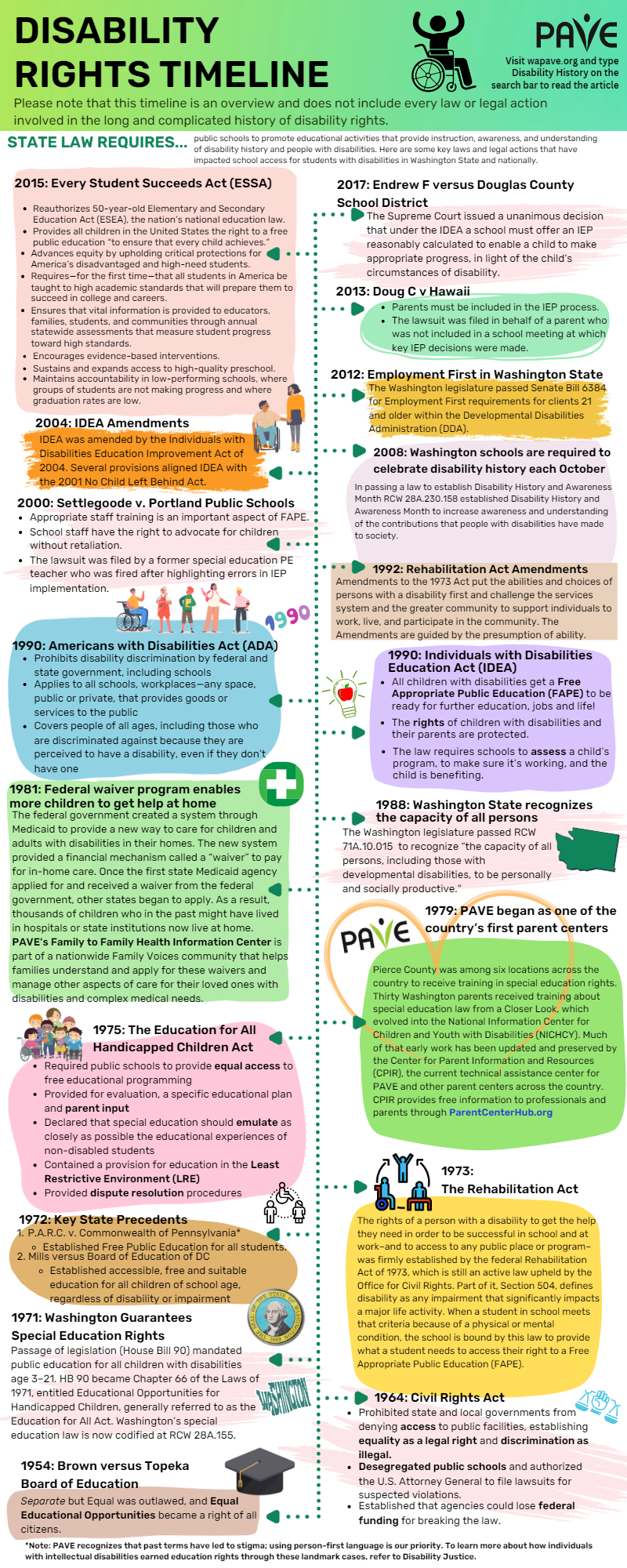
Infographic of the Disability Rights Timeline. Visit wapave.org and type disability History on the search bar to read the article and receive accessible information included  in this infographic

View this infographic in PDF form

Get Ready for School with IEP Essentials

Every student deserves a strong start to the school year. For families of children with disabilities, preparing for school includes reviewing the Individualized Education Program (IEP). The IEP is a legal document and a living plan that outlines the supports and services a student needs to access their education. Families play a key role in shaping the IEP and making sure it works for their child.

A Brief Overview

  • The start of a new school year is a great time for families to revisit or begin the IEP process to support their student’s learning.
  • If a student doesn’t yet have an IEP, requesting an evaluation is the first step to determine eligibility for special education services.
  • Review the IEP before school starts to prepare questions and suggestions for the team.
  • Talk with your student about what to expect to reduce anxiety and build confidence.
  • Learn about the Individuals with Disabilities Education Act (IDEA) to understand your rights and responsibilities in the IEP process.
  • Communicate regularly with the IEP team to monitor progress and adjust plans as needed.
  • Gather documents, write questions, and invite support to prepare for IEP meetings.
  • Follow up after meetings to confirm next steps and maintain communication.
  • Take small, manageable steps to stay involved and support your student’s success.

Introduction

The beginning of a new school year is the perfect time to revisit your student’s Individualized Education Program (IEP). Whether your child already has an IEP or you’re just starting to explore the special education process, this season offers a fresh opportunity to reflect, plan, and engage.

As you and your student get ready for school, the most important thing is the “I” in IEP. The “I” is for “Individualized”. A thoughtful IEP highlights abilities and helps your student access the supports needed to learn. It helps ensure they receive the support necessary to learn, grow, and make meaningful progress—not just in school, but in life beyond graduation.

IEPs are built by teams, and families are essential members. When parents and students understand the process and actively participate, they help shape a plan that truly works.

What to do before the first day

If your student doesn’t have an IEP and you wonder whether a disability might be affecting their learning, now is a great time to explore the special education process. Understanding how evaluations work is the first step. If you’re unsure whether your child needs one, check out our article on How to Request an Evaluation, which explains how to get started.

Before the school year begins, review the IEP to prepare questions and suggestions for the team. PAVE recommends using their Steps to Read, Understand, and Develop an Initial IEP worksheet to guide this process.

After reviewing your student’s IEP or beginning the process to request one, the next step is ensuring your child is properly enrolled in school. Enrollment procedures vary by district, but they typically include submitting documentation, verifying residency, and understanding school assignment policies. For a clear overview of how and when to enroll your student, read this PAVE article: Starting School: When and How to Enroll a Student in School.

To help ease anxiety and build excitement, talk with your child about what to expect. Discuss new activities, classmates, and what will feel familiar. If your school offers an open house, plan to attend together. During your visit, take pictures and ask your child what they notice or wonder about. You can review the photos later to help them feel more prepared. PAVE’s article, Tips to Help Parents Plan for the Upcoming School Year, provides actionable strategies for easing anxiety, fostering independence, and creating a positive school experience.

What parents need to know about FAPE

At the heart of special education is the right to a Free Appropriate Public Education (FAPE), guaranteed by the Individuals with Disabilities Education Act (IDEA). FAPE means that students with disabilities are entitled to an education tailored to their individual needs—not a one-size-fits-all program. This is what makes IDEA unique: it ensures that every eligible student receives services designed specifically for them through an Individualized Education Program (IEP).

To qualify for an IEP, a student must go through an evaluation process to determine if a disability is impacting their education. If the student meets criteria under IDEA, they become eligible for special education services. These services are not about placing a student in a specific classroom—they’re about providing the right support, wherever the student learns. As you review your child’s IEP or prepare for meetings, ask: Is this plan appropriate and suitable for my child’s unique abilities and needs?

IDEA includes six important principles

The IDEA, updated several times since 1990, outlines legal rights for students with disabilities and their families. This PAVE article, Special Education Blueprint: The Six Principles of IDEA, explores the core principles, including: Free Appropriate Public Education (FAPE), Appropriate Evaluation, Individualized Education Program (IEP), Least Restrictive Environment (LRE), Parent and Student Participation, and Procedural Safeguards.

Effective communication is key to student success

Understanding legal rights is just the beginning—clear, consistent communication with the IEP team is one of the most effective ways to ensure your student’s plan leads to meaningful progress. Consider creating a communication plan with your child’s teachers or case manager. This might include weekly emails, a journal sent home in the backpack, scheduled phone calls, or progress reports. Be sure to have this plan written into the IEP or included in the Prior Written Notice (PWN) so everyone stays on the same page.

Writing down how you’d like to stay in touch helps the team understand what works best for your family. Get creative—what matters most is that the plan supports clear, consistent communication for the whole team. ​Here are a few ideas for ongoing communication with the school: ​

  • A journal that your student carries home in a backpack​
  • A regular email report from the Special Education teacher​
  • A scheduled phone call with the school​
  • A progress report with a specific sharing plan decided by the team​
  • Get creative to make a plan that works for the whole team! ​

Keep a log of communication with the school district and educational service providers. PAVE provides a downloadable Communication Log to help you track emails, phone calls, and texts.

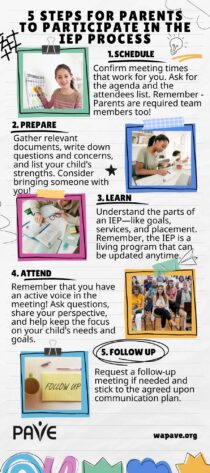
Ready, set, go! 5 steps for parents to participate in the IEP process

Understanding the laws and principles of special education can help parents get ready to dive into the details of how to participate on IEP teams. Getting organized with schoolwork, contacts, calendar details, and concerns and questions will help.

This 5-step process is downloadable as an infographic.

5 Steps for Parents to Participate in the IEP Process (English)

Download the IEP Essentials in 5 Steps in:
English | Chinese (Simplified) 中文 (Zhōngwén) | Korean 한국어 (Hangugeo) | Russian Русский (Russkiy) | Somali Soomaali | Spanish Español | Tagalog | Ukrainian українська | Vietnamese Tiếng Việt

1. Schedule

Parents or guardians should receive a written invitation to the meeting. The school and family agree on a date and time, and the school documents efforts to include families at all IEP team meetings. If the proposed time doesn’t work, remember that parents are required members of the team—you can request a different time that works better for you. 

Ask beforehand for the agenda and a list of who will attend. This helps ensure there’s enough time to fully address the topics being discussed. If a key team member can’t attend the meeting, you have the option to either provide written consent to excuse their absence or request to reschedule if their participation is important to you. ​For a list of suggested attendees and a downloadable form to save contact information, PAVE provides a Who’s Who on the IEP Team.​

If your student already has an IEP, a re-evaluation occurs at least once every three years unless the team decides differently. A parent can ask for a re-evaluation for sooner if needed, though typically a re-evaluation will not occur more than once a year.

2. Prepare

You can ask for a copy of the evaluation results or a draft IEP before the meeting to help you prepare. It’s a good idea to gather letters or documents from medical providers or specialists that support your concerns. Writing down a few questions ahead of time can help you remember what you want to ask. You might also make a list of your student’s strengths and talents—this helps the team build on what’s already working. If you have specific concerns, you can write a letter and ask for it to be included in the IEP. Some families invite a support person to attend the meeting, someone who can take notes, help you stay focused, and offer encouragement.

3. Learn

Knowing the technical parts of an IEP will help you understand what’s happening at the meeting. The IEP is a living program—not just a document—and it can be updated anytime to better meet your child’s needs. The IEP is a work-in-progress, and the document can be changed as many times as needed to get it right and help everyone stay on track.

Familiarize yourself with the components of an IEP: 

4. Attend

At the meeting, each person should be introduced and listed on the sign-in sheet. Schools generally assign a staff member as the IEP case manager, and that person usually organizes the team meeting. Any documents that you see for the first time are draft documents for everyone to work on.

Be present and free of distractions so you can fully participate. Ask questions, share your perspective, and help keep the focus on your child’s needs and goals. If your child isn’t attending, placing a photo of them on the table may remind the team to keep conversations student-centered.

Everyone at the table has an equal voice, including you!

5. Follow up

After the meeting, follow through with the agreed communication plan. Make sure that everyone’s contact information is current and that you know how and when updates will be shared. If you still have concerns after the meeting, request a follow-up meeting or submit additional notes.

Stay organized with calendars, contact lists, and copies of important documents. Talk with your child about the upcoming year to ease anxiety and build excitement!

Tips for a smooth school year

As the school year begins, it’s important to think proactively about how to support your child’s learning and development. Establishing routines, setting goals, and building relationships with school staff can make a big difference.

If all of this sounds a little overwhelming, break the work into steps. Determine the best way to help your family stay organized with paperwork and information. Choose a calendar system that helps you track appointments and school events, such as back-to-school night or parent-teacher conferences.

Help your child’s team understand what works best for your student and share their strengths with a one-pager or a letter of introduction. PAVE provides a one-pager template, What You Need To Know About My Child, and a sample letter of introduction, Sample Letter to the IEP Team – Today Our Partnership Begins.

Let’s wrap things up!

Getting ready for school can feel like a lot, especially when your child has an IEP. But you don’t have to do everything at once. Take it one step at a time, and remember: you are not alone. This journey includes your child, and you’re walking it together. You are a vital part of your child’s team, and your voice truly matters. When families and schools work as partners, amazing things can happen. So trust yourself, speak up, and share what you know—because no one knows your child better than you. You bring love, insight, and hope to the table.

From all of us at PAVE, we wish you a happy and successful school year!

Learn More

Parents, Navigate Adapted Physical Education, IEPs, and 504 Plans

Overview

  • Physical Education (PE) can be adapted in four main ways to support students with disabilities.
  • Federal and state law protects a student with disability’s rights to access (be taught) PE. Adapted PE can be provided as a special education service in a student’s Individualized Education Program (IEP). It can also be included in a Section 504 plan.
  • Adapted PE can be useful for post-high school transition plans
  • Changes in WA State regulations mean that more teachers will qualify to design and teach Adapted Physical Education. These regulations are in effect as of May 1, 2024.
  • The Updated Guidance on Adapted Physical Education from the Washington Office of Superintendent of Public Instruction (OSPI) quoted in this article gives more information about Adaptive PE and how it fits into special education in WA State. Download or read Updated Guidance on Adapted Physical Education.

Full article

Physical Education (PE) is part of school for all students and may be particularly important for your student with a disability. What are the ways in which PE (general curriculum or Adapted PE) can improve their quality of life, now and into their adult years? This short list may give you ideas for your student’s IEP or 504 plan, and to discuss with your student for them to bring to a meeting with the IEP/504 team.

Classes teach students to care for their body and develop physical, mental, and emotional skills that include:

  • Motor skills (training to use muscles for a specific task, such as swinging a baseball bat to hit a ball, or running very hard in a race)
  • Physical fitness (keeping healthy and strong by exercising the body)
  • Social-emotional skills, teamwork, social play skills
  • Skills for athletics like team sports like soccer or basketball or individual athletics like gymnastics or dance
  • Skills for recreation like biking, swimming, hiking, throwing frisbees,

How Adapted PE works:

Access or accessible means how easy it is to do, to get, or understand something.

There are four main areas where adjusting or changing the general PE curriculum (school courses) may help students with disabilities access PE. Some of these changes will benefit ALL students using the general PE curriculum.

  • The physical space can be adjusted to work well for all students:
  • The size of the space and the number of other students can affect how accessible the PE class is for some students
  • Lighting, sound, and what someone can see may all affect comfort in a class.. Making thoughtful changes to these things can make a PE class more accessible.
  • Teaching: the teacher gathers information about individual students to ensure they use teaching methods accessible to everyone. This might mean spoken instructions, movements, pictures, written words, showing how to do something, or videos.
  • Equipment: depending on a student’s disability, some students might need PE equipment to move more slowly, be bigger or smaller, more tactile (easier to feel), be easier to see, and similar changes.
  • Rules: to make sure PE is inclusive, rules of the game may need to be added or taken away.

The information-gathering process above is a good place for you and your student to provide information about your student’s supports such as doctors, therapists, and interests outside of school that might be supported by Adapted PE. This information can be offered to the entire IEP/504 team, to give a well-rounded view of your student. You might want to review PAVE’s articles for students in the References section, below. It’s a good start for your student to self-advocate and practice self-direction.

Examples of Adapted PE

The point of Adapted PE is to change the general PE curriculum so that it is accessible for all students based on their individual strengths and needs. How it looks varies a lot depending on the student, but here are a few examples of Adapted PE in action:

  • A third grader with autism spectrum disorder uses a play script on her communication device to invite other students to play tag with her.
  • A high-school senior with Down syndrome is introduced to adult recreation opportunities in his community so he can continue building healthy habits beyond graduation.
  • A seventh grader with Cerebral Palsy attends general PE class. The Adapted PE teacher, general PE teacher, and the physical therapist collaborate to create an exercise plan to strengthen the student’s legs while using their gait trainer (walker).

Adapted Physical Education teachers are trained to make changes to the general education PE curriculum to make it accessible to students with disabilities.

IEPs can include Adapted PE as a service

Eligibility for an Individualized Education Program (IEP) uses an evaluation. The process helps to decide whether a student has a disability, whether the disability has a significant impact on (really affects) learning, and whether the student needs Specially Designed Instruction (SDI) and/or related services to access a Free Appropriate Public Education (FAPE). FAPE is the right of any student, ages 3-21, who is eligible for school-based services delivered through an IEP.

If a student’s access to PE really affects learning and the student needs the school’s PE course to be individualized, then Adapted PE can be given as an IEP service. IEP teams discuss how Specially Designed Instruction (SDI) is delivered for each individual student.

When Adapted PE is part of the IEP, there is a range of options for placement. A student might be in a general PE class, with or without accommodations. Additional aids, services, and modifications may be added depending on what the student needs. Get more details in the Updated Guidance on Adapted Physical Education.

This is a great opportunity for a student to share their goals and needs about physical activities with their IEP team. The topic might be a way to interest your student in IEP meetings even before the required age for planning their life after high school. See the Resources section below for information about students attending or leading their IEP team.

Post-High School Transition and Adapted PE

Physical education and/or Adapted PE can play a key role in students’ post-high school transition plans if, as young adults, they are to continue to maintain healthy, active lives.

If your student receives Adapted PE in their IEP or 504 plan, you and their transition team can help them identify the sports and recreation activities, entertainments, and any after-school programs they enjoy or want to join. Students can plan to continue favorite school PE activities out in the community and explore new options. The transition period is also an ideal time for students to create their own fitness plans or exercise routines that they can do independently after high school. For these aspects of your student’s transition planning, their PE/Adapted PE teacher can be invited to join the transition team, if they are not already a part of it.
Adapted PE teachers and physical and occupational therapists, if part of your student’s team, can collaborate on functional living skills related to physical activities and recreation. Some examples might include using a locker room, showing ID or membership at a reception desk, registering for programs or classes, and care and proper use of their own sports equipment at home. Frequently Asked Questions About Adapted Physical Education (Society of Health and Physical Educators (SHAPE))

Rules changed and removed some difficulties with getting Adapted PE

Until spring of 2024, Adapted PE was not recognized as a separate subject matter area or specialty that the state would endorse (add to the training listed on a teacher’s professional certificate). This meant a shortage of teachers who could design Adapted PE for students. It made it difficult for some students with disability in Washington State to get SDI in physical education.

As of May 1, 2024, qualifying[1] teachers in Washington State can be trained for and receive a specialty endorsement in Adapted Physical Education. The endorsement shows the teacher has specific skills and knowledge in both PE Learning Standards and special education competencies. As more teachers are taught this specialty, it will be easier to find teachers with Adapted PE training in Washington State.

The OSPI Updated Guidance says that in addition to teachers with an Adapted PE endorsement, SDI for physical education can be provided by “any other appropriately qualified special education endorsed teacher, or an “appropriately qualified Educational Staff Associate (ESA) such as an Occupational Therapist (OT) or a Physical Therapist (PT).”

Summary:

  • Physical Education (PE) is an important part of school. Students with disabilities have the right to be taught physical education.
  • Adapted Physical Education (APE) is when the general PE curriculum is changed or adjusted to accommodate the individualized needs of a student with disability.
  • Adapted PE can be included in an Individualized Education Plan or a Section 504 plan.
  • If a student needs Adapted PE, it’s important to include someone on the IEP team who is qualified to design individualized adapted PE, as well as the teacher or other school personnel who will be teaching the student.
  • Only certain qualified education professionals can design and supervise other educators and school staff teaching Adapted PE. Changes in WA State rules in 2024 allow more education professionals to qualify in Adapted PE.

Resources:

Updated Guidance on Adapted Physical Education  (WA State Office of Superintendent of Public Instruction (OSPI))

Frequently Asked Questions About Adapted Physical Education (Society of Health and Physical Educators (SHAPE))

Attention Students: Lead your own IEP meetings and take charge of your future (PAVE)

Students: Get Ready to Participate in Your IEP Meeting with a Handout for the Team (PAVE)

Who’s Who on the IEP Team (PAVE)

Student Rights, IEP, Section 504 and More (PAVE)

A previous version of this article was based on information provided by two experts in the field of Adapted Physical Education, Toni Bader, and Lauren Wood, who are Adapted Physical Education teachers in the Seattle area:

  • Toni Bader, M.Ed., CAPE – SHAPE Washington, Adapted Physical Education, Seattle Public Schools (tonibader24@hotmail.com)
  • Lauren Wood, NBCT, Adapted Physical Education Teacher, Highline Public Schools, and SHAPE Washington Board Member (lauren.wood@highlineschools.org)

[1] “Certificated teachers who hold any special education endorsement or a Health/Fitness endorsement are eligible to add the APE specialty endorsement to their certificate”  –OSPI Updated Guidance

Youth, Explore Adapted Physical Education in Your IEP or 504 Plan

Overview

  • Physical Education (PE) can be adapted (changed) in four main ways to support students with disabilities.
  • Federal and state law protects your rights to be taught PE. Adapted PE can be included in your Individualized Education Program (IEP). It can also be included in a Section 504 plan.
  • Adapted PE can be useful for post-high school transition plans.
  • Taking part in IEP and 504 meetings is important when looking at adapted physical education. It lets you share your needs, preferences, and goals. This helps create a physical education program that fits your abilities, supports your well-being, and creates a positive and inclusive environment. (Click on the links in the reference section to learn more about going to IEP and 504 meetings.)
  • Changes in WA State rules mean that more teachers will qualify to design and teach Adapted Physical Education. These rules are in effect as of May 1, 2024.
  • The Updated Guidance on Adapted Physical Education, from the Washington Office of Superintendent of Public Instruction (OSPI) quoted in this article gives more information about Adaptive PE and how it fits into special education in WA State. Download or read Updated Guidance on Adapted Physical Education.

Full article

Why is physical education important? How is it helpful to me, as an individual with a disability?

Classes can teach you to care for your body and learn physical, mental, and emotional skills that include:

  • Motor skills (training to use your muscles for certain things, such as swinging a baseball bat to hit a ball, or running very hard in a race)
  • Physical fitness (keeping healthy and strong by exercising your body)
  • Social-emotional skills, teamwork, social play skills
  • Skills for athletics like team sports like soccer or basketball or individual athletics like gymnastics or dance
  • Skills for recreation like biking, swimming, hiking, throwing frisbees, playing games with friends

How Adapted PE works:

Access or accessible means how easy it is to do, to get, or understand something.

There are four main areas where changing general PE curriculum (school courses) may help you access PE. Some of these changes will benefit ALL students using the general PE curriculum.

  • The physical space can be changed to work well for all students:
  • The size of the space and the number of other students can affect how accessible the PE class is for you.
  • Lighting, sound, and what you see can all affect your comfort in a class. Making thoughtful changes to these things can make a PE class more accessible.
  • Teaching: the teacher gathers information about individual students to make sure that they use teaching methods that are accessible to everyone. This might mean spoken instructions, movements, pictures, written words, showing how to do something, or videos.
  • Equipment: depending on your disability, you might need PE equipment to move more slowly, be bigger or smaller, easier to feel, be easier to see and other changes like those.
  • Rules: to make sure PE includes everyone, rules of the game may need to be added or taken away.

Examples of Adapted PE

The point of Adapted PE is to change the general PE curriculum so that it is accessible for you or any other student with a disability. The changes can be individualized, which means it is designed for one individual student with disability. Changes will depend on what your needs are and will be different from student to student. Here are some examples:

  • A third grader with autism spectrum disorder uses a play script on her communication device to invite other students to play tag with her.
  • A high-school senior with Down Syndrome is introduced to adult recreation choices in his community so he can continue building healthy habits after graduation.
  • A seventh grader with Cerebral Palsy attends general PE class. The Adapted PE teacher, general PE teacher, and the physical therapist work together to create an exercise plan to strengthen the student’s legs while using their walker.
  • Design a unified team for sport activities and competitions, so a high school student with disabilities can play in the same team with students without disabilities
  • Adapted Physical Education teachers are trained to make changes to the general education PE curriculum to make it accessible to students with disabilities.

IEPs can include Adapted PE as a service

To get an Individualized Education Program (IEP) you need an evaluation. This process helps to decide if a student has a disability, if the disability has a significant impact on (really affects) learning, and if you need Specially Designed Instruction (SDI) and/or related services to access a Free Appropriate Public Education (FAPE). FAPE is the right of any student, ages 3-21, who is eligible for school-based services delivered through an IEP.

If a student’s access to PE affects learning and needs the school’s PE course to be individualized, Adapted PE can be given as an IEP service. IEP teams discuss how Specially Designed Instruction (SDI) is delivered for each individual student.

If you have Adapted PE in your IEP, there is a range of options for placement. You might be in a general PE class, with or without accommodations. Additional aids, services, and modifications may be added depending on what you need. Get more details in the Updated Guidance on Adapted Physical Education.

You can go to IEP and 504 meetings to let the team know what you want and need.  Beginning at age 14, you can participate in IEP and 504 meetings. You do not have to be invited by the school or your parents, but it’s a good idea to let your parents know you want to go, and to get ready before the meeting. When you are at these meetings, you can show other team members what is important to you about your learning, including Physical education. (Click on the links in the reference section to learn more about going to IEP and 504 meetings.)

All of you on the team can work out a PE plan, which may include Adapted PE, and put it in your IEP. There are two articles in the References section at the end about going to your IEP meeting.

Post-High School Transition and Adapted PE

Physical education and/or Adapted PE can play a key role in your’ post-high school transition plans so you can be healthy and active in your adult life.

If you have Adapted PE in your IEP or 504 plan, you can work with your transition team to identify the sports and recreation activities, entertainments, and any after-school programs you enjoy or want to join. You can plan to continue favorite school PE activities out in the community and explore new options. The transition period is also an ideal time for you to create fitness plans or exercise routines to do independently. For this part of your transition planning, your PE/Adapted PE teacher can be invited to join the transition team, if they are not already a part of it.
Adapted PE teachers and physical and occupational therapists, if part of your IEP or 504 team, can work together on skills related to physical activities and recreation. Some examples might include using a locker room, showing ID or membership at a reception desk, registering for programs or classes, and care and proper use of your sports equipment at home.

Rules changed and removed some difficulties with getting Adapted PE

Until spring of 2024, Adapted PE was not accepted as a specialty that the state would endorse (add to the training listed on a teacher’s professional certificate). This caused a shortage of teachers who could design Adapted PE for students. It made it difficult for some students with disability in Washington State to get SDI in physical education.

As of May 1, 2024, qualifying[1] teachers in Washington State can be trained for and receive a specialty endorsement in Adapted Physical Education. The endorsement shows the teacher has specific skills and knowledge in both PE Learning Standards and special education competencies. As more teachers are taught this specialty, it will be easier to find teachers with Adapted PE training in Washington State.

The OSPI Updated Guidance says that in addition to teachers with an Adapted PE endorsement, SDI for physical education can be provided by “any other appropriately qualified special education endorsed teacher, or an “appropriately qualified Educational Staff Associate (ESA) such as an Occupational Therapist (OT) or a Physical Therapist (PT).”

Summary:

  • Physical Education (PE) is an important part of school. Students with disabilities have the right to be taught physical education.
  • Adapted PE is when the general PE school course (curriculum) is changed to accommodate (meet the needs) of an individual student with disability.
  • Adapted PE can be included in an Individualized Education Plan or a Section 504 plan.
  • If a student needs Adapted PE, it’s important to include someone on the IEP team who is qualified to design adapted PE, as well as the teacher or other school staff who will be teaching the student.
  • Only certain qualified education professionals can design and supervise other educators and school staff teaching Adapted PE. Changes in WA State rules in 2024 allow more education professionals to qualify in Adapted PE.

Resources:

Updated Guidance on Adapted Physical Education  (WA State Office of Superintendent of Public Instruction (OSPI))

Attention Students: Lead your own IEP meetings and take charge of your future (PAVE)

Students: Get Ready to Participate in Your IEP Meeting with a Handout for the Team (PAVE)

Who’s Who on the IEP Team (PAVE)

Student Rights, IEP, Section 504 and More (PAVE)

A previous version of this article was based on information provided by two experts in the field of Adapted Physical Education, Toni Bader, and Lauren Wood, who are Adapted Physical Education teachers in the Seattle area:

Toni Bader, M.Ed., CAPE – SHAPE Washington, Adapted Physical Education, Seattle Public Schools (tonibader24@hotmail.com)

Lauren Wood, NBCT, Adapted Physical Education Teacher, Highline Public Schools, and SHAPE Washington Board Member (lauren.wood@highlineschools.org)


[1] “Certificated teachers who hold any special education endorsement or a Health/Fitness endorsement are eligible to add the APE specialty endorsement to their certificate”  –OSPI Updated Guidance

Placement: Deciding Where a Student Spends the School Day

Where and when a student goes to school is called the placement. The Individualized Education Program (IEP) describes how much time a student spends in different settings. It also includes a statement about how much time the student spends with non-disabled students.

The IEP Team, including the parent, makes decisions about placement after talking about the student’s needs and goals from the IEP. The placement decision happens after the team has looked at the strengths, needs and goals for the student.

The IEP team chooses a placement that team members believe will meet the needs and goals for the student.

The IEP document usually includes a table or chart, called the “Service Matrix.” This shows where a student spends different parts of the day, who is providing the teaching or service, and the timing. The district includes parents in any decisions about placement. 

Placement discussions can get tricky.  Schools and families sometimes think outside the box to come up with the best fit. Placement options might include:

  • general education classes
  • general classes with support services and/or modifications
  • self-contained special education classes
  • a private school with a program or teaching style that meets a specific need
  • education provided at home
  • online school
  • residential care
  • a treatment facility
  • any combination of the above

School districts are required to provide a placement to meet the needs of a student with an IEP. Districts are not required to offer every program or service in every school building. For example, a district might have a self-contained preschool classroom in one but not every elementary-school building. A student who needs that setting to succeed might get bused to a different neighborhood school.

Placement decisions have requirements. Federal laws that govern special education are included in the Individuals with Disabilities Education Act (IDEA). A major principle of the IDEA is that students with disabilities are educated with non-disabled students “to the maximum extent appropriate.”  This principle is called the Least Restrictive Environment (LRE). ​PAVE has an article with more detail about LRE.

To meet the LRE requirement, schools need to explain in writing why a more restrictive setting is required to meet the needs of the student.  

Parents have a lot to contribute about the strengths and needs of their student. This is important information for any placement decision.

In Washington State, all public schools are overseen by the Office of Superintendent for Public Instruction. OSPI requires that schools and IEP teams consider the following when making placement decisions:

  1. The content of the student’s IEP
  2. The Least Restrictive Environment (LRE)
  3. The likelihood that the placement will provide a reasonably high probability of helping the student attain annual goals
  4. The consideration of any potential harmful effects that the placement option might have on the student or the quality of services needed.

Parents review the placement decision as part of the IEP team to make sure all four factors are considered. This can include a review of the accommodations, services, supports and specialized instruction needs so the student can succeed in multiple settings.  

A conversation about placement can happen anytime a parent or school staff member has a question about whether the placement is working. ​Sometimes families disagree with the student’s placement. Sometimes families believe that the school is not following the placement outlined by the IEP. A parent can always call an IEP meeting to discuss concerns. Teams work together to address concerns raised by any member of the team, which includes the parent.

The IDEA provides parents with ways to formally dispute any action by the school. ​These are called dispute resolution options. ​There are also alternative dispute resolution options available. OSPI provides detail about these options on its website. ​ PAVE can help you understand different options.  

Here are some websites to visit for more information about placement:   

OSPI: www.k12.wa.us

Center for Parent Information and Resources: Parent Center Hub article on Placement and LRE


Disability Teaches Us: Meaningful Inclusion Series

Families have an opportunity to learn about how children with disabilities can be included meaningfully and successfully in classrooms with their non-disabled peers. A three-part webinar series called “Disability Teaches Us: Meaningful Inclusion,” and additional training materials and resources are available on the Family Engagement Collaborative Website.

This website is part of the Inclusionary Practices Project (IPP), funded by Washington State’s Office of Superintendent of Public Instruction (OSPI). The Family Engagement Collaborative is comprised of PAVE, Open Doors for Multicultural Families, Roots of Inclusion, and Education Northwest.

In March and April of 2022, PAVE worked with The Office of the Education Ombuds and Inclusion for All to introduce the work of Dr. Priya Lalvani as part of the Disability Teaches Us Series and the OSPI Inclusionary Practices Project. Dr. Priya Lalvani is Professor of Disability Studies at Montclair State University and is editor of Constructing the (M) other: Narratives of Disability, Motherhood, and the Politics of Normal. Dr. Lalvani co-authored Undoing Ableism: Teaching about Disability in K-12 Classrooms.

According to Dr. Lalvani, inclusive education is more than placing students with disabilities into general education settings. It is “the philosophy and practice of educating diverse students in classrooms which are heterogenous in terms of ethnicity, class, culture, gender identity, (dis)ability and other identity markers, using strategies that are responsive to each student’s strengths and needs.”

Learn more about the theory of inclusive education and the work of Dr. Lalvani by watching the Disability Teaches Us series, available through the Family Engagement Collaborative website, fecinclusion.org. You can also access additional training and resources to support inclusive education practices.

These resources can help everyone understand that inclusion means more than just providing a seat in the Least Restrictive Environment (LRE). LRE is an aspect of the federal Individuals with Disabilities Education Act (IDEA), which requires delivery of educational services to students with disabilities in general education to the maximum extent appropriate to meet their individual needs. For more information about LRE and state and federal requirements, read PAVE’s article, Special Education is a Service, Not a Place

Families can seek individualized assistance by clicking Get Help from PAVE’s website, wapave.org.

Special Education is a Service, Not a Place

A Brief Overview

  • A student with a disability has the right to a Free Appropriate Public Education (FAPE) in the Least Restrictive Environment (LRE). General education spaces and curriculum are LRE.
  • Services are generally portable, and special education is delivered to the student to enable access to FAPE within the LRE to the maximum extent appropriate.
  • Federal law protects a student’s right to FAPE within the LRE in light of a child’s circumstances, not for convenience of resource allocation.
  • The TIES Center at the University of Minnesota partnered with the Haring Center for Inclusive Education at the University of Washington to build a resource for families and schools writing IEPs to support students within general education: Comprehensive Inclusive Education: General Education and the Inclusive IEP.

Full Article

An ill-informed conversation about special education might go something like this:

  • Is your child in special education?
  • Yes.
  • Oh, so your student goes to school in that special classroom, by the office…in the portable…at the end of the hall…in a segregated room?

This conversation includes errors in understanding about what special education is, how it is delivered, and a student’s right to be included with general education peers whenever and wherever possible.

This article intends to clear up confusion. An important concept to understand is in the headline:

Special Education is a service, not a place!

Services are portable, so special education is delivered to the student in the placement that works for the student to receive a Free Appropriate Public Education (FAPE), in light of the child’s circumstances. A student with a disability has the right to FAPE in the Least Restrictive Environment (LRE).

General education is the Least Restrictive Environment. An alternative placement is discussed by the student’s Individualized Education Program (IEP) team if access to FAPE is not working for the student in a general education setting with supplementary aids and supports.

Keep in mind that genuine inclusion doesn’t just meet a seat in the classroom. Adult support, adaptations to the learning materials, individualized instruction, and more are provided to support access to education within the LRE.

Here is some vocabulary to further understanding:

  • FAPE: Free Appropriate Public Education. The entitlement of a student who is eligible for special education services.
  • IDEA: Individuals with Disabilities Education Act. The entitlement to FAPE is protected by this law that allocates federal funds to support eligible students.
  • LRE: Least Restrictive Environment. A student eligible for special education services has a right to FAPE in the LRE to the maximum extent appropriate. General education is the least restrictive, and an alternative placement is discussed when data indicate that supplementary aids and supports are not working to enable access to FAPE in general education.
  • IEP: Individualized Education Program. School staff and family caregivers make up an IEP team. The team is responsible to develop a program reasonably calculated to enable a student to make progress appropriate toward IEP goals and on grade-level curriculum, in light of the child’s circumstances. Based on a student’s strengths and needs (discovered through evaluation, observation, and review of data), the team collaborates to decide what services enable FAPE and how to deliver those services. Where services are delivered is the last part of the IEP process, and decisions are made by all team members, unless family caregivers choose to excuse some participants or waive the right to a full team process.
  • Equity: When access is achieved with supports so the person with a disability has a more level or fair opportunity to benefit from the building, service, or program. For example, a student in a wheelchair can access a school with stairs if there is also a ramp. A person with a behavioral health condition might need a unique type of “ramp” to access equitable learning opportunities within general education.
  • Inclusion: When people of all abilities experience an opportunity together, and individuals with disabilities have supports they need to be contributing participants and to receive equal benefit. Although IDEA does not explicitly demand inclusion, the requirement for FAPE in the Least Restrictive Environment is how inclusion is built into special education process.
  • Placement: Where a student learns. Because the IDEA requires LRE, an IEP team considers equity and inclusion in discussions about where a student receives education. General education placement is the Least Restrictive Environment. An IEP team considers ways to offer supplementary aids and supports to enable access to LRE. If interventions fail to meet the student’s needs, the IEP team considers a continuum of placement alternatives—special education classrooms, alternative schools, home-bound instruction, day treatment, residential placement, or an alternative that is uniquely designed. 
  • Supplementary Aids and Supports: The help and productivity enhancers a student needs. Under the IDEA, a student’s unique program and services are intended to enable access to FAPE within LRE. Note that an aid or a support is not a place and therefore cannot be considered as an aspect of a restrictive placement. To the contrary, having additional adult support might enable access to LRE. This topic was included in the resolution of a 2017 Citizen Complaint in Washington State. In its decision, OSPI stated that “paraeducator support is a supplementary aid and service, not a placement option on the continuum of alternative placements.”

Note that the IDEA protects a student’s right to FAPE within LRE in light of a child’s circumstances, not in light of the most convenient way to organize school district resources. Placement is individualized to support a student’s strengths and abilities as well as the needs that are based in disability.

Tip: Families can remind the IEP team to Presume Competence and to boost a student from that position of faith. If the team presumes that a student can be competent in general education, how does it impact the team’s conversation about access to FAPE and placement?

LRE does not mean students with disabilities are on their own

To deliver FAPE, a school district provides lessons uniquely designed to address a student’s strengths and struggles (Specially Designed Instruction/SDI). In addition, the IEP team is responsible to design individualized accommodations and modifications. (Links in this paragraph take you to three PAVE training videos on these topics.)

  • Accommodations: Productivity enhancers. Examples: adjusted time to complete a task, assistive technology, a different mode for tracking an assignment or schedule, accessible reading materials with text-to-speech or videos embedded with sign language…
  • Modifications: Changes to a requirement. Examples: an alternative test, fewer problems on a worksheet, credit for a video presentation or vision board instead of a term paper.

Note that accommodations and modifications are not “special favors.” Utilizing these is an exercise of civil rights that are protected by anti-discrimination laws that include the Rehabilitation Act of 1973 (particularly Section 504 as it relates to school) and the Americans with Disabilities Act (ADA—particularly Title II).

Related Services may support LRE and other aspects of equitable access

An IEP may include related services (occupational therapy, speech, nursing, behavioral or mental health support, parent training, transportation, and more). For some students, related services may be part of the support structure to enable inclusion in the Least Restrictive Environment. If an IEP includes related services, then the IEP team discusses how and where they are delivered.

A tool to support inclusion

The TIES Center at the University of Minnesota partnered with the Haring Center for Inclusive Education at the University of Washington to build a resource to support families and schools in writing IEPs that support students within general education classrooms: Comprehensive Inclusive Education: General Education and the Inclusive IEP.

The resource includes a variety of tools and recommendations for how school and family teams can approach their meetings and conversations to support the creation and provision of a program that recognizes:

  • Each child is a general education student. 
  • The general education curriculum and routines and the Individual Education Program (IEP) comprise a student’s full educational program.
  • The IEP for a student qualifying for special education services is not the student’s curriculum.

Who is required on an IEP team?

Keep in mind that IEP teams are required to include staff from general education and special education (WAC 392-172A-03095). All team members are required for formal meetings unless the family signs consent for those absences. Here’s a key statement from the TIES Center resource:

“The IEP is intended to support a student’s progress in general education curriculum and routines, as well as other essential skills that support a student’s independence or interdependence across school, home, and other community environments.  A comprehensive inclusive education program based upon these principles is important because without that focus, a student’s learning opportunities and school and post-school outcomes are diminished. In order to create an effective comprehensive inclusive education program, collaboration between general educators, special educators, and families is needed.”

LRE decisions follow a 4-part process

OSPI’s website includes information directed toward parents: “Placement decisions are made by your student’s IEP team after the IEP has been developed. The term ‘placement’ in special education does not necessarily mean the precise physical building or location where your student will be educated. Rather, your student’s ‘placement’ refers to the range or continuum of educational settings available in the district to implement her/his IEP and the overall amount of time s/he will spend in the general education setting.”

Selection of an appropriate placement includes 4 considerations:

  1. IEP content (specialized instruction, goals, services, accommodations…)
  2. LRE requirements (least restrictive “to the maximum extent appropriate”)
  3. The likelihood that the placement option provides a reasonably high probability of helping a student attain goals
  4. Consideration of any potentially harmful effects the placement option might have on the student, or the quality of services delivered

What are placements outside of general education?

If a student is unable to access appropriate learning (FAPE) in general education because their needs cannot be met there, then the IEP team considers alternative placement options. It’s important to note that a student is placed in a more restrictive setting because the student needs a different location within the school, not because it’s more convenient for adults or because it saves the school district money.

According to IDEA, Sec. 300.114, “A State must not use a funding mechanism by which the State distributes funds on the basis of the type of setting in which a child is served that will result in the failure to provide a child with a disability FAPE according to the unique needs of the child, as described in the child’s IEP.”

IEP teams may discuss whether there’s a need for a smaller classroom setting or something else. Keep in mind that a home-based placement is a very restrictive placement because it segregates a student entirely from their peers.

The continuum of placement options includes, but is not limited to:

  • general education classes
  • general education classes with support services and/or modifications
  • a combination of general education and special education classes
  • self-contained special education classes
  • day treatment, therapeutic school specializing in behavioral health
  • private placement outside of the school district (non-public agency/NPA)
  • residential care or treatment facilities (also known as NPAs)
  • alternative learning experience (ALE)
  • home-based placement  

School districts are not required to have a continuum available in every school building. A school district, for example, might have a self-contained setting or preschool services in some but not all locations. This gives districts some discretion for choosing a location to serve the placement chosen by an IEP team.

Placement and location are different

Note that the IEP team determines the placement, but the school district has discretion to choose a location to serve the IEP.

For example, an IEP team could determine that a student needs a day treatment/behavioral health-focused school in order to access FAPE—an appropriate education. If the IEP team chooses a Day Treatment placement, then the school district is responsible to find a location to provide that placement. Following this process, a public-school district might pay for transportation and tuition to send a student to a private or out-of-district facility. If a request for a specialized placement is initiated by the family, there are other considerations.

OSPI’s website includes this information:

“… if you are requesting that your student be placed in a private school or residential facility because you believe the district is unable to provide FAPE, then you must make that request through a due process hearing.”

Resources about inclusionary practices

An agency called Teaching Exceptional Children Plus features an article by a parent about the value of inclusion in general education. The January 2009 article by Beth L. Sweden is available for download online: Signs of an Inclusive School: A Parent’s Perspective on the Meaning and Value of Authentic Inclusion.

Understood.org offers an article and a video about the benefits of inclusion.

An agency that promotes best-practice strategies for school staff implementing inclusive educational programming is the IRIS Center, a part of Peabody College at Vanderbilt University in Nashville, Tenn.

As stated earlier, The TIES Center at the University of Minnesota partnered with the Haring Center for Inclusive Education at the University of Washington to build a resource for families and schools writing IEPs to support students within general education: Comprehensive Inclusive Education: General Education and the Inclusive IEP.

The Inclusionary Practices Family Engagement Collaborative is a partnership of four non-profit organizations committed to strengthening family-school partnerships to support culturally-responsive approaches that center the experiences of students with disabilities. Watch recorded trainings offered to help you start the conversation.

Inclusion Vs. Self-Contained Opportunities for Students in School

Debate continues even today on whether students should be educated in inclusive programs or self-contained programs.

When looking at the Individuals with Disabilities Education Act (IDEA), the law never uses the word “inclusion,” instead the law refers to “Least Restrictive Environment” or LRE.

For some students LRE cannot be achieved in a fully “inclusive” classroom. There are a number of reasons based on the individual needs of the child.  For instance, in a fully inclusive classroom the level of stimulation may be too high, the classroom size may limit the student’s ability to gain the knowledge they need or there are language barriers.  If a student is deaf and uses sign language, for example, the inclusive class may not have the ability to allow the student to “communicate with their peers in their language or mode of communication.”* However, opportunities for people with disabilities to be educated with their non-disabled peers to the greatest extent “appropriate” for the student with the disability is an essential part of the law. There is the expectation that the student with disabilities is a general education student first. Therefore, removal from the general education environment should only occur when it is determined that even with appropriate aids and services the student will not benefit.

So how is all of this decided and is there a blanket process? The answer is no. Each child’s program and services must be decided on an individual basis. The decision is not “one size fits all’ nor is it a decision that is only made once and then continued for the rest of the student’s educational career. The IEP (Individualized Education Program) Team must consider the student’s placement each year as they review the IEP and develop the new goals. Only after the goals have been created should placement be discussed. Placement does not drive services, but services drive placement options. This means that the parent needs to be a large part of the team discussions and, as appropriate, so should the student. The IEP team should consider the many factors that can have an impact on the quality of the education the student will receive.

To address these different factors the IEP team may wish to consider the following questions:

If the student is going to be in an inclusive class setting:

  • Is the learning environment able to support the child’s academic needs? For some students, the need for more specialized instruction may make learning in the inclusive environment more difficult unless supports are put in place to assist in that instruction.
  • Can the child sustain attention among the 25 to 30 students in the classroom? Classes can be large, especially as students get older, and such increases in student count can cause some students to become anxious or to lose the ability to stay focused. The need for accommodations, such as sitting at the front of the classroom or wearing earplugs, may be needed to support the student.
  • What are some of the unwritten “social skills” that a student is expected to follow and how will the learning of social cues be provided? Social skills are an area that has long been challenging for some people with disabilities. If they have not had the opportunity to learn the social cues they are at a disadvantage that can cause difficulties in learning. Some have the opinion that social cues and social skills need to be a part of the learning environment, not just for students with disabilities, but for all the students.
  • What opportunities will be made possible for the child to display their newly learned skills in different settings or with different people? Studies show that until a skill can be demonstrated in more than one setting, it is not truly learned. Therefore, when considering the inclusive environment, opportunities to demonstrate new skills should be available in different settings.
  • How will the team know if the child is gaining the needed skills outlined in the IEP? Measurable goals require the ability to show data and track progress. When considering goals in an inclusive setting the data collection should not be overlooked. The goals need to be well defined and the tracking needs to be done on a consistent basis using measurements that are understood by all.

If the team is considering a self-contained environment they may wish to consider the following questions:

  • Is the learning environment able to support the child’s academic needs?Research has shown that students who are educated in separate settings from those of their peers without disabilities, have greater learning gaps as they get older. The expectation for learning can be decreased because the student is not challenged at the same level that their peers in the general education setting might be. So, it is important to consider whether the child is being appropriately challenged academically. The team may want to look at the learning objectives for all students of that age or grade and then consider how they can adapt or address those learning objectives in a manner that will support the student.
  • Is the teacher able to address the varied needs of the all the students in the classroom? Many times, a self-contained setting will have students with a wide-range of ages and learning needs. While in an inclusive classroom students will have varied learning styles and skills, the expectation is that the students will all receive instruction in a universal manner that addresses those different learning styles. In the self-contained setting there is still the need for the learning strategies to be universal in their design to provide the greatest opportunity for the student to gain the expected skill.
  • Is there ample opportunity for the student to practice the new skills they have learned? Just as in the inclusive setting, students need the opportunity to test their knowledge and skills with different people and in different environments. If the self-contained setting does not provide for opportunities to test these new skills, it may limit the child’s learning.

The options are there for parents to consider. The questions and how they are answered may help determine the approach that is used to support the student. Remember, that while students with disabilities are to be considered general education students first, it doesn’t mean that the need to look at the full range of placement options shouldn’t occur. The decisions will be made by the team with the expectation that all decisions are based on what is appropriate for that student at that time.

Websites used for this article:

Inclusion vs. Self- Contained Education for Children with ASD Diagnoses

Mainstreaming and Inclusion Vs. Self Contained Classrooms: https://prezi.com/4-eoazdwxtey/mainstreaming-and-inclusion-vs-self-contained-classrooms-for-special-needs-education/

Wisconsin Education Association Council: http://weac.org/articles/specialedinc/

IDEA – http://idea.ed.gov/explore/view