
Evaluations Part 1: Where to Start When a Student Needs Special Help at School

When a student is struggling in school and may have a disability, families can request a formal evaluation to explore eligibility for special education services. The process includes submitting a written referral, participating in a team-based assessment, and using the results to guide individualized supports. Even if a student doesn’t qualify for an IEP, other protections and accommodations may still be available. 

A Brief Overview 

  • Special Education is provided through the Individualized Education Program (IEP) for students with qualifying disabilities. 
  • Anyone with knowledge of a student’s needs can make a referral for evaluation. 
  • If a student is struggling and has a known or suspected disability, the school must evaluate to determine eligibility for special education. 
  • Referrals must be made in writing, and schools must support families in removing barriers to this process, including providing translation and interpretation. 
  • To qualify for an IEP, a student must meet three criteria: have a disability, experience adverse educational impact, and need Specially Designed Instruction (SDI). 
  • Families are active participants in the evaluation and IEP development process and may request revisions to evaluation summaries and IEP statements. 
  • Eligibility is determined based on how a disability affects learning, not solely on a medical diagnosis, and must fit one of 14 federally recognized categories. 
  • Schools follow specific timelines for responding to referrals, completing evaluations, and developing IEPs.  
  • PAVE provides Sample Letters to Support Families in Their Advocacy, including a Sample Letter to Request an Evaluation

Introduction

When a student is struggling in school and may have a disability, families have the right to ask for an evaluation to better understand their child’s needs. This process helps identify learning challenges and guides decisions about supports that can make school more accessible. Starting with a referral for evaluation, families and schools can work together to identify what a student needs to thrive with individually tailored school-based supports. 

Who Can Make the Referral?

Anyone with knowledge of a student’s learning or developmental needs can make a referral for special education evaluation. This includes parents, guardians, family members, teachers, school staff, counselors, early learning providers, and even community members. Referrals can be made for students ages 3–21 who are suspected of having a disability and may need special education services.

School districts are required to actively seek out and evaluate students who may need support. This responsibility is called Child Find, and it is part of the federal Individuals with Disabilities Education Act (IDEA). Districts must have procedures in place to locate, identify, and evaluate students, including those who are unhoused, in foster care, highly mobile, or attending private schools within district boundaries.

Removing the Barriers to Evaluation

Schools must support individuals who are unable to write by helping them complete the referral in another format. This includes offering assistance in drafting the referral or providing alternative methods such as verbal requests or translated forms. The goal is to remove barriers that might prevent a family from initiating the evaluation process.

Schools are legally required to provide evaluation materials and meeting support in the family’s native language or preferred mode of communication. This includes oral translation, sign language interpretation, Braille, or other formats when written language is not used. During the evaluation process, districts must ensure that parents understand all documents and decisions, and must document that translation or interpretation was provided. For example, prior written notice must be translated orally or by other means, and the district must keep written evidence that the parent understood the content. These protections are outlined in the statewide Procedural Safeguards developed by the Office of Superintendent of Public Instruction (OSPI).

Appropriate Evaluation

The IDEA requires schools to use “technically sound” instruments in evaluation. Generally, that means the tests are evidence-based as valid and reliable, and the school recruits qualified personnel to administer the tests. A single assessment tool, such as an Intelligence Quotient (IQ) test, is not enough to determine eligibility for special education services. Instead, schools must conduct a comprehensive, unbiased evaluation using multiple methods to understand a student’s unique educational needs. This process involves a team approach and includes parents or guardians as active participants. The results help guide decisions about how best to support the student’s learning.

Evaluation Criteria as a 3-part Process

Not every student who has a disability and receives an evaluation will qualify for an IEP. The school district’s evaluation asks 3 primary questions in each area of learning that is evaluated:

  1. Does the student have a disability?
  2. Does the disability adversely impact education?
  3. Does the student need Specially Designed Instruction (SDI)?

If the answer to all three questions is Yes, the student qualifies for an IEP.

Family Role in Evaluation

Keep in mind that a student does not need to meet all three criteria to be evaluated. Under the Child Find Mandate of IDEA, the school district must evaluate a child if there is a known or suspected disability that may have significant impact on learning. 

Families are active participants in the evaluation process. After the evaluation is reviewed, the IEP team meets to talk about how to build a program to meet the needs that were identified in the evaluation. Key findings are summarized in the Adverse Educational Impact Statement, which guides the rest of the IEP. Additional findings become part of the present levels statement, which are matched with IEP goal setting and progress monitoring.

Read the Adverse Educational Impact Statement carefully to make sure it captures the most important concerns. The rest of the IEP is responsible to serve the needs identified in this statement. Families can request changes to this statement at IEP meetings. PAVE’s article, Advocacy Tips for Parents, provides information to help families prepare for and participate in meetings.

From Evaluation Results to IEP

Information, or data, collected during the evaluation is essential for developing the IEP. One of the most important outcomes of the evaluation is determining whether the student needs Specially Designed Instruction (SDI), which is the “special” in special education. The evaluation determines whether SDI is needed to help a student overcome barriers and access learning in ways that work best for them.

SDI is tailored instruction that helps a student overcome barriers caused by a disability and access learning in ways that work best for them. This may include changes in content, teaching strategies, or learning environments. For example, SDI might involve breaking tasks into smaller steps, using visual supports, or providing extra time for assignments. These supports are designed to help the student make meaningful progress in school.

Understanding how SDI works can help families participate more fully in IEP development. Asking questions about SDI can lead to more effective planning and collaboration. For example:

  • What specific instruction will be provided?
  • Who will deliver it?
  • How will progress be measured?

These questions can guide meaningful conversations during IEP meetings and ensure that the IEP reflects the student’s strengths, challenges, and learning needs.

To learn more, watch PAVE’s three-part video series: Student Rights, IEP, Section 504, and More.

In What Areas Can a Student Be Evaluated?

When a parent signs consent for an evaluation, looking through the list of areas the school intends to evaluate is important to ensure that all concerning areas are included. Families can request additional areas to include in the evaluation, including a Functional Behavioral Assessment, for example.

Keep in mind that strengths are measured alongside challenges and can provide important details. An IEP should always include statements about what the student does well, and the IEP team uses this information to reinforce and build on strengths throughout the program.

Below is an infographic showing skill areas that are commonly evaluated:
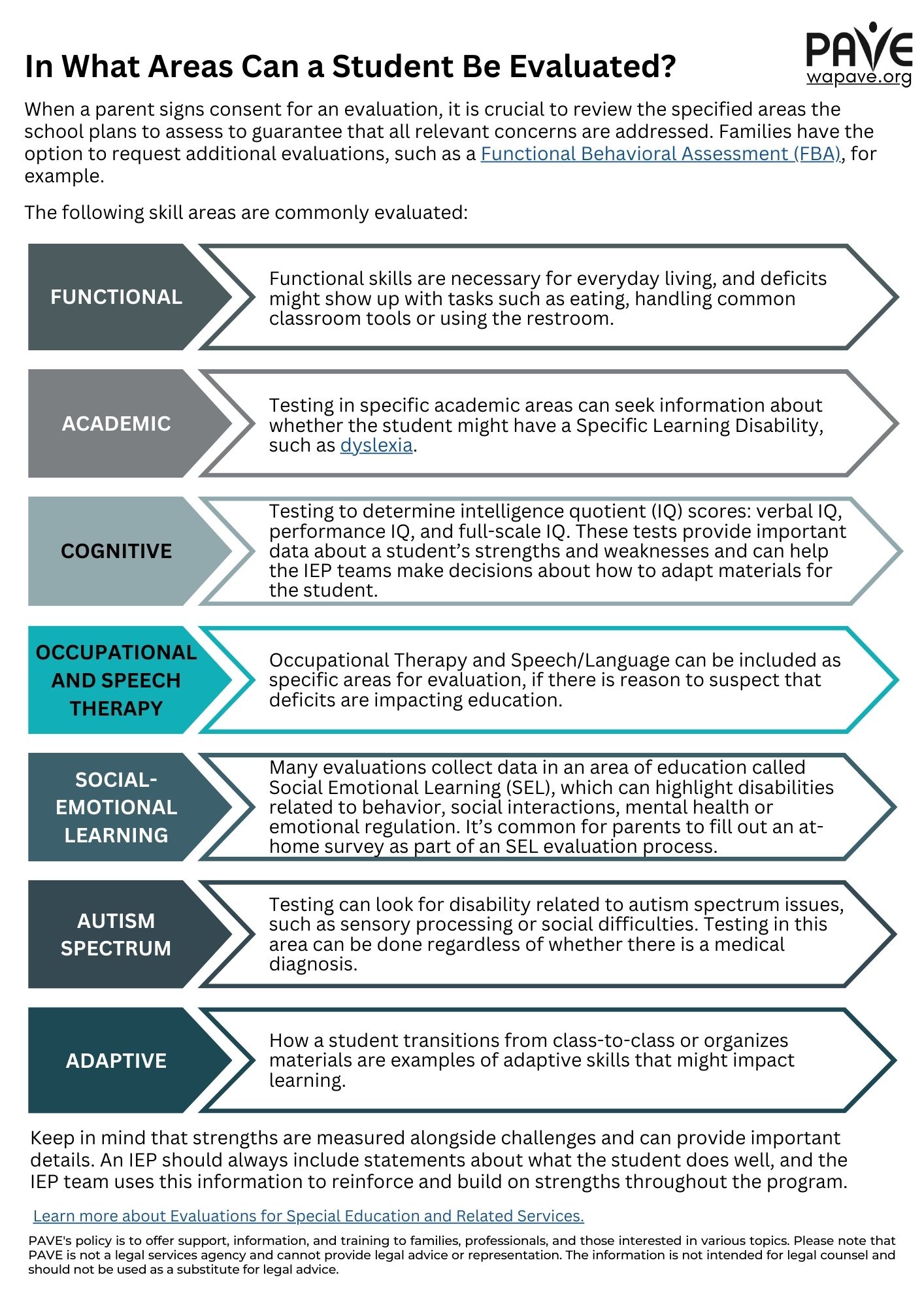
Areas of evaluation

Download In What Areas Can a Student Be Evaluated?:
English | Chinese (Simplified) 中文 (Zhōngwén) | Korean 한국어 (Hangugeo) | Russian Русский (Russkiy) | Somali Soomaali | Spanish Español | Tagalog | Ukrainian українська | Vietnamese Tiếng Việt

Eligibility Categories for Special Education

Once a student’s evaluation confirms a disability that impacts learning, the next step is to determine whether the disability fits one of 14 federally recognized categories. These categories are outlined in Washington’s Administrative Code (WAC 392-172A-01035):

  • Autism
  • Emotional Disturbance
  • Multiple Disabilities
  • Specific Learning Disability
  • Visual Impairment / Blindness
  • Deaf-Blindness
  • Hearing Impairment
  • Orthopedic Impairment
  • Speech/Language Impairment
  • Developmental Delay (ages 0-8)
  • Deafness
  • Intellectual Disability
  • Other Health Impairment
  • Traumatic Brain Injury

These categories are intentionally broad to reflect the diverse ways disabilities can affect learning. The IEP team may discuss which category best fits the student’s unique situation. While a medical diagnosis can help inform the process, eligibility is determined by how the disability impacts the student’s education. This impact can be assessed with or without a formal diagnosis.

There is no such thing as a “behavior IEP” or an “academic IEP.” Once a student qualifies, the school is responsible for addressing all identified areas of need. The IEP is personalized to include programming, services, and placement designed to support the whole child.

In Washington State, children through age 9 may be eligible for services under the category of Developmental Delay. Full definitions for each category are available in WAC 392-172A-01035 and are also reproduced in this PAVE article: Washington Special Education Categories.

Timeline of Evaluation and Development of an IEP

The school follows specific deadlines for an evaluation process. They have 25 school days to respond to the referral in writing. If they proceed with the evaluation they have 35 schools days to complete the assessment. For an eligible student, an IEP must be developed within 30 calendar days.

Track your student’s progress from the point of referral for evaluation to the development of the IEP with the infographic below.
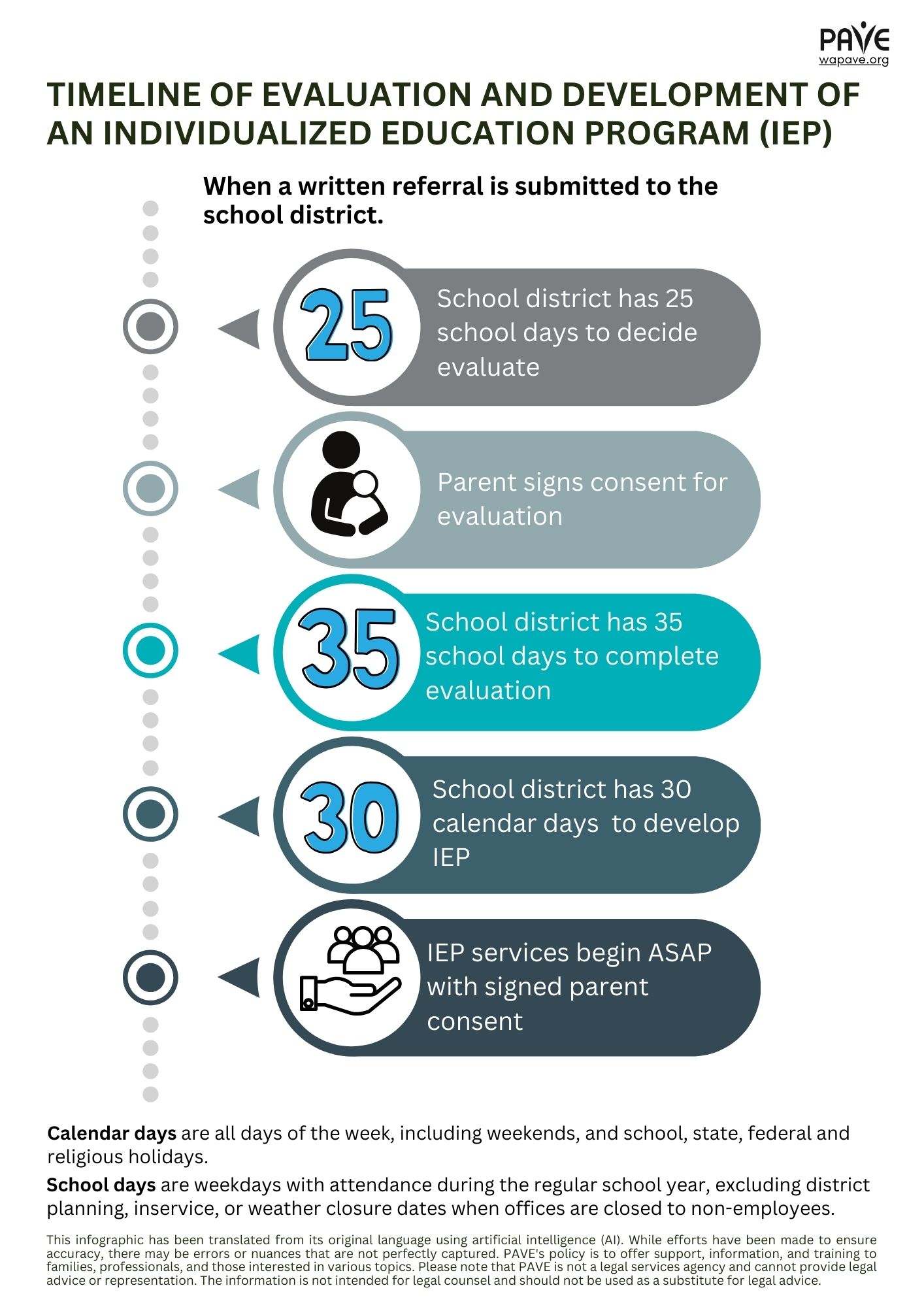
Timeline of Evaluation and development of an individualized education program (IEP)

Download the Timeline of Evaluation and Development of an IEP:
English | Chinese (Simplified) 中文 (Zhōngwén) | Korean 한국어 (Hangugeo) | Russian Русский (Russkiy) | Somali Soomaali | Spanish Español | Tagalog | Ukrainian українська | Vietnamese Tiếng Việt

Sample Letter to Request an Evaluation

Washington law requires that referrals for special education evaluation be made in writing. If a verbal request was previously denied, start again with a formal written letter sent by email, certified mail, or delivered in person.

OSPI provides a downloadable referral form on its Making a Referral for Special Education page. The person making the referral can use this form or any other written format that clearly communicates the request to evaluate.

Address the referral to the district special education director or program coordinator, and include an administrator at the student’s school. Be sure to include the student’s full name and birthdate, a clear statement requesting evaluation in all areas of suspected disability, and specific concerns. Supporting documents or letters from doctors, therapists or other providers may be attached. Include complete contact information and a statement that the parent or guardian is prepared to sign consent for the evaluation to begin.

Download the Sample Letter to Request an Evaluation:
English | Chinese (Simplified) 中文 (Zhōngwén) | Korean 한국어 (Hangugeo) | Russian Русский (Russkiy) | Somali Soomaali | Spanish Español | Tagalog | Ukrainian українська | Vietnamese Tiếng Việt

Options When Families and Schools Disagree

Families can ask school staff to explain their decisions in writing. If a parent or guardian disagrees with something the school decides, they have rights to informal and formal dispute resolution options that are protected by the IDEA. Schools must provide a document called procedural safeguards, which outlines these options and explains the rights of both students and families. PAVE continues this topic in an article: Evaluations Part 2: Next Steps if the School Says ‘No.’

Eligibility for Section 504 Protections

Section 504 of the Rehabilitation Act of 1973 is a federal civil rights law that helps protect students with disabilities from discrimination in schools that receive federal funding. It applies to individuals whose disabilities significantly affect major life activities—such as learning, breathing, walking, or concentrating. Because the law is broadly written, it can apply to a wide range of conditions and circumstances.

Students who receive services through an IEP also benefit from protections under Section 504, which are built into the IEP process. In some cases, students who don’t qualify for an IEP may still be eligible for support through a Section 504 Plan.

Protections against bullying and discriminatory discipline are aspects of Section 504. PAVE provides articles about Bullying at School: Resources and the Rights of Students with Special needs and What Parents Need to Know when Disability Impacts Behavior and Discipline at School.

Learn More

PAVE provides downloadable toolkits ready for you, including Where to Begin When a Student Needs Help. For the full list of toolkits, type “toolkit” in the search bar at the top of this page.

Click on Get Support at the top of this page to submit a Support Request and receive individually tailored support, training, information, and resources.
Evaluations Part 2: Next Steps if the School Says ‘No’

Families may feel uncertain or discouraged when a school denies a request for special education evaluation or finds a student ineligible for services. Fortunately, there are steps families can take to respond, seek clarification, and continue advocating for their child’s needs. Understanding available options and protections can help families take informed action and make decisions that support their child’s access to appropriate educational services.

A Brief Overview

  • If the school denies a request for a special education evaluation or does an evaluation and determines a student is ineligible for services, families have options.
  • Schools must issue a Prior Written Notice (PWN) explaining their decision to evaluate or deny a request.
  • Students who do not qualify for an IEP may still be eligible for a Section 504 Plan.
  • Procedural Safeguards provide a specific process for special education and offer families the right to file formal complaints when they disagree with school decisions.
  • When there is a dispute about a district’s evaluation, one option is to request an Independent Educational Evaluation (IEE) from a provider outside of the school district. This article includes a downloadable sample letter in multiple languages to help with that process.
  • PAVE supports students and families navigating educational services. Click Get Support at wapave.org to request 1:1 support.

Introduction

Parents have a variety of choices if the school denies a request to evaluate a student for special education, or if the school does an evaluation and finds the student ineligible for services through an Individualized Education Program (IEP). These decisions can feel discouraging, but they do not mark the end of the road. Under the Individuals with Disabilities Education Act (IDEA) and its implementation through Washington Administrative Code (WAC 392-172A), families have the right to challenge decisions, seek clarification, and request further evaluation. Understanding these options can help families take informed next steps and ensure that their concerns are heard and addressed.

Ask for the Decision in Writing

The school is required to respond through a formal letter, called Prior Written Notice (PWN), to explain its rationale for moving forward with an evaluation or denying the request. If the explanation is unclear or lacks detail, families can ask for a more complete written response. Schools may not deny an evaluation based on internal resource limitations or staffing challenges. According to the Child Find Mandate of IDEA, schools are obligated to evaluate any student with a known or suspected disability, regardless of whether other classroom supports are being used. For example, schools may implement approaches like Response to Intervention (RTI) to support learning, but these methods cannot be used to postpone or deny assessment when a disability is suspected.

Request a Meeting

Discussing a student’s difficulties in a meeting, in-person or virtually, can help school staff understand a parent’s level of concern. A district representative, such as a director of special education, can provide insight about the process and additional options. Parents can invite anyone they would like to attend who has knowledge of the student, including a support person to take notes and help track the conversation.

Is a Section 504 Plan Appropriate?

If a student has a known disability, with some educational impacts, but there is no documented need for Specially Designed Instruction (SDI) and/or related services, the student might qualify for accommodations provided through a Section 504 Plan.

Section 504, which is part of the Rehabilitation Act of 1973, defines disability as an impairment that impacts a major life activity. A formal evaluation is helpful but not required, and parent involvement is best practice. The team asks:

  1. Does the student have a disability?
  2. Does the disability limit one or more major life activities?

If the answer to these two questions is yes, the school can develop a plan to support the student within the general education setting. Assistive technology and modifications to the curriculum can be part of the plan, which includes individualized accommodations to ensure the student is able to access school in ways that are equitable. PAVE provides an article with more information about Section 504.

Options When Resolution Requires More Support

Families are protected by Procedural Safeguards, which outline a specific processes for resolving disagreements in special education. When informal conversations don’t lead to resolution, options such as mediation, community complaint, and due process may be appropriate. PAVE’s article, When Parents and Schools Disagree: Navigating Special Education Disputes, offers clear guidance on these pathways and what to expect. 

If a school denies a request for a specific evaluation, such as a Functional Behavioral Assessment (FBA) or an assistive technology evaluation, families can still pursue dispute resolution options. These types of assessments may be essential for understanding a student’s behavioral needs or identifying tools that support access to learning. Requests for these evaluations are protected under the same legal framework as other special education decisions, specifically the procedural safeguards.

The Office of Superintendent of Public Instruction (OSPI) provides assistance to navigate these processes through a Special Education Parent Liaison, and families may also seek help from the Governor’s Office of the Education Ombuds for collaborative problem-solving. For personalized assistance, PAVE supports students with disabilities and their families. Click Get Support at wapave.org to request 1:1 support.

Request an Independent Education Evaluation (IEE)

Families who disagree with a school district’s evaluation results have the right to request an Independent Educational Evaluation (IEE) conducted by a qualified professional outside the district. An IEE can offer additional information that may support the need for Specially Designed Instruction (SDI) and/or related services.

If the school district denies a request for an IEE at public expense, the district must initiate a due process hearing within 15 calendar days to show that its evaluation was appropriate.

When an IEE request is accepted, the school district provides a list of independent evaluators. Parents have discretion to call each one or to seek an alternative evaluator at their own expense before choosing who will evaluate the student. The school must consider the results of the IEE when deciding whether the student qualifies for special education programming.

Sample Letter to Request an IEE

Download the Sample Letter to Request a Functional Behavioral Assessment (FBA) in:
English | Chinese (Simplified) 中文 (Zhōngwén) | Korean 한국어 (Hangugeo) | Russian Русский (Russkiy) | Somali Soomaali | Spanish Español | Tagalog | Ukrainian українська | Vietnamese Tiếng Việt

Families can email the IEE request letter, send it by certified mail (and keep the receipt), or hand carry it to the district office and request a date/time receipt. It is important to keep a copy of this letter and all school-related correspondence in the student’s home records. Organizing with a binder or a filing system helps with keeping track of all letters, meetings, conversations, etc. These documents will be important for student throughout their educational career and beyond, including when they transition out of school.

Final Thoughts

When a school says “no,” it can feel like a door has closed—but that moment can also mark the beginning of a more empowered path forward. Each action a family takes is a meaningful expression of care and commitment. Family caregivers should trust their instincts, lean on trusted resources, and reach out for support. Persistence paired with informed choices can lead to real change and this journey is about more than advocacy—it’s about championing a child’s right to thrive.

Learn More

PAVE Provides Sample Letters to Support Families in their Advocacy

PAVE offers a collection of downloadable sample letters, available in multiple languages, to help families advocate for their children’s educational needs. These letters support clear and effective communication between families and schools, making it easier to request evaluations, meetings, or behavioral support. Whether you’re just getting started or need help with a specific concern, these tools can guide your next steps.

What is an Advocate?

An advocate is someone who works toward a cause or goal. While professional advocates may be trained to support others, family caregivers often become advocates themselves when they speak up for a child’s needs. Sometimes the hardest part of advocacy is figuring out what to do next. When a child has unmet needs at school, students and family advocates can request evaluations, meetings, or behavioral assessments to help improve services. Putting these requests in writing helps formalize the process and ensures that everyone involved is accountable.

PAVE helps families get started with a collection of sample letters, available for download in multiple languages. We’ve bundled links to those letter templates here for easy reference. Each link takes you to a short article with key information to help you understand the process of special education and how your customized letter can move you forward in that process.

Always Keep Your “Why” in Mind

Why are you taking action? Because you want something to improve for your child! PAVE’s short video, Quick Start Your Advocacy in Two Steps, might help you get ready to craft a letter. The video helps you ask two key questions:

  • What do you want?
  • Who has the power to work with you and make that happen?

As you write your letter, keep those questions and your “why” top of mind.

Request an Evaluation

Sample Letter to Request Evaluation: Schools are required to evaluate students to determine eligibility for a Section 504 Plan or an Individualized Education Plan (IEP). A referral can come from anyone with knowledge of the student and must be in writing. This article provides a sample letter and a link to an alternative form provided by the Office of Superintendent of Public Instruction (OSPI).

Download the Sample Letter to Request an Evaluation in:
English | Chinese (Simplified) 中文 (Zhōngwén) | Korean 한국어 (Hangugeo) | Russian Русский (Russkiy) | Somali Soomaali | Spanish Español | Tagalog | Ukrainian українська | Vietnamese Tiếng Việt

Request an IEP Meeting

Sample Letter to Request an IEP Meeting: Family members can request an IEP team meeting anytime there are concerns about how the IEP is being implemented and whether a student may have unmet needs. This article includes information about who is required to attend an IEP meeting and the rights of parents to participate in educational decision making.

Download the Sample Letter to Request an IEP Meeting in:
English | Chinese (Simplified) 中文 (Zhōngwén) | Korean 한국어 (Hangugeo) | Russian Русский (Russkiy) | Somali Soomaali | Spanish Español | Tagalog | Vietnamese Tiếng Việt

Request a Functional Behavioral Assessment

Sample Letter to Request a Functional Behavioral Assessment: If a child’s behavior is getting in the way of their education, the school is responsible to assess the problematic behaviors and develop a support plan to teach the student what to do instead. In addition to a sample letter, this article provides a link to a video to help families and schools work together through this process.

Download the Sample Letter to Request a Functional Behavioral Evaluation in:
English | Chinese (Simplified) 中文 (Zhōngwén) | Korean 한국어 (Hangugeo) | Russian Русский (Russkiy) | Somali Soomaali | Spanish Español | Tagalog | Ukrainian українська | Vietnamese Tiếng Việt

Request an Independent Educational Evaluation (IEE)

Evaluations Part 2: Next Steps if the School Says ‘No’: If the school evaluates a student and says they aren’t eligible for an IEP or a specific area of service, parents have steps they can take if they disagree. One option is to request an Independent Educational Evaluation (IEE) from an outside provider. This article provides a sample letter for requesting an IEE at school district expense. If the family requests an IEE because they disagree with the school’s evaluation or its conclusions, then the district must pay for the IEE or deny the request through Due Process: IEE denials are evaluated by an Administrative Law Judge.

Download the Sample Letter to Request an Independent Educational Evaluation (IEE) in:
English | Chinese (Simplified) 中文 (Zhōngwén) | Korean 한국어 (Hangugeo) | Russian Русский (Russkiy) | Somali Soomaali | Spanish Español | Tagalog | Ukrainian українська | Vietnamese Tiếng Việt

Final Thoughts

Families who want individualized assistance can reach out to PAVE by completing the Get Support  form. Check out the PAVE Calendar for upcoming trainings and events.

Sample Letter to Request Evaluation

Anyone with knowledge of a student may request a special education evaluation, and Washington State law requires that referrals be made in writing. Schools must respond within specific timelines and provide language access and support throughout the process. Families have the right to participate in all decisions and may dispute outcomes if they disagree. Special education is a service designed to meet individual needs, not a predetermined placement.

A Brief Overview

  • Washington State requires special education referrals to be in writing (WAC 392-172A-03005). Schools must assist individuals who cannot write.
  • Anyone with knowledge of a student can write a referral.
  • The state provides a Referral for Special Education Evaluation form for making a special education referral, available for download in multiple languages from the Office of Superintendent of Public Instruction (OSPI) website. The form is not required—any written request is valid.
  • Another option is to write a referral using the sample letter at the end of this article.
  • Schools are responsible to provide families with a referral form in their native language and to provide qualified interpreters so families can participate in all meetings to discuss their student’s special education eligibility and services.
  • Schools must respond to a referral within 25 school days and provide a Prior Written Notice (PWN) explaining their decision.
  • If the school agrees to evaluate, parent consent is required before the process begins. The evaluation must be completed within 35 school days, and an IEP developed within 30 calendar days if the student qualifies.
  • If a student is found ineligible for an IEP or the school refuses to evaluate, families may dispute the decision using procedural safeguards, request an Independent Educational Evaluation (IEE), or pursue evaluation for a Section 504 Plan.

Introduction

When a student is struggling in school and there is reason to suspect the challenges are disability related, anyone can refer the student for an educational evaluation. If the evaluation shows that the student is eligible, services are provided through an Individualized Education Program (IEP). Washington State requires special education referrals to be in writing, as specified in Washington Administrative Code (WAC 392-172A-03005).

What Schools Must Do After a Referral

If someone who knows the student asks for an evaluation, the school is responsible for:

  • Documenting the request
  • Recording the date the referral was made
  • Providing a referral form in the person’s native language
  • Responding to the request within 25 school days

If the person asking for the evaluation cannot write, the school is responsible for supporting them to complete the referral.

The school must provide a referral form in the native language of the person making the request. Schools are required to provide qualified interpreters to support parent participation in the referral process and for all meetings where a student’s eligibility and/or educational services are discussed. The Office of Superintendent of Public Instruction (OSPI) provides Parent Rights Information Sheets, downloadable in many languages on the Interpretation and Translation Services webpage.

Evaluation Process and Timelines

When a student is referred for a special education evaluation, the school has 25 school days to decide if they will do the evaluation. These are days when students are actually in school. The school must tell the family their decision in writing. This letter is called a Prior Written Notice (PWN), and it follows rules from WAC 392-172A-05010.

Usually, the school and family meet to talk about the referral and how the student is doing. If everyone agrees to move forward, the parents or caregivers sign a form giving permission for the evaluation to begin. Families can ask questions about what the evaluation will include. The school will look at all areas where the student might need help. This helps them understand the student’s strengths and challenges. If the student qualifies for special education, the results will help create a plan called an Individualized Education Program (IEP).

If the school decides not to evaluate and the family disagrees, the family has the right to take steps to solve the disagreement. These steps are explained in the procedural safeguards.

When the school agrees to evaluate the student, staff must promptly seek parent consent to begin the evaluation process (WAC 392-172A-03005).

Generally, parents sign a form that lists what the school will include in its evaluation. Parents can ask for additional areas to be evaluated to make sure the school gets data for all areas of concern. Families can ask for more information about what the evaluation will look like, where it will take place, how long it will take, and who will participate. The school and family can creatively plan the evaluation process if accommodations are needed. For example, if a student isn’t able to attend in-person school, the evaluation can be done in alternative locations.

After a parent signs consent, the school has 35 school days to finish the evaluation and meet with the family to talk about the results. The deadline may be extended if the family agrees, particularly to accommodate needs of the family or student.

The 35-day deadline does not apply if the student is unavailable for the evaluation or enrolls in another school district before the evaluation is finished (WAC 392-172A-03005).

For students found eligible for services, the school develops an IEP within 30 calendar days and requests parent consent for services to begin. The school and family meet to review a DRAFT version of the IEP and write a final version together before consent is signed. School staff provide a Prior Written Notice (PWN) with a summary of the meeting, agreements, and timelines before services start. PWN requirements are described in WAC 392-172A-05010.

How to Refer a Student for Evaluation for Special Education

The Office of Superintendent of Public Instruction (OSPI) is the guidance agency for Washington State. OSPI provides a Referral for Special Education Evaluation form, downloadable in multiple languages from a website page titled, Model Forms for Services to Students in Special Education. Families may use OSPI’s form, a form provided by their school, or their own choice of format to write their request for a student to be evaluated.

Further explanation of the referral and evaluation process is provided on the OSPI website page, Making a Referral for Special Education.

A non-discriminatory evaluation is part of the protections for a student with a known or suspected disability that may significantly impact their access to education (Child Find Mandate). Child Find protections are part of the federal Individuals with Disabilities Education Act (IDEA). Child Find applies whether there are academic and/or non-academic school impacts.

PAVE provides more detail about IEP eligibility and evaluation process: Evaluations Part 1: Where to Start When a Student Needs Special Help at School.

Sample Letter to Request an Evaluation

Below is a sample letter to write a request for a special education evaluation. You can copy and paste the text of this sample letter into your word processor to build your own letter.

Download the Sample Letter to Request an Evaluation in:
English | Chinese (Simplified) 中文 (Zhōngwén) | Korean 한국어 (Hangugeo) | Russian Русский (Russkiy) | Somali Soomaali | Spanish Español | Tagalog | Ukrainian українська | Vietnamese Tiếng Việt

The state provides an alternative form, downloadable from OSPI’s website page titled, Making a Referral for Special Education. Your school district is responsible to provide a form, in your language, for you to submit your written request. These formats are your choice—any written request is valid. If you cannot write, you can ask for an evaluation by telling the school and they can write the request with you.

Submit your written request through email, by mail, or by hand delivery, to the special education/special services manager at your school’s district office. You may submit additional copies to school administrators and/or a school psychologist—the person who manages evaluations for your school. Be sure to keep copies of all of your communications with the school in an organized, safe place.

Special Education is a Service, Not a Location

A request for a special education evaluation is NOT a recommendation to remove a student from the regular classroom and move them into an exclusive learning environment. Federal and state laws require that students receive education and services in the Least Restrictive Environment (LRE) to the maximum extent possible to meet their needs. Special Education is a service, while LRE refers to placement. You can read more about this in the PAVE article, Special Education is a Service, Not a Place. Decisions about placement are made by the IEP team, which includes the family. The IEP team is responsible to consider the child’s circumstances and capacities as its top priority—not pre-built programs or district resources. The PAVE article, Parent Participation in Special Education Process is a Priority Under Federal Law, provides detail about parent participation in special education process.

Parents Can Appeal Decisions and/or Seek a 504 Plan

If a student is evaluated and found not eligible for an IEP (or if the school refuses to do an evaluation), the family has the right to dispute the decision using Procedural Safeguards.

If they disagree with the district’s evaluation or its findings, the family may seek an Independent Educational Evaluation (IEE), which is done by an agency outside of the school district. The district must pay for an IEE or deny the request using Due Process. See PAVE’s article: Evaluations Part 2: Next Steps if the School Says ‘No’ to Your RequestThe article includes a sample letter to request an IEE.

Another option if a student doesn’t get an IEP is to develop a Section 504 Plan, which accommodates a person with a disability that impacts a major life activity (learning, walking, speaking, writing, socializing…). Section 504 is part of the Rehabilitation Act of 1973, which protects the civil rights of individuals with disabilities against discrimination throughout their lives. See PAVE’s article about Section 504 rights, which also protect students who qualify for an IEP: Section 504: A Plan for Equity, Access and Accommodations.

Final Thoughts

Requesting a special education evaluation is a straightforward process that begins with a written referral. By following the required steps and understanding your rights, you can help ensure your student receives the support they need. Whether you use a formal form or write your own letter, the request must be clear and submitted in writing. This step initiates the evaluation process and ensures the school is legally obligated to respond.

Learn More

The Power of Data: Shaping IEPs and 504 plans for Student Success 

Data plays a crucial role in special education, helping teachers, parents, and support teams create effective learning plans for students with disabilities. By understanding data, students and their families can work together with educators to ensure students successfully reach their educational goals.

Brief Overview

  • Data includes information on a student’s learning, behavior, and progress from various sources, used to develop Individualized Education Programs (IEPs) or Section 504 plans.
  • Data helps set learning goals, choose strategies, and decide on accommodations, with regular reviews to adjust plans.
  • Data helps parents and students advocate for support, track progress, and request extra services if needed.
  • This article contains descriptions of the various types of data, test scoring systems, and assessments commonly used in special education.
  • If families and school districts disagree about evaluation data, there are procedural safeguards to help resolve disputes.

What is Data in Special Education?

Data is any information collected about a student’s learning, behavior, and progress. It can come from test scores, classroom performance, teacher observations, and feedback from parents and students. This information is used to develop an Individualized Education Program (IEP) or a Section 504 plan that meets the student’s unique needs.

Types of Data Used in IEPs


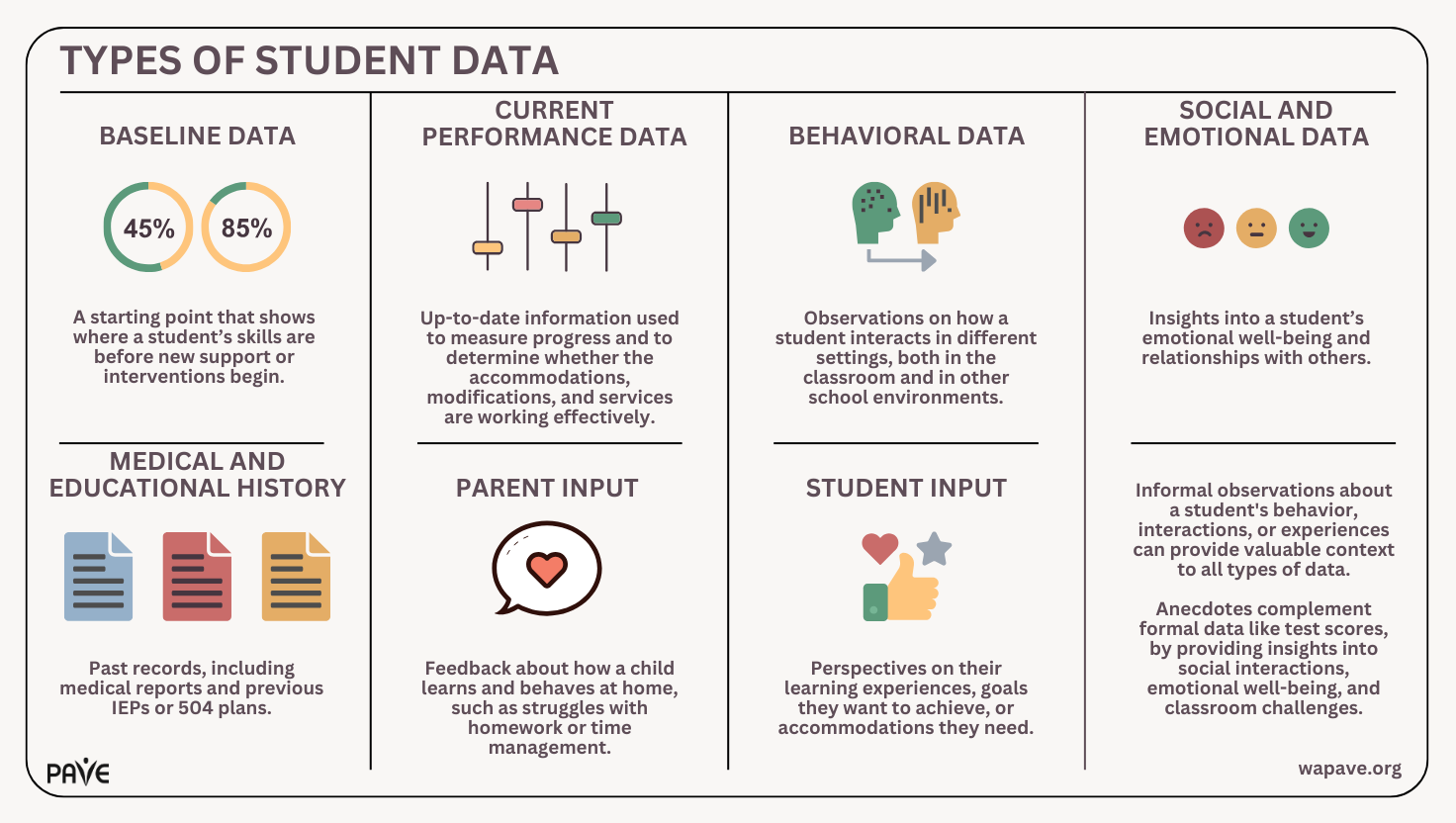
Types of Student Data
IEP and Section 504 teams use different types of data to understand a student’s abilities and challenges. These include:

  • Baseline Data: A starting point that shows where a student’s skills are before new support or interventions begin. This could include initial test scores, observations of classroom behavior, and assessments of academic abilities such as reading fluency or math skills. Baseline data is crucial because it helps educators and parents track how the student progresses over time.
  • Current Performance Data: Up-to-date information used to measure progress and to determine whether the accommodations, modifications, and services are working effectively. Performance data includes recent test scores, progress and grade reports, class assignments and homework, and observations from IEP or 504 team members. Teachers and staff might also track how often a student completes assignments or engages with the material being taught.
  • Behavioral Data: Observations on how a student interacts in different settings, both in the classroom and in other school environments. It can include records of behavioral incidents, such as disruptions or outbursts, as well as observations on how the student interacts with peers and follows classroom routines. Behavioral data helps identify patterns and triggers for specific behaviors, which can be addressed with strategic interventions.
  • Social and Emotional Data: Insights into a student’s emotional well-being and relationships with others. This type of data helps to understand how the student is managing relationships, emotional regulation, and any challenges they may be facing in terms of anxiety, stress, or peer interactions. Information may come from school counselors, social workers, or teacher reports on the student’s ability to work in groups or handle stress in academic settings.
  • Medical and Educational History: Past records, including medical reports and previous IEPs or 504 plans. These records help educators understand what interventions have been tried before, what worked, and what didn’t. They also give context to the student’s academic performance over the years and may provide insight into any ongoing health conditions that might affect their learning.
  • Parent and Student Input: Parents often provide important feedback about how their child learns and behaves at home, such as struggles with homework or time management, which can complement academic performance data. Students themselves can share their perspectives on their learning experiences, goals they want to achieve, or accommodations they need, helping ensure the plan aligns with their needs.

Informal observations about a student’s behavior, interactions, or experiences can provide valuable context to all types of data. These anecdotes from parents, students, teachers, or service providers offer personal accounts of how a student responds to situations or interventions. By complementing formal data like test scores, these observations provide insights into social interactions, emotional well-being, and classroom challenges. This helps to understand the student’s strengths and areas for growth. When combined with formal data, anecdotal feedback creates a more comprehensive and effective educational plan tailored to the student’s needs.

Using Data to Customize Student Supports

An IEP or 504 plan is created based on data collected through evaluations and observations. This information helps set learning goals, choose instructional strategies, and decide on accommodations and services. For example, if a student struggles with reading, data can show whether the challenge lies in comprehension, vocabulary, or decoding words.

The IEP or 504 team, including parents, teachers, and specialists, meets regularly to review data and adjust the IEP or 504 plan as needed to ensure they remain effective. Under Washington Administrative Code (WAC 392-172A-03015), students with IEPs must be re-evaluated at least once every three years, though parents or educators can request more frequent assessments if needed. Data for IEPs must be reviewed at least annually to determine whether the student’s goals and services need to be updated (WAC 392-172A-03110(3)).

The Office of Superintendent of Public Instruction (OSPI) has outlined the requirements for review and reevaluation of 504 plans in the Students’ Rights Information Sheet: Section 504, a document available for download in multiple languages on the OSPI website. School districts must re-evaluate a student’s eligibility for a 504 plan at least every three years and review the 504 plan annually to ensure that it continues to be effective. Parents or teachers can request a review at any time.

Understanding Test Scores

Test scores provide important insights into a student’s learning progress.  Scoring systems vary, and the results can be presented in different formats. Some common types include:

  • Raw scores indicate the number of correct answers or tasks completed correctly. For example, if a student correctly answers 35 out of 40 questions, their raw score is 35.
  • Standard scores compare a student’s performance to others of the same age, with 100 as the average. The mean is the average score, and the standard deviation shows how much the scores vary from that average. With a standard deviation of 15 on the Wechsler Intelligence Scale for Children (WISC-V), most students’ scores will fall between 85 and 115, and scores further from 100 indicate greater differences from the average.
  • Percentile ranks show where a student’s performance ranks in comparison to their peers. If a student is in the 70th percentile, they scored higher than 70% of their peers statewide. A score in the 30th percentile means the student scored higher than 30% of other students.
  • Age and grade equivalent scores show how a student’s performance compares to typical expectations for their age or grade. A 5th-grade student with a grade equivalent score of 7.0 is performing at the level expected of an average 7th grader.

Types of Assessments

There are two main types of tests used in special education: norm-referenced and criterion-referenced. Norm-referenced tests compare a student’s performance to other students in the same age group or grade level. For example, an IQ test measures a child’s cognitive abilities compared to others of the same age by assessing areas like verbal comprehension, perceptual reasoning, working memory, and processing speed. Criterion-referenced tests measure how well a student has learned specific skills. Classroom-based assessments are often criterion-referenced tests, like a math test that focuses on a student’s ability to accurately complete addition and subtraction problems. The Smarter Balanced Assessments (SBA) are English language arts (ELA) and math tests given to students in grades 3-8 and 10. The SBA is both a norm-referenced assessment, comparing student performance to state and national benchmarks, and a criterion-referenced assessment, measuring students’ mastery of skills needed for graduation and academic progress.

Using Data to Advocate for Student Needs

Data helps parents and students advocate for the right support. If test scores show that a student is falling behind, families can use this information to request extra services, such as tutoring or assistive technology. Data also helps track progress to see if current strategies are working or if changes are needed.

Asking questions about the data can help parents and guardians better understand their child’s needs and ensure they are getting the right support. By engaging in these conversations, parents can advocate for their child more effectively and make sure their progress is being tracked accurately. Here are some helpful questions to ask during meetings with the IEP or 504 team:

  • Can you show me the data that supports this change in supports or services?
  • What specific data or assessments have been used to understand my child’s academic performance?
  • How do my child’s scores compare with other students in their age group or grade level?
  • What scoring type was used to determine these evaluation results?
  • Can you explain how the data indicates where my child might need additional support?
  • Based on the test scores and data, what are my child’s strengths and how can we use them to improve their weaknesses?
  • How often will we review the data to see if my child is making progress? Will there be ongoing assessments and, if so, which assessments will be used?

Resolving Disagreements over Evaluation Data

Procedural Safeguards outline the evaluation process and the dispute resolution options when families and school districts disagree about evaluations. Under the Individuals with Disabilities Education Act (IDEA), parents have the right to request an Independent Educational Evaluation (IEE). The IEE must be requested in writing and PAVE provides a Sample Letter to Request an IEE paid for at public expense by the school district. If the request is approved, the school district provides a list of independent evaluators. The school must consider the IEE results when determining the student’s eligibility for special education services. If the school district denies the request for an IEE, it must start a due process hearing within 15 calendar days to justify its evaluation. Parents have the right to request an IEE anytime a student is evaluated and they disagree with the result.

According to Section 504 Notice of Parent Rights, downloadable in multiple languages on the OSPI website, parents have the right to request mediation or an impartial hearing, if they disagree with the school district’s identification, evaluation, educational program, or placement.

Final Thoughts

Data plays a powerful role in shaping IEP and 504 plans for students with disabilities. By using detailed information from various sources, educators, parents, and support teams can create personalized and effective plans that meet each student’s unique needs. Understanding and using data empowers students and parents to take an active role in education, working closely with teachers and specialists to ensure that students receive the right support to succeed in school and beyond.

Beyond School Walls: A Guide to Homeschooling in Washington State 

Homeschooling is a popular and flexible educational option for many families. “Home-based instruction” (HBI), as it’s referred to in Washington State law, must meet specific required subjects and instructional hours (or school days) annually. If you’re considering homeschooling, it’s important to understand the legal requirements and steps involved, including the qualifications that make a parent or guardian eligible to provide home-based instruction. Homeschooled students can access public school resources like extracurricular activities, part-time classes, and even special education services. By understanding and adhering to these guidelines, you can ensure a successful and enriching homeschooling experience for your child.

A Brief Overview

  • Homeschooling or home education programs are called “home-based instruction (HBI)” in Washington state.
  • A parent or guardian must meet one of four qualifying criteria to homeschool, or register through an approved private school extension program.
  • Homeschooling must cover 11 required subjects and at least 1,000 instructional hours annually (or 180 school days), but Washington law (RCW 28A.200.020) allows for flexibility in teaching methods and curriculum selection, emphasizing a personalized approach.
  • Beginning on their eighth birthday, your child must be enrolled in a school or home-based instruction, in accordance with Washington’s compulsory attendance law (RCW 28A.225.010).
  • If your student was enrolled in school prior to homeschooling and they are 8 years of age or older, they must be withdrawn by written and signed statement, and you must file a Declaration of Intent with your local public school district. The Declaration of Intent must be filed by September 15th annually, or within two weeks of the beginning of the public school year.
  • Homeschooled children must complete yearly assessments, either through standardized testing or an evaluation by a certificated educator. Parents and guardians must keep the results in their homeschooling files as a permanent record.
  • Families can request a special education evaluation from the public school district regardless of whether their child is enrolled in public school. If the child is eligible, the district must provide ancillary services unless the family declines them (RCW 28A.150.350).
  • Homeschooled students can participate in public school resources, including part-time enrollment in virtual or in-person classes, extracurricular activities, and sports.
  • PAVE provides a downloadable Annual Checklist for Home-Based Instruction to help families maintain compliance with Washington’s homeschool statutes.

Introduction

Whether you are looking for an alternative to public school or continuing a home education program you began before moving from out of state, there are some things you need to know before homeschooling your student in Washington State. Homeschooling, referred to as “home-based instruction (HBI)” in the state statutes, comes with specific guidelines and requirements.

To homeschool, a parent or guardian must:

  1. Meet the qualifications for homeschooling under state law (RCW 28A.225.010(4))
  2. Provide 180 school days or 1,000 instructional hours annually in the 11 required subjects
  3. Formally withdraw the student from public school
  4. Notify the school district of annually with a Declaration of Intent
  5. Have the student complete an annual test or assessment
  6. Maintain homeschool records

What qualifications must a parent or guardian meet to homeschool?

A parent or guardian has to meet one of the following qualifications to homeschool their child:

  1. Hire a certified teacher to supervise the instruction.
  2. Complete 45 college quarter credits or the equivalent in semester credits.
  3. Complete a course in home-based education, sometimes referred to as a parent qualifying course, at a postsecondary or vocational-technical institute.
  4. Gain approval from the superintendent as “sufficiently qualified to provide home-based instruction.” Those who have homeschooled in another state and move into Washington may be more successful with this by demonstrating a documented history of homeschooling.

If you do not meet these qualifications, you may homeschool through a private school extension program. Locate an approved private school that allows the homeschooling option and contact the school directly.

What do homeschool students learn?

Washington law mandates that homeschooled children receive at least 1,000 instructional hours annually (or 180 school days), similar to the public school system. There are 11 required subjects, although parents do not have to teach every subject daily, weekly, or even yearly. Some subjects, like social studies, are for younger grades, while others, like history, are for older grades. The homeschool curriculum must include the following subjects:

  • Occupational education
  • Science
  • Math
  • Language
  • Social studies
  • History
  • Health
  • Reading
  • Writing
  • Spelling
  • Art and music appreciation

You have full control over your homeschooling curriculum, allowing you to tailor the education to your child’s needs and interests. You are responsible for decisions related to educational philosophy, selection of books, teaching materials, curriculum, and methods of instruction (RCW 28A.200.020).

Washington law acknowledges that “home-based instruction is less structured and more experiential than the instruction normally provided in a classroom setting.” As a result, the nature and quantity of instructional and educational activities are “construed liberally”. This flexibility gives you the freedom to create a personalized educational experience. (RCW 28A.225.010(5))

When and how can I withdraw my student from public school?

Children living in Washington must be enrolled in a school or home-based instruction starting on their eighth birthday. The law requires compulsory attendance from age eight until eighteen (RCW 28A.225.010). Any educational programs your child participates in before age eight are not subject to state requirements for home-based instruction.

If your child is enrolled in a public or private school and you decide to homeschool, you must first formally withdraw your student. This process involves submitting a withdrawal form provided by the school or a written statement including the student’s name, school name, date of withdrawal, your signature, and the date of signing.

If your child is 8 years of age or older, notify the school district of your intent to homeschool on the same day that you withdraw them from public school, even if they have not yet begun classes or an educational program at the school.

How do I notify the school district that I am homeschooling my child?

For every school year that your child is homeschooled, you must file a written statement, called a Declaration of Intent, with the district superintendent. The address of the superintendent is usually the district office, which you can find on the school’s website or by calling your local school. You may retain a district-stamped copy of the Declaration of Intent by including a second copy and a self-addressed envelope with prepaid postage in your mailer. The deadline to file is September 15th or within two weeks of the beginning of the public school year.

A Declaration of Intent is not required for children who begin school before age 8. For example, a 5-year-old who has started kindergarten may be withdrawn for home-based instruction. The child started going to school before compulsory attendance applied. As a result, the parent is not required to file a Declaration of Intent. If you intend to start your student’s educational career in homeschool, submit your first Declaration of Intent when your child turns 8 years old and compulsory education begins.

The Office of Superintendent of Public Instruction (OSPI) has provided a Sample Declaration of Intent that includes all of the required information: the child’s name, age, address, and parent’s name. This documents that the parent is complying with compulsory education requirements, and the student is receiving an education. The Declaration of Intent must also specify whether a certified teacher will supervise the instruction.

What are my options to complete the required annual assessments?

There are two options for the required annual assessments:

  1. Standardized Test: Administered annually by a qualified individual approved by the test publisher. The test must be a standardized academic achievement test recognized by Washington State Board of Education (SBE). For a list of examples of tests, see the SBE Home Instruction FAQs page.
  2. Annual Assessment: Conducted by a certificated person currently working in the field of education. The evaluation must be written. Washington law does not provide as much detail about the criteria for evaluations, but it should include “statements and documents that reflect the child’s progress, or lack thereof” (OSPI).

The purpose of the annual test or evaluation is to provide an external metric to measure a student’s progress. The results are for the parent’s use only, unless the child is later enrolled at a public or private school. Parents can choose either option each year based on what works best for their child. Keep the test results in your permanent homeschool record.

Homeschooled students may take part in standardized testing at the public school. The testing dates for the year are usually available at the school office by late September and parents can call the assessment coordinator at the school district to register their student for these tests. Be sure to request a copy of the test scores for your homeschooling file during registration for the standardized test.

If a homeschooled student performs poorly on a test or assessment and the results indicate that they are “not making reasonable progress consistent with his or her age or stage of development,” the parent or guardian is expected to “make a good faith effort to remedy any deficiency”. (RCW28A.200.010(1)(c))

What records do homeschooled students have?

Maintaining good records is an essential part of homeschooling in Washington state, serving as proof of education and compliance with state laws. While the law does not specify the exact form records should take, there are several types of documentation that are meaningful for homeschooled students:

  • Attendance records tracking the 180 school days or 1,000 instructional hours required
  • Curriculum information documenting the textbooks and workbooks used
  • Student work samples and portfolios demonstrating application of what they’ve learned
  • Communication with school officials, including the annual Declaration of Intent and proof of mailing, such as the Certified Mail-Return Receipt
  • Test results, such as annual standardized tests and assessments
  • Immunization records

These records can be requested by school administrators if your child later enrolls in a traditional school setting. You should permanently keep proof of compliance with home education laws, including the Declaration of Intent and results of the annual assessments. Homeschool Legal Defense Association (HSLDA) recommends keeping all records from your student’s high school years because they may be requested as proof of education by a post-secondary education program, upon joining the military, or as part of an employment-related background check.

Does the public school have to provide special education and related services to homeschooled students?

Families have the right to request an evaluation for special education from the public-school district regardless of whether a child attends public school. If the child is found eligible, the local district is responsible for providing services unless the family does not want them. In some cases, families arrange to have a child attend private or home-based school but receive special-education services through the public school. These special education services are known as “ancillary services” and they are defined in Washington Administrative Code (WAC) as “any cocurricular service or activity, any health care service or activity, and any other services or activities, except ‘courses,’ for or in which preschool through twelfth grade students are enrolled by a public school” (WAC 392-134-005).

Ancillary services include but are not limited to:

  • Therapies, such as counseling, speech and hearing therapy
  • Counseling and health services
  • Testing and assessments
  • Supplementary or remedial instruction
  • Tutorial services, which may include home or hospital instruction
  • Sports activities

According to The Pink Book: Washington State Laws Regulating Home-Based Instruction, available on OSPI’s Home-Based Instruction page, the definition of “course” specifies that a service or activity meets all of the requirements of an ancillary service but is instructional in nature.

Can homeschooled students take part in public school classes or activities?

Students homeschooled in Washington have access to public school resources, including standardized testing, extracurricular activities, and specialized programs. Families can enroll their children as part-time students to access specific classes or services that complement their home-based instruction (RCW 28A.150.350(d)). Homeschooled students can attend virtual and online public school programs on a part-time basis without losing their homeschool status.

Access to extracurricular activities includes participation in sports and other interscholastic competitions through the Washington Interscholastic Activities Association (WIAA). Homeschooled students are considered “regular members” as long as they have met the State’s home-based instruction requirements, and –

  • Annually file a WIAA Rule 18.6.3 form with the principal’s office where the student is enrolled part-time. This form is available on the WIAA website, on the Student Eligibility Center page in multiple languages.
  • Do not receive assistance from the school district, and the school district does not receive funding for the student.
  • Meet both WIAA and the local school district eligibility requirements.
  • Follow transfer rules if they change schools after registering as a homeschool student.
  • Provide acceptable documentation of any interscholastic eligibility standards required of all other student participants.
  • Comply with WIAA and local school district regulations during participation.
  • Adhere to the same team responsibilities and standards of behavior and performance as other team members.
  • Participate as a member of the public school in the service area where they reside.

Final Thoughts

Homeschooling in Washington State provides families with a flexible and personalized approach to education while adhering to the state’s legal requirements. By understanding and meeting the necessary qualifications, maintaining proper records, and fulfilling annual assessment obligations, parents and guardians can ensure their child’s education remains compliant and effective. The wide array of resources, from specialized classes to extracurricular activities, further supports a well-rounded learning experience. Whether you are new to homeschooling or continuing from another state, Washington’s supportive framework allows for a rich and adaptable educational journey tailored to each child’s unique needs.

Early Intervention: How to Access Services for Children Birth to 3 in Washington

New parents often worry about their child’s growth and development, especially when comparing with other children. Early intervention can be crucial for children with developmental delays or disabilities. In Washington, families can connect with a Family Resource Coordinator (FRC) for guidance and access free developmental screenings. The Department of Children, Youth and Families (DCYF) offers services through Early Support for Infants and Toddlers (ESIT), providing evaluations and individualized plans (IFSP) to support eligible children from birth to age three. These services, protected under the Individuals with Disabilities Education Act (IDEA), are typically free and aim to help children thrive in various settings. 

A Brief Overview

  • PAVE provides downloadable toolkits specifically designed for parents and families of young children, including From Birth to Three Toolkit and Transition Toolkit for Ages 3-5
  • Families concerned about a child’s development can call the Family Health Hotline at 1-800-322-2588, with support in multiple languages. Parents can complete a free developmental screening online at Parent Help 123. 
  • Washington’s Department of Children, Youth and Families (DCYF) administers family-focused services for eligible children from birth to age 3 through Early Support for Infants and Toddlers (ESIT). 
  • The Individualized Family Service Plan (IFSP), funded by Part C of the Individuals with Disabilities Education Act, is a whole family plan developed with input from caregivers and professionals. It includes goals, services, and progress monitoring, and is reviewed regularly. 
  • To qualify, a parent must provide written permission for ESIT to conduct an early intervention evaluation of their child. If the evaluation results indicate that the child has a developmental delay or disability, ESIT will develop an IFSP. PAVE provides a Next Steps Checklist: When Your Child is Found Eligible for Early Intervention Services (EIS)
  • Early intervention services (EIS) are designed to meet the child’s individual needs, including various therapies and support services. Services are typically provided in the child’s home or other natural environments. 
  • Various dispute resolution options are available, including mediation and due process. Parents can contact their ESIT Family Resource Coordinator (FRC) if they have concerns or disagreements. 
  • Most early intervention services are provided at no cost to families. Some services may be billed to insurance with family consent, but certain services are always free under IDEA. 
  • Active-duty servicemembers whose dependents receive EIS must enroll in the Exceptional Family Member Program (EFMP) for their branch, or the Coast Guard’s Special Needs Program (SNP).  

Introduction 

New parents may struggle to know whether their child’s growth and development are on track. They may have a feeling that a milestone is missed, or they may observe siblings or other children learning and developing differently. Sometimes a parent just needs reassurance. Other times, a child has a developmental delay or a disability. In those cases, early interventions can be critical to a child’s lifelong learning. 

Seek guidance from a Family Resource Coordinator (FRC) 

Washington families concerned about a young child’s development can call the Family Health Hotline at 1-800-322-2588 (TTY 1.800.833.6384) to connect with a Family Resource Coordinator (FRC). Support is provided in English, Spanish and other languages. Families can access developmental screening online for free at HelpMeGrow Washington

Several state agencies collaborated to publish Early Learning and Development Guidelines. The booklet includes information about what children can do and learn at different stages of development, focused on birth through third grade. Families can purchase a hard copy of the guidelines from the State Department of Enterprise Services. A free downloadable version is available in English, Spanish, and Somali from DCYF’s Publication Library. Search by title: Washington State Early Learning and Development Guidelines, or publication number: EL_0015. 

Washington early intervention services are provided by ESIT 

In Washington, the Department of Children, Youth and Families (DCYF) administers services for eligible children from birth to age 3 through Early Support for Infants and Toddlers (ESIT). Families can contact ESIT directly, or they can reach out to their local school district to request an evaluation to determine eligibility and consider what support a child might need. The ESIT website includes videos to guide family caregivers and a collection of Parent Rights and Leadership resources, with multiple language options. 

Early intervention services (EIS) are provided in the child’s “natural environment,” which includes home and community settings where children would be participating if they did not have a disability. According to ESIT, “Early intervention services are designed to enable children birth to 3 with developmental delays or disabilities to be active and successful during the early childhood years and in the future in a variety of settings—in their homes, in childcare, in preschool or school programs, and in their communities.” 

Early services are delivered through an IFSP 

Children who qualify receive services through an Individualized Family Service Plan (IFSP). The right to an IFSP is protected by Part C of the Individuals with Disabilities Education Act (IDEA). The IDEA is a federal grant program that provides funding for states to implement early learning and special education programs. Part B of the IDEA protects an eligible school-age student’s right to an Individualized Education Program (IEP). Part A includes general guidance about the educational rights of children 0-22. 

Family caregivers, childcare professionals, teachers, or anyone else can refer a child for an early learning evaluation if there is reason to suspect that a disability or developmental delay may be impacting the child’s growth and progress. The school district’s duty to seek out, evaluate and potentially serve infants, toddlers or school-aged students with known or suspected disabilities is guaranteed through the IDEA’s Child Find Mandate

First Step: Evaluate to determine eligibility 

Early intervention is intended for infants and toddlers who have a developmental delay or disability. Eligibility is determined by evaluating the child (with parental consent) to see if the little one does, in fact, have a delay in development or a disability. Eligible children can receive early intervention services from birth to the third birthday. PAVE provides an article that describes What Happens During an Early Intervention Evaluation, and a checklist for When Your Child is Found Eligible for Early Intervention Services (EIS)

Next Step: Develop a service plan 

If an infant or toddler is eligible, early intervention services are designed to meet the child’s individual needs. Options might include, but are not limited to:   

  • Assistive technology (devices a child might need) 
  • Audiology or hearing services 
  • Speech and language services 
  • Counseling and training for a family 
  • Medical services 
  • Nursing services 
  • Nutrition services 
  • Occupational therapy 
  • Physical therapy 
  • Psychological services 

Services are typically provided in the child’s home or other natural environment, such as daycare. They also can be offered in a medical hospital, a clinic, a school, or another community space.  

Individualized Family Service Plan (IFSP): What is the plan? 

The IFSP is a whole family plan, with the child’s primary caregivers as major contributors to its development and implementation. Parents/custodial caregivers must provide written consent for services to begin. In Washington, Family Resource Coordinators (FRCs) help write the IFSP. Team members may include medical professionals, therapists, child development specialists, social workers, and others with knowledge of the child and recommendations to contribute.  

The IFSP includes goals, and progress is monitored to determine whether the plan is supporting appropriate outcomes. The plan is reviewed every six months and is updated at least once a year but can be reviewed at any time by request of parents or other team members. The IFSP includes: 

  • The child’s current developmental levels and needs in physical, cognitive, communication, social/emotional, and adaptive areas 
  • Family information: resources, priorities, and concerns of parents/caregivers. 
  • Major results/outcomes expected from the child and family 
  • Specific services: 
  • Where services are provided—any services provided outside the child’s “natural environment” of home/daycare/community require a statement explaining the rationale for the placement 
  • When the child receives services—the number of days or sessions for each service, and how long each session will last 
  • Who pays for the services 
  • Name and contact information for the Family Resource coordinator (FRC) responsible for IFSP implementation 
  • Steps to begin at age 2.5 to support the child’s transition out of early intervention and perhaps into school-based services. 
  • If relevant, additional services or information for the family—such as financial guidance or parenting support 

PAVE provides a downloadable checklist to help parents familiarize themselves with the IFSP.  

Dispute resolution options are available 

If parents have a concern or disagree with any part of the early intervention process, they can contact their Family Resource Coordinator (FRC). If issues remain unresolved, families may choose from a range of dispute resolution options that include mediation, due process, and more. ESIT provides access to a downloadable parent rights brochure with information about dispute resolution options in multiple languages. 

Most services are free to families 

Washington State provides most early intervention services at no cost to families of eligible children. Some services covered by insurance are billed to a child’s health insurance provider, with the signed consent of a family caregiver. The early intervention system may not use health care insurance (private or public) without express, written consent. 

Part C of the IDEA requires states to provide the following services at no cost to families: Child Find (outreach and evaluation), assessments, IFSP development and review, and service coordination. 

Early intervention services for military families 

Military-connected infants and toddlers receiving early intervention services must be enrolled in the Exceptional Family Member Program (EFMP) while their servicemember is on active-duty orders. The Exceptional Family Member Program (EFMP) is a mandatory program for all branches of the U.S. Armed Forces that helps military dependents with special medical or educational needs. The Army, Navy, Air Force, Marine Corps, and Space Force each have an EFMP and the Coast Guard, which operates under the authority of the Department of Homeland Security, has a similar program called the Special Needs Program (SNP). 

The Early Childhood Technical Assistance Center (ECTA), funded by the U.S. Department of Education’s Office of Special Education (OSEP), builds state and local capacity to improve outcomes for young children with disabilities and their families. Military-connected families and others relocating or living outside of Washington State can contact the early intervention services program in their new state with the help of ECTA’s Early Childhood Contacts by State directory

Military families moving from or to installations that have Department of Defense Education Activity (DoDEA) schools will receive their early intervention services from Educational and Developmental Intervention Services (EDIS). Referrals may come to EDIS from any military medical provider or the parents. Upon receipt of a referral to EDIS, an initial service coordinator is assigned to contact and assist the Family. The initial service coordinator gathers information to understand the family’s concern, shares information about early intervention, and makes arrangements to proceed with the process. In EDIS, any member of the early intervention team can serve as an initial service coordinator. EDIS is provided in locations where DoDEA is responsible for educational services, including some installations on the eastern side of the United States.  

Learn More 

PAVE provides downloadable toolkits specifically designed for parents and families of young children: 

  • From Birth to Three Toolkit: This toolkit provides places to begin if caregivers suspect that a baby or young child may need services due to a developmental delay or disability. 
  • Transition Toolkit for Ages 3-5: This toolkit encompasses a collection of our informative articles, complemented by sample letters to provide you with a solid foundation as you navigate through this crucial transition period. 

For additional information: 

  • The Learn the Signs. Act Early. website provides tools for tracking milestones and materials for families to learn more and plan home-based activities that promote skill development. “Early intervention services can change a child’s developmental path and improve outcomes for children, families, and communities,” the CDC encourages. “Help your child, help your family! Families benefit from early intervention by being able to better meet their children’s needs from an early age and throughout their lives.” 
  • Check the PAVE calendar for trainings and events, including the Starting Strong webinar about how IDEA supports the rights of infants and toddlers with developmental delays or disabilities and their families. 

Section 504: A Plan for Equity, Access and Accommodations

A student with a disability is protected by multiple federal laws. One of these laws is the Rehabilitation Act of 1973. This law is enforced by the U.S. Department of Education’s Office for Civil Rights. Section 504 is part of the Rehabilitation Act and it helps protect students from being treated unfairly because of their disability.

To uphold a student’s civil rights under Section 504, schools provide accommodations and support to ensure that a student with a disability has what they need to access the opportunities provided to all students. Making sure all students have the same opportunities is called equity, and it’s something schools must do. Students with disabilities are protected in all parts of school life, like classes, sports, clubs, and events.

A Brief Overview

  • Section 504 is part of the Rehabilitation Act of 1973, which is upheld by the U.S. Department of Education’s Office for Civil Rights
  • Section 504 prohibits discrimination based on disability in any program or activity that receives federal funding. All Washington state public schools must comply with this federal law. 
  • Every student with a disability is protected from discrimination under this law, including each student with a 504 Plan and each student with an Individualized Education Program (IEP). 
  • Eligibility for Section 504 support at school is determined through evaluation. Washington’s Office of Superintendent of Public Instruction (OSPI) provides fact sheets in multiple languages that describe the evaluation process and state requirements. 
  • A mitigating measure is a coping strategy used by individuals with disabilities to reduce the effects of a disability, but these measures cannot be considered when determining if a student has a substantially limiting impairment. 
  • Dispute resolution options are outlined in the Section 504 Notice of Parent Rights, downloadable in multiple languages on the OSPI website.  

Introduction

Every student with a disability is protected from discrimination under this law, including each student with a 504 Plan and each student with an Individualized Education Program (IEP). Section 504 protects a person with disabilities throughout life and covers individuals in any public facility or program. A person can have a 504 Plan to support them in a vocational program, higher education, or in any location or service that receives federal funds.

All people with recognized disabilities also have protections under the Americans with Disabilities Act (ADA). Within a school, business, or other organization, the person responsible for upholding civil rights under these two laws might hold a title such as Section 504/ADA Compliance Officer. If you have concerns about civil rights being followed in any group, ask to speak with the person responsible for Section 504/ADA compliance. You may also ask for policies, practices, and complaint options in writing.

Hidden disabilities, or those that are not readily apparent to others, are also recognized disabilities protected by Section 504 and the ADA. Hidden disabilities may include but are not limited to learning disabilities, psychological disabilities, and episodic conditions, such as epilepsy or allergies.

Defining “Disability” under Section 504

Section 504 does not specifically name disability conditions and life impacts in order to capture known and unknown conditions that could affect a person’s life in unique ways. In school, determination is made through evaluations that ask these questions:

  1. Does the student have an impairment?
  2. Does the impairment substantially limit one or more major life activities?

Washington’s Office of Superintendent of Public Instruction (OSPI) provides fact sheets about Section 504 in multiple languages that describe the evaluation process and state requirements. Included in the fact sheets is this information about what Section 504 means for students:

“Major life activities are activities that are important to most people’s daily lives. Caring for oneself, performing manual tasks, walking, seeing, hearing, speaking, breathing, learning, working, eating, sleeping, standing, bending, reading, concentrating, thinking, and communicating are some examples of major life activities.

“Major life activities also include major bodily functions, such as functions of the digestive, bowel, bladder, brain, circulatory, reproductive, neurological, or respiratory systems.

“Substantially limits should also be interpreted broadly. A student’s impairment does not need to prevent, or severely or significantly restrict, a major life activity to be substantially limiting.”

Pyramid of Rights: Students at the top have all these protections! 

Special Education Rights are protected by the Individuals with Disabilities Education Act (IDEA). Eligible students are served with an Individualized Education Program (IEP).

Civil Rights are protected by Section 504 of the Rehabilitation Act of 1973 and the Americans with Disabilities Act (ADA). Students with disabilities impacting a “major life activity” receive accommodations and individualized support as part of their IEP (if eligible) or through a Section 504 Plan.

General Education Rights are protected by Every Student Succeeds Act (ESSA). All children in the United States have the right to access free public education through age 21 or until they earn a high school diploma.

FAPE rights under Section 504

The right to a Free Appropriate Public Education (FAPE) is protected by Section 504 and the Individuals with Disabilities Education Act (IDEA). The most common way schools protect Section 504 FAPE rights is through accommodations. A student might have specifically designed help to accomplish their schoolwork, manage their emotions, use school equipment, or something else. The sky is the limit, and Section 504 is intentionally broad to capture a huge range of possible disability conditions that require vastly different types and levels of support.

Here are two specific topic areas to consider when a student is protected by Section 504:

  • FAPE rights include the right to be supported against bullying.
  • FAPE rights protect students against unfair treatment in student discipline.

Medical Diagnosis

A school cannot require a parent to provide a medical diagnosis to evaluate a student. However, a diagnosis can provide helpful information. The school could request a medical evaluation, at no cost to the parent, if medical information would support decision-making.

Note that a medical diagnosis does not automatically mean a student needs a 504 Plan. Doctors cannot prescribe a 504 plan—only the 504 team can make that decision. However, the 504 team must consider all information provided as part of its evaluation process.

Evaluation and Eligibility Determination

Eligibility for school-based services is determined through evaluation. Federal law that protects students in special education process is the Individuals with Disabilities Education Act (IDEA).

IDEA includes Child Find protections that require schools to evaluate a student if there is a reasonable suspicion that disability is impacting educational access. A student is evaluated in all areas of suspected disability to determine eligibility for services. If the student is found eligible, the evaluation provides key information about service needs.

Parents or guardians, teachers, district personnel, and others with information about the student can refer the student for evaluation for special education by completing the OSPI Referral for Special Education Evaluation form (direct download), which is available on the OSPI website.

After the student is evaluated, the 504 team will discuss the results of the evaluation with the parent or guardian. Depending on the results, the student will be found:

  • Eligible for Section 504 protections but not an IEP. Data from the evaluation is used to build a Section 504 Plan for supporting the student with individualized accommodations and other needed supports.
  • Eligible for an IEP. The special education program includes goals that track progress toward learning in areas of specially designed instruction (SDI). Accommodations and supports that are protected by Section 504 are built into the IEP.
  • The school determines that the student does not have a disability, or that a disability does not substantially limit educational activities. The student will not receive school-based services through an individualized plan or program.

Evaluations must disregard mitigating measures

A mitigating measure is a coping strategy that a person with a disability uses to eliminate or reduce the effects of a disability. For example, a person who is deaf might read lips or a person with dyslexia may read using audible books. Because a person has adapted to their disability does not mean they give up the right to appropriate, individualized support. In its guidance, OSPI states: “Mitigating measures cannot be considered when evaluating whether or not a student has a substantially limiting impairment.”

A school also cannot determine a student ineligible based on a condition that comes and goes. Students with health conditions that are episodic or fluctuate, like sickle cell disease, Tourette’s Syndrome, or bipolar disorder, might qualify for Section 504 protections, even if they appear unaffected on some school days.  According to OSPI, “An impairment that is episodic or in remission remains a disability if, when in an active phase, this impairment substantially limits a major life activity.”

Section 504 Dispute Resolution Options

When navigating disagreements with a school’s decisions, it’s important for parents to know their rights and the resources available to them. The Section 504 Notice of Parent Rights is the procedural safeguards for student and parent rights under Section 504. It is available for download in multiple languages from OSPI. This document outlines the various options for resolving disputes between families and school districts. Understanding these rights can empower parents to advocate effectively for their children.

If they disagree with the methods, findings, or conclusions from a district evaluation, families have the right to request an Independent Educational Evaluation (IEE) at school district expense. The district is required to provide information on where to obtain an IEE and the guidelines to follow. Should the district refuse the IEE, they have 15 calendar days to either initiate a due process hearing or agree to fund the IEE. PAVE offers a downloadable sample letter for requesting an Independent Educational Evaluation. Being aware of these steps ensures that parents can take timely action to support their child’s educational needs.

Anyone can file a complaint about discrimination involving students with disabilities in a Washington public school, which is prohibited by Washington law (RCW 28A.642.010). A civil rights complaint can be filed at the local, state, or federal level. Here are resources related to those three options:

IDEA: The Foundation of Special Education

The Individuals with Disabilities Education Act (IDEA) is a federal law that was passed in 1990 and has been amended. The IDEA provides children with qualifying disabilities, from birth to age 21, with the right to services designed to meet their unique, individual needs.

A Brief Overview

  • The Individuals with Disabilities Education Act (IDEA) is a federal law that entitles children to special education services if disability significantly impacts access to education and a specially designed program is needed.
  • IDEA has been federal law since 1990, and key concepts are from the Education for All Handicapped Children Act, passed in 1975. PAVE provides an article and infographic about disability rights history.
  • A primary principle of the IDEA is the right to FAPE (Free Appropriate Public Education) for students eligible for special education services. FAPE rights are also protected by civil rights laws, including Section 504 of the Rehabilitation Act of 1973.
  • IDEA consists of four parts that ensure that individuals with disabilities receive support and education throughout their lives, from early childhood through adulthood.
  • To qualify for an IEP, a student meets criteria in one of the 14 eligibility categories (WAC 392-172A-01035), the disability must have a negative impact on their learning, and the student must require specially designed instruction (SDI) to benefit from the general education curriculum.

Introduction

Eligible children ages 3-21 who receive services at school have a right to FAPE: Free Appropriate Public Education. In accordance with the IDEA, FAPE is provided when individualized services enable a student with a disability to make progress that is appropriate, in light of their circumstances.

Services are delivered through an Individualized Education Program (IEP). A non-discriminatory evaluation and family participation on an IEP team are aspects of FAPE. Families have dispute resolution options that are described in the Procedural Safeguards.

IDEA requires FAPE to be provided in the Least Restrictive Environment to the maximum extent possible, which creates a responsibility for schools to serve students in the general education environment, with appropriately inclusive access to grade-level learning, whenever possible. Access to general education might be provided through an adapted curriculum, additional adult support, assistive technology, or something else. PAVE provides more information about Washington State’s work to improve inclusive practices.

Many of these concepts were part of IDEA’s predecessor law, the Education for All Handicapped Children Act, passed in 1975. That was the first United States law that required schools to provide special education services to all children with eligible disabilities. PAVE provides an article and infographic about disability rights history. The IDEA’s primary features are further detailed later in this article.

The IDEA drives how states design their own special education policies and procedures. Title 34, Part 104 is the non-discrimination federal statute under the Office for Civil Rights Department of Education. In Washington State, rules for the provision of special education are in Chapter 392-172A of the Washington Administrative Code (WAC).

FAPE is an important acronym to learn!

Families often ask: What does the school have to provide? The answer to that question is FAPE. The school district is responsible to make sure a student with an eligible disability condition is receiving FAPE.

As part of their right to FAPE, a student eligible for an IEP has the right to an individualized services program that ensures their education is appropriate, equitable, and accessible. All of those terms are part of FAPE. Figuring out how to provide FAPE is the work of an IEP team, and part of FAPE is ensuring that family is part of the decision-making team.

FAPE must ensure that the student finds meaningful success, in light of their circumstances. Trivial progress on IEP goals or the same goals year after year does not meet the federal standard for FAPE. A lawsuit referred to as Endrew F was settled by the 2017 U.S. Supreme Court and included specific requirements for meaningful progress and parent participation.

If a neighborhood school cannot provide the services and programming to guarantee FAPE within the general education classroom, then the school district is responsible to work through the IEP process to design an individualized program and placement that does meet the student’s needs. Keep in mind that Special Education is a Service, Not a Place: see PAVE’s article with that statement as its title.

IDEA considers the whole life of a person with a disability

IDEA includes Parts A, B and C. The right of a child with disabilities to receive an education that prepares that child for adult life is stated in Part A: ​

“Disability is a natural part of the human experience and in no way diminishes the right of individuals to participate in or contribute to society…

“Improving educational results for children with disabilities is an essential element of our national policy of ensuring equality of opportunity, full participation, independent living, and economic self-sufficiency for individuals with disabilities.”

Part B of the IDEA covers children ages 3 through 21—or until graduation from high school. Students who receive services through an Individualized Education Program (IEP) are covered under Part B.

Part C protects infants and toddlers, aged 0 (birth) to 3 years old, who need family support for early learning. ​The disability category of developmental delay overlaps early learning and IEP and can qualify a child for free, family-focused services to age 3 and school-based services through age 9. PAVE provides downloadable toolkits specifically designed for parents and families of young children:

  • From Birth to Three Toolkit: This toolkit provides places to begin if caregivers suspect that a baby or young child may need services due to a developmental delay or disability.
  • Transition Toolkit for Ages 3-5: This toolkit encompasses a collection of our informative articles, complemented by sample letters to provide you with a solid foundation as you navigate through this crucial transition period.

Part D outlines grants and funding for programs that help students with disabilities get a better education, including:

  • Teacher training programs to train teachers and school staff in Washington State on the best ways to teach students with disabilities.
  • Office of the Superintendent of Public Instruction (OSPI)’s Multi-Tiered System of Supports (MTSS) – a system that helps train school staff on how to support students’ academic, social, emotional, and behavioral needs.
  • Parent Training and Information Centers help students with disabilities and their families understand their rights, navigate the special education process, and get involved in their children’s education. PAVE provides Parent Training and Information (PTI) to family caregivers, youth, and professionals in Washington state with questions about services for children and young people with disabilities, aged 0-26. In addition, Community Parent Resource Centers (CPRCs) serve the same function as PTIs but are typically smaller and located in underserved communities, often addressing the needs of families from culturally or linguistically diverse backgrounds. CPRC, Open Doors for Multicultural Families serves multicultural families in South King County.
  • Educational technology funds can be used to buy or create technology that helps children with disabilities learn, so they have the same opportunities as other students.
  • Transition services help students with disabilities move from high school to adult life, like getting a job, going to college, or living independently.
  • Washington’s Early Support for Infants and Toddlers (ESIT), can use Part D funds to help research and expand services for young children with disabilities to get them ready for school.
IDEA: A, B, C, and D

Click to print the explanation of IDEA

Eligibility for school-based services

To qualify for an IEP, a student meets criteria in one of the 14 eligibility categories defined in WAC 392-172A-01035. The disability must have a negative impact on learning. Not every student who has a disability and receives an evaluation will qualify for an IEP. Following procedures described by the IDEA, school districts evaluate students to consider 3 key questions:

  1. Does the student have a disability?
  2. Does the disability adversely impact education?
  3. Does the student need Specially Designed Instruction (SDI)?

When each answer is yes, a student qualifies for services. In each area of identified need, Specially Designed Instruction (SDI) is recommended to help the student overcome the impact of the disability to access FAPE. Progress in that area of learning is tracked through goal-setting and progress monitoring.

Special Education Blueprint: The Six Principles of IDEA 

Navigating the education system can be challenging for students with special needs and their families. Fortunately, the Individuals with Disabilities Education Act (IDEA) provides a robust framework to ensure that eligible students receive the support they need. IDEA is a federal law built on six key principles that guarantee specific rights and protections. 

The six principles of IDEA are: 

1. Free Appropriate Public Education (FAPE) 

Students with disabilities have the right to a free and appropriate education (FAPE) tailored to their needs. This means they get special education services, accommodations, and modifications at no cost to their families. To better understand what FAPE entails, let’s break down its key components: 

  • Free: Education for children with disabilities is provided at no cost to parents, except for incidental fees like club memberships, which are the same as for general education students. 
  • Appropriate: Each child with a disability is entitled to an education tailored to their individual needs, including suitably challenging goals and supporting progress in the general education curriculum. Depending on the unique needs of the student, appropriate services may include transition services that continue through the school year in which the student turns 21 years of age. 
  • Public: Children with disabilities have the same right to attend public schools as their non-disabled peers. Public schools must accommodate their individual needs and help them plan for the future. 
  • Education: All children in the state between the ages of 5 and 18 are entitled to a public education. Eligible children with disabilities will receive a public education that includes special education and related services, preparing them for further education, employment, and independent living. 

2. Appropriate Evaluation 

IDEA requires schools to take a closer look at children with potential disabilities (Child Find Mandate). Before a student can receive special education services, an appropriate evaluation must be conducted. This comprehensive assessment is designed to identify the child’s specific educational needs. The evaluation must be free of bias, use multiple methods of assessment, and be conducted by a team of qualified professionals. Parents and guardians have the right to be involved in this process. The results provide information that the school and parents use to make decisions about how the child’s education can be improved. 

The school follows specific deadlines for an evaluation process. They have 25 school days to respond to the referral in writing. If they proceed with the evaluation, they have 35 school days to complete the assessment. 

3. Individualized Education Program (IEP) 

The IEP is a critical component of IDEA. The IEP is developed collaboratively by a team that includes the student, parent(s) or guardian(s), teachers, school administrators, and other specialists. The program is reviewed at least once a year. Every student on an IEP gets some extra help from teachers, but the rest of the program depends on what a student needs to learn. Areas of need may be academic, social and emotional skills, and/or general life skills.  

Washington State requires schools to start IEP services within 30 calendar days of the eligibility finding. That means school staff generally start drafting the IEP right after the school and family meet to talk about the evaluation and the student’s eligibility. A family member can ask to extend the 30-day deadline, but schools cannot delay the process without parental consent. 

4. Least Restrictive Environment (LRE) 

IDEA emphasizes that children should be educated alongside their non-disabled peers “to the maximum extent appropriate.” This principle ensures that children with disabilities have access to the same educational opportunities as their peers. General education classrooms and school spaces are the least restrictive. If the school has provided extra help in the classroom but the special education student still struggles to access FAPE, then the IEP team considers other options. The school explains placement and LRE in writing on the IEP document.  

5. Parent and Student Participation 

The IDEA and state regulations about IEP team membership make it clear that parents or legal guardians are equal partners with school staff in making decisions about their student’s education. This includes participation in IEP meetings, access to educational records, and the ability to provide input on educational goals and services. As a child matures, they are also encouraged to participate in the decision-making process, promoting self-advocacy and independence.  When the student turns 18, educational decision-making is given to the student. The school does its best to bring parents and students into the meetings, and there are specific rules about how the school provides written records and meeting notices (WAC 392-172A-03100). 

6. Procedural Safeguards 

Procedural safeguards are designed to protect parent and student rights by ensuring that they receive a written explanation of their rights at the time of referral for special educational evaluation and every year after. When parents and schools disagree, these rights describe the actions a parent can take informally or formally. 

A copy of the procedural safeguards is downloadable in multiple languages from the Office of Superintendent of Public Instruction (OSPI), the guidance agency for Washington schools. Parents may receive procedural safeguards from the school any time they request them. They also may receive a copy if they file a complaint with the state. Procedural safeguards are offered when a school removes a student for more than 10 days in a school year through exclusionary discipline.  

Learn more about IDEA 

IDEA ensures that individuals with disabilities receive support and education throughout their lives, from early childhood through adulthood.  It drives how states design their own special education policies and procedures. In Washington State, rules for the provision of special education are in Chapter 392-172A of the Washington Administrative Code (WAC). 

PAVE provides training on a variety of topics, including IDEA. Trainings are live and on-demand, in person and online. Register for an upcoming training on the PAVE calendar

Additional Information: 

Starting School: When and How to Enroll a Student in School

A Brief Overview

  • Compulsory attendance begins at 8 years of age and continues until the age of 18 unless the student qualifies for certain exceptions.
  • Infants and toddlers receiving early intervention services may be eligible to start preschool as early as 3 years old to continue receiving specialized instruction and related services.
  • A student aged 4 years old by August 31 may be screened for Transition to Kindergarten (TK), a state program designed for students who need additional support to be successful in kindergarten the following year.
  • A child must have turned 5 years old by August 31 to enroll in kindergarten, and 6 years old to enroll in first grade.
  • When registering your student for school, contact the school to find out what documents are required in addition to those listed in this article.
  • Students with a condition that may require medication or treatment

Full Article

If your child has never enrolled in school, back to school season can be a confusing time. This article answers frequently asked questions about school entrance age, compulsory education, and the enrollment process.  Note that “enrollment” and “registration” are used interchangeably regarding the steps leading up to a student starting school and within the OSPI (Office of Superintendent of Public Instruction) website.

At what age are children required to attend school?

Federal law protects the rights of children and youth to receive a publicly funded education. This is called compulsory education, or compulsory attendance. The age at which a child must begin school varies by state. In Washington state, children must begin attending school full-time at the age of 8 and continue attending regularly until the age of 18 (RCW 28A.225.010).

There are some exceptions to compulsory attendance, including if a child is –

  • enrolled in a private school, extension program, or residential school operated by the Department of Social and Health Services (DSHS) or the Department of Children, Youth, and Families (DCYF).
  • enrolled in home-based instruction that meets State supervision requirements.
  • excused by the school district superintendent for physical or mental incapacity.
  • incarcerated in an adult correctional facility.
  • temporarily excused upon the request of the parents when the excused absences meet additional requirements under Washington state law (RCW 28A.225.010).

Compulsory attendance is required in Washington until the age of 18, unless the student is 16 years or older and meets additional criteria for emancipation, graduation, or certification (RCW 28A.225.010).

At what age can a student begin attending school?

Students with special needs or disabilities may qualify for early education programs. An infant or toddler with a disability or developmental delay receiving early intervention services may be eligible to start preschool between the ages of 3-5 to continue receiving specialized instruction and related services through the public school district until they reach the minimum enrollment age for kindergarten. Washington’s Transition to Kindergarten (TK) program screens 4-year-olds with a birthday by August 31st to identify those in need of additional preparation to be successful in kindergarten.

Parents may choose to enroll a child in kindergarten at 5 years old, if the birthday occurred before August 31st of the same year, but kindergarten is not required under compulsory education. Similarly, a child must be 6 years of age to enroll in first grade.

Families have the right to choose whether to enroll their students in school until the child turns 8 years old and compulsory attendance applies.

How do I enroll my student in school?

If this is the first time your child will attend this school, call the school and ask what you must bring with you to enroll your child and the best time to go to the school for enrollment. Consider that things will be busiest right before the school day starts, during lunch breaks, and as school is ending. Also find out if there is an on-site school nurse and the best time to reach that person.

A parent or legal guardian must go with the student to the school for registration with the required information and documents. According to the Office of Superintendent of Public Instruction (OSPI)’s Learning by Choice Guide, most schools require the following at a minimum:

  • Proof of age (e.g., birth certificate or passport).
  • Health history, including name, address, and phone number of child’s doctor and dentist.
  • Proof of residency (e.g., utility bill, tax statement).
  • Parent or guardian’s telephone numbers.
  • Child’s immunization records.

If your child has attended another school, also provide:

  • Withdrawal form or report card from the last school attended.
  • Expulsion statement.

Enrollment for Military-Connected Students

A Washington law passed in 2019 (HB 1210-S.SL, School Enrollment-Nonresident Children from Military Families) allows advance enrollment of children of active-duty service members with official military orders transferring or pending transfer into the state. This means that qualifying children must be conditionally enrolled in a specific school and program and registered for courses. The parent must provide proof of residence within fourteen days of the arrival date listed in the military orders before the school will finalize the enrollment. The address on the proof of residency may be a temporary on-base detailing facility; a purchased or leased residence, or a signed purchase and sale or lease agreement; or military housing, including privatized and off-base housing. The child will be conditionally enrolled and registered for courses.

Schools are responsible for the health and safety of students during all school-related activities. If a student has a condition that may require medication or treatment while at school, Washington state law (RCW 28A.210.320 and WAC 392-380) requires additional steps before the student may begin attending school. The parent or guardian must:

  1. Provide the school with a written prescription and/or treatment plan from a licensed health care provider,
  2. Provide the prescribed medication and/or equipment outlined in the treatment plan, and
  3. Create an Individualized Healthcare Plan with the school nurse.

Schools may develop their own forms, so contact your child’s intended school to get the correct forms and provide complete, accurate information.

Download How to Enroll a Student in School Handout

How to Enroll a Student in School Checklist To download the fillable form and get access to the clickable links, download the PDF

Additional Considerations for Military-Connected Students

Children with parents in the uniformed services may be covered by the Interstate Compact on Educational Opportunities for Military Children, also known as MIC3, was created with the hope that students will not lose academic time during military-related relocation, obtain an appropriate placement, and be able to graduate on time. MIC3 provides uniform policy guidance for how public schools address common challenges military-connected students experience when relocating, including several issues related to enrollment. Learn more about how to resolve Compact-related issues with this MIC3 Step-by-Step Checklist.

Families who are new to Washington can learn more about navigating special education and related services in this article, Help for Military Families: Tips to Navigate Special Education Process in Washington State.

Additional Information

School Services That Can Be Billed to Medicaid

Brief Overview:

  • This information is good to know for families of students with Individualized Education Programs (IEPs) and Individualized Family Service Plans (IFSP) when those students have Apple Health (Medicaid/CHIP) for their health insurance.
  • Schools can bill Medicaid for many common IEP and IFSP services. When schools do this, they don’t have to spend special education funds on these services and can use that money to pay for other special education needs.
  • Medicaid billing can be complicated and difficult, and not all schools in WA State do it.
  • Parents can advocate for their student’s school to join the WA State Health Care Authority School-Based Services Program to bill Medicaid and free up money in the special education budget. Parents and caregivers can learn to advocate and resources for that are listed in the article.

Full Article

Individualized services that children receive through their IEP or IFSP may be covered by Medicaid. Medicaid will pay for health-related services in an Individual Education Program (IEP) or Individual Family Service Plan (IFSP) if they are already Medicaid-covered services, if the student qualifies for Medicaid for health insurance.

The Individuals with Disabilities Education Act (IDEA) requires that Medicaid be the primary payer to schools and providers of services included in an IEP or IFSP. (This means that if a school doesn’t use special education funds to pay for these services, Medicaid should be billed before any other insurance or individual.)

Which individualized services will Medicaid pay for?

  • An evaluation to see if a student is eligible for special education (if the student is found eligible)
  • Re-evaluations for special education
  • Nursing/health services
  • Physical Therapy
  • Occupational Therapy
  • Speech Pathology/Audiology
  • Mental Health Care
  • Other health services that schools provide, and Medicaid covers, as long as it’s included in an IEP or IFSP

Will Medicaid pay for services in a 504 plan?

If a student with a 504 plan needs medical services as part of their plan to receive a Free Appropriate Public Education (FAPE), Medicaid will not be the primary payer—but after a school bills any other potential payers (such as private health insurance), a school can bill Medicaid for any remaining costs.

If your student has Medicaid (Apple Health) or CHIP for health insurance, school health services like mental health care, substance use disorder services and monitoring medication can be covered by Medicaid, even if they are not included in a student’s IEP, IFSP, or 504 plan.

If a Local Education Agency (LEA, or school district) runs early childhood programs like Early Head Start, Head Start, or school-based preschool, schools can bill Medicaid for Medicaid-eligible Early and Periodic Screening, Diagnostic and Treatment benefits (EPSDT), even if they are not in a child’s IFSP. This ensures that children in these programs get these essential screening and well-child services.

Why is billing Medicaid important?

When Medicaid pays for services, schools do not have to use special education dollars for those services. Instead, special education dollars can be used for expenses like hiring adequate support staff, adaptive or communication technology, durable mobility supports, and enhanced accessibility supports for inclusive student activities.

How do schools get Medicaid to pay for these services?

Washington State public school districts, educational service districts (ESDs), public charter schools, and tribal schools are all eligible to participate in the School Based Health Services program at Washington State’s Health Care Authority (HCA).

Each school district that wants to bill Medicaid signs a contract with the state Medicaid agency and the Health Care Authority. School districts submit their costs for Medicaid-covered services to the state’s Health Care Authority (HCA), which reimburses their costs while billing Medicaid for those services. School or district staff are responsible to fill out the Medicaid claim forms with the proper billing codes. Staff need to take specific training to do this.

Some schools decide not to bill Medicaid and use special education funds for these services. Why?

Unlike healthcare providers, schools are not set up to bill programs like Medicaid. The billing process can be complicated and time-consuming (for example, the billing guide that HCA provides to schools who want to bill Medicaid is 57 pages long).

In 2023, a new federal law (the Bipartisan Safer Communities Act) required Medicaidto make the billing process easier for schools; in May 2023, the Centers for Medicare and Medicaid Services (CMS) announced new guidance on this topic, which was sent to all states.

The Network for Public Health Law says the law made “important and substantial changes to reimbursement for school-based Medicaid services”. The law requires updates to outdated Medicaid billing guides and gives more help to states and local education agencies (LEAs, or school districts) who want Medicaid to reimburse them for school-based healthcare services. The law also made grants available to states to “implement, enhance or expand school-based programs” for healthcare (HHS) and for programs run by the Department of Education.

One purpose of the new law was to make billing Medicaid simpler and less expensive for schools. A second purpose was to encourage states to allow schools to use Medicaid for more types of healthcare services. The law also provides grants and other funding for mental health services for students.

As of July 2024, the Health Care Authority is still examining the new guidance to see if they want to make changes to the School-Based Health Care Services program.

Parents may think it makes sense to use Medicaid funds rather than special education funds for IEP/IFSP services. This chart from the Health Care Authority lists the schools and districts who have contracted with HCA and get Medicaid reimbursement for school-based health services. (current as of June 2024).

If a school or district is not listed, what are some ways parents can advocate for a school to start billing Medicaid?

  • Ask the school principal or superintendent about the reasons for not billing Medicaid. Ask what would need to change for the district to start Medicaid billing. This information is useful for gathering support from other parents and school personnel, and for getting policymakers to make the change.
  • There are national and statewide organizations that want to expand the use of Medicaid to pay for school-based services for all Medicaid-eligible students, not only students with IFSPs/IEPs. Parents may wish to visit their websites, learn about what they want to change, and contact these organizations for information about advocacy and organizing other parents around this topic.
  • District-wide decisions and policies are often made locally by a district’s administration team, the School Board, or both together. Contact information for district administration will be on the district’s website (and possibly on the school’s website). Contact information for school boards is usually available on a town or city government’s website, and sometimes on the district’s website.
  • Does the school or district have a Special Education PTA? If so, this group of parents and educators may be a good way to find other people interested in this topic. If not, a school’s Parent Teacher Organization (PTO) is also a useful resource. List of WA State Special Education PTAs.
  • When parent advocate groups ask for change, it can be very helpful to offer assistance to help make their request a reality. Can parent volunteers be used in any way to make the change easier? What other creative assistance might be helpful? Discussions with district administration and school boards about “why this won’t work” will let you know where and what type of help is needed.
  • Many organizations which support families, including families whose child or children have disabilities can offer advice or training for parents who want to advocate about the need for services in schools. This list is a starting point—you may find other groups or organizations which are not on the list.

Student Rights, IEP, Section 504 and More

Getting the right help for students with disabilities is made easier when families learn key vocabulary and understand how to use it. PAVE provides videos to support learning about student rights and how to work with the school to get individualized support.

Video number 1: Pyramid of Rights Protections for Students With Disabilities

The first video provides a visual to help—a pyramid of student rights. Learn about special education rights, civil rights, and general education rights. Students with Individualized Education Programs (IEPs) are protected by the full pyramid of rights. Students with IEPs and Section 504 Plans have civil rights that protect their right to be accommodated and supported at school. All children in the United States have the right to access a free public education. Learn key terms from these rights: Free Appropriate Public Education (FAPE), equity, and access, and how to use those words to help a student get their needs met.

Here are resource links referenced in the video:

The video mentions that a civil rights complaint can be filed at the local, state, or federal level and may include elements of more than one civil rights protected area, such as disability discrimination, racism, and/or sexual discrimination. Here are resources with more information about civil rights complaint options and how to access forms:

  • Local: OSPI maintains a list of school officials responsible for upholding student civil rights. Families can reach out to those personnel to request a complaint form for filing a civil rights complaint within their district.
  • State: OSPI provides a website page with direct links to step-by-step instructions for filing a civil rights complaint with the state Equity and Civil Rights Office, or the Human Rights Commission.
  • Federal: The U.S. Department of Education provides guidance about filing a federal complaint. The U.S. Department of Agriculture is another option for dispute resolution related to civil rights.

The video provides information about some special education dispute resolution options. Here are related resources:

The Youth Education Law Collaborative offers some free legal assistance on topics related to educational equity, with a priority for students and their families who demonstrate financial need. They can be reached by telephone at 1-206-707-0877 or 1-844-435-7676.

Video number 2: Accommodations and Modifications

Our second video shares more detail about the rights of students under Section 504 of the Rehabilitation Act. Key to protecting those rights is the accommodations, modifications, and supports that enable a student with a disability to access what typically developing students can access without support. Non-discriminatory practices related to bullying, student discipline, and attendance are protected rights. Click on the video to learn more about what the right to equity means.

Here are resource links related to this video:

PAVE article: Section 504: A Plan for Equity, Access and Accommodations

Video number 3: IEP Goal Setting

Our third video provides more detail about the rights of a student with an IEP. A three-step process is provided to help family caregivers make sure a student’s IEP goals are supporting the right help in the right way. Learn about Present Levels of Performance (PLOP), Specially Designed Instruction (SDI), and SMART goals to become a well-trained partner in the IEP team process. PAVE provides a fillable worksheet to assist parents in developing suggestions to share with the IEP team.

To get help from PAVE’s Parent Training and Information staff, click Get Help to complete an online Help Request Form.

We’d love to know whether these trainings are helpful. Please share your feedback by completing a short survey.

For more trainings and events, check out your options on the PAVE Calendar.

IEP Tips: Evaluation, Present Levels, SMART goals

Getting services at school starts with evaluation. Eligible students get an individualized Education Program (IEP), which describes a student’s present levels of performance and how specially designed instruction supports progress toward annual goals.

This article provides a quick overview of the basic IEP process and provides tips for family caregivers to get more involved. PAVE offers a fillable worksheet to assist parents in developing suggestions to share with the IEP team.

Step 1: Evaluate

To determine eligibility for special education, the school district collects data to answer 3 primary questions:

  1. Does the student have a disability?
  2. Does the disability adversely impact education?
  3. Does the student need Specially Designed Instruction (SDI)?

If the answer to all three questions is ‘Yes’, the student qualifies for an Individualized Education Program (IEP).

If the answer to any of the three questions is ‘No’, the student may be eligible for support through a Section 504 Plan.

TIP: Does the data being collected capture information in all areas of concern? District special education staff can provide input if more specialized evaluation tools are needed.

Step 2: Write the Present Levels of Performance (PLOP)

(Also referred to Present Levels of Educational Performance (PLEP)

When an IEP is drafted, information from the evaluation transfers to the present levels of academic achievement and functional performance (PLOP for short). Students, family members, and outside providers may contribute additional information. There are required elements, depending on age:

  • Preschool: how disability affects participation in appropriate activities within the natural environment​
  • School-age: how disability affects involvement and progress in general education​

​​TIP: Does the PLOP list talents and skills to encourage a strength-based IEP? This section of the IEP can describe how teaching strategies support a student and create opportunities for progress toward goals.

Step 3: Write Goals to Measure Effectiveness of Specially Designed Instruction (SDI)

Goals are written for each area of SDI that a student is eligible to receive. Remember that the 3-part evaluation determines whether SDI is needed. Evaluation, PLOP, and goals are tied to the same data points.

TIP: Here are some questions to consider when reading/writing goals with the IEP team:

  • Are a student’s natural talents and curiosity described and appreciated as part of goal setting?
  • What is the SDI to support the goal, and why is it a good approach or strategy for this learner?
  • Are goals providing opportunity for appropriate progress, given the child’s circumstances?
  • Do the goals properly address the concerns revealed through evaluation and explained in the PLOP?
  • Can the students use their own words to describe IEP goals and how they are making progress? Student goal-tracking worksheets are readily available online.
  • Is the goal SMART: Specific, Measurable, Achievable, Relevant, Time-Bound?

Grid for Goal Development

In accordance with the Individuals with Disabilities Education Act (IDEA), an IEP goal is reasonably calculated to enable a child to make progress appropriately, in light of the child’s circumstances. Parents/students have the right to participate in goal setting and progress monitoring.

These points can be used to design a grid to outline goal setting and to note whether written goals are SMART. A downloadable PDF shows these points in a grid format. A family participant on an IEP team can draft rewritten or proposed goals for the IEP team to consider. Submitting those suggestions to IEP team members before a meeting might help ensure that a parent’s suggestions are a critical part of the agenda.

  • Challenge: Identify the learning barrier/issue.
  • Skill: What needs to be learned?
  • SDI (Specially Designed Instruction): What is the teaching strategy?
  • SMART Goal: Yes/No? Use the following questions to determine whether the goals need improving.

Review whether IEP Goals are SMART:

  • Specific: Is the targeted skill clearly named or described? How will it be taught?
  • Measurable: How will progress toward the goal be observed or measured?
  • Achievable: Is a goal toward this skill realistic for the student, considering current abilities?
  • Relevant: Is the skill something that is useful and necessary for the student’s success in school and life?
  • Time-Bound: What specific date is set to determine whether the goal is met?

Learn more about SMART Goals in this short video:

Pathways to Support: Where to Begin If Your Child Receives Services Through Early Support for Infants and Toddlers (ESIT)

When an infant or toddler receiving early intervention services from Washington’s Early Support for Infants and Toddlers (ESIT) program approaches the age of three (3), the Family Resource Coordinator (FRC) begins transition planning for when the child will age out of early intervention services on their third birthday. If the child is potentially eligible for special education and related services, the transition includes evaluation and development of an Individualized Education Program (IEP). Each plan is unique and designed to respond to individual needs.

Transition begins 6-9 months before your child’s third birthday

Transition Planning BeginsTransition ConferenceEvaluation for an IEP
FRC starts talking about transitionScheduled by the FRC for 90 days before your child’s third birthday Begins with parent’s signature of consent for evaluation
FRC transmits your child’s records to the school system, with your written consent, including the most recent IFSP and evaluations/ assessments Explanation of parents rights in special educationSchool receives the records from ESIT
FRC identifies and shares community resourcesDiscussion of options for early childhoods special education and other appropriate servicesFamily provides information and concerns
Development of a transition timelineChild is evaluated for eligibility for an IEP
Writing transition plan into the IFSPEligibility meeting is held within 35 school days

Not all children who qualified for early-learning support will qualify for an IEP. Children who are not eligible for IEP services might be eligible to receive accommodations and support through a Section 504 Plan.

If your child needs support to prepare for school readiness

If a student is having a hard time at school and has a known or suspected disability, the school evaluates to see if the student qualifies for special education, through a process called Child Find. Washington State requires special education referrals to be in writing (WAC 392-172A03005). Anyone with knowledge of a student can write a referral. The state provides a form for making a special education referral, but the form is not required—any written request is valid.

  • Complete the Sample Letter to Request an Evaluation.
  • Make a copy for your records.
  • Call your local school district or go on their website to identify the correct office, person, and address to mail (signed, return receipt requested), email, or hand-deliver your request.
  • Refer to the IEP Referral Timeline to track your child’s progress through the evaluation process.
  • This article forms part of the 3-5 Transition Toolkit