
Evaluations Part 1: Where to Start When a Student Needs Special Help at School

When a student is struggling in school and may have a disability, families can request a formal evaluation to explore eligibility for special education services. The process includes submitting a written referral, participating in a team-based assessment, and using the results to guide individualized supports. Even if a student doesn’t qualify for an IEP, other protections and accommodations may still be available. 

A Brief Overview 

  • Special Education is provided through the Individualized Education Program (IEP) for students with qualifying disabilities. 
  • Anyone with knowledge of a student’s needs can make a referral for evaluation. 
  • If a student is struggling and has a known or suspected disability, the school must evaluate to determine eligibility for special education. 
  • Referrals must be made in writing, and schools must support families in removing barriers to this process, including providing translation and interpretation. 
  • To qualify for an IEP, a student must meet three criteria: have a disability, experience adverse educational impact, and need Specially Designed Instruction (SDI). 
  • Families are active participants in the evaluation and IEP development process and may request revisions to evaluation summaries and IEP statements. 
  • Eligibility is determined based on how a disability affects learning, not solely on a medical diagnosis, and must fit one of 14 federally recognized categories. 
  • Schools follow specific timelines for responding to referrals, completing evaluations, and developing IEPs.  
  • PAVE provides Sample Letters to Support Families in Their Advocacy, including a Sample Letter to Request an Evaluation

Introduction

When a student is struggling in school and may have a disability, families have the right to ask for an evaluation to better understand their child’s needs. This process helps identify learning challenges and guides decisions about supports that can make school more accessible. Starting with a referral for evaluation, families and schools can work together to identify what a student needs to thrive with individually tailored school-based supports. 

Who Can Make the Referral?

Anyone with knowledge of a student’s learning or developmental needs can make a referral for special education evaluation. This includes parents, guardians, family members, teachers, school staff, counselors, early learning providers, and even community members. Referrals can be made for students ages 3–21 who are suspected of having a disability and may need special education services.

School districts are required to actively seek out and evaluate students who may need support. This responsibility is called Child Find, and it is part of the federal Individuals with Disabilities Education Act (IDEA). Districts must have procedures in place to locate, identify, and evaluate students, including those who are unhoused, in foster care, highly mobile, or attending private schools within district boundaries.

Removing the Barriers to Evaluation

Schools must support individuals who are unable to write by helping them complete the referral in another format. This includes offering assistance in drafting the referral or providing alternative methods such as verbal requests or translated forms. The goal is to remove barriers that might prevent a family from initiating the evaluation process.

Schools are legally required to provide evaluation materials and meeting support in the family’s native language or preferred mode of communication. This includes oral translation, sign language interpretation, Braille, or other formats when written language is not used. During the evaluation process, districts must ensure that parents understand all documents and decisions, and must document that translation or interpretation was provided. For example, prior written notice must be translated orally or by other means, and the district must keep written evidence that the parent understood the content. These protections are outlined in the statewide Procedural Safeguards developed by the Office of Superintendent of Public Instruction (OSPI).

Appropriate Evaluation

The IDEA requires schools to use “technically sound” instruments in evaluation. Generally, that means the tests are evidence-based as valid and reliable, and the school recruits qualified personnel to administer the tests. A single assessment tool, such as an Intelligence Quotient (IQ) test, is not enough to determine eligibility for special education services. Instead, schools must conduct a comprehensive, unbiased evaluation using multiple methods to understand a student’s unique educational needs. This process involves a team approach and includes parents or guardians as active participants. The results help guide decisions about how best to support the student’s learning.

Evaluation Criteria as a 3-part Process

Not every student who has a disability and receives an evaluation will qualify for an IEP. The school district’s evaluation asks 3 primary questions in each area of learning that is evaluated:

  1. Does the student have a disability?
  2. Does the disability adversely impact education?
  3. Does the student need Specially Designed Instruction (SDI)?

If the answer to all three questions is Yes, the student qualifies for an IEP.

Family Role in Evaluation

Keep in mind that a student does not need to meet all three criteria to be evaluated. Under the Child Find Mandate of IDEA, the school district must evaluate a child if there is a known or suspected disability that may have significant impact on learning. 

Families are active participants in the evaluation process. After the evaluation is reviewed, the IEP team meets to talk about how to build a program to meet the needs that were identified in the evaluation. Key findings are summarized in the Adverse Educational Impact Statement, which guides the rest of the IEP. Additional findings become part of the present levels statement, which are matched with IEP goal setting and progress monitoring.

Read the Adverse Educational Impact Statement carefully to make sure it captures the most important concerns. The rest of the IEP is responsible to serve the needs identified in this statement. Families can request changes to this statement at IEP meetings. PAVE’s article, Advocacy Tips for Parents, provides information to help families prepare for and participate in meetings.

From Evaluation Results to IEP

Information, or data, collected during the evaluation is essential for developing the IEP. One of the most important outcomes of the evaluation is determining whether the student needs Specially Designed Instruction (SDI), which is the “special” in special education. The evaluation determines whether SDI is needed to help a student overcome barriers and access learning in ways that work best for them.

SDI is tailored instruction that helps a student overcome barriers caused by a disability and access learning in ways that work best for them. This may include changes in content, teaching strategies, or learning environments. For example, SDI might involve breaking tasks into smaller steps, using visual supports, or providing extra time for assignments. These supports are designed to help the student make meaningful progress in school.

Understanding how SDI works can help families participate more fully in IEP development. Asking questions about SDI can lead to more effective planning and collaboration. For example:

  • What specific instruction will be provided?
  • Who will deliver it?
  • How will progress be measured?

These questions can guide meaningful conversations during IEP meetings and ensure that the IEP reflects the student’s strengths, challenges, and learning needs.

To learn more, watch PAVE’s three-part video series: Student Rights, IEP, Section 504, and More.

In What Areas Can a Student Be Evaluated?

When a parent signs consent for an evaluation, looking through the list of areas the school intends to evaluate is important to ensure that all concerning areas are included. Families can request additional areas to include in the evaluation, including a Functional Behavioral Assessment, for example.

Keep in mind that strengths are measured alongside challenges and can provide important details. An IEP should always include statements about what the student does well, and the IEP team uses this information to reinforce and build on strengths throughout the program.

Below is an infographic showing skill areas that are commonly evaluated:
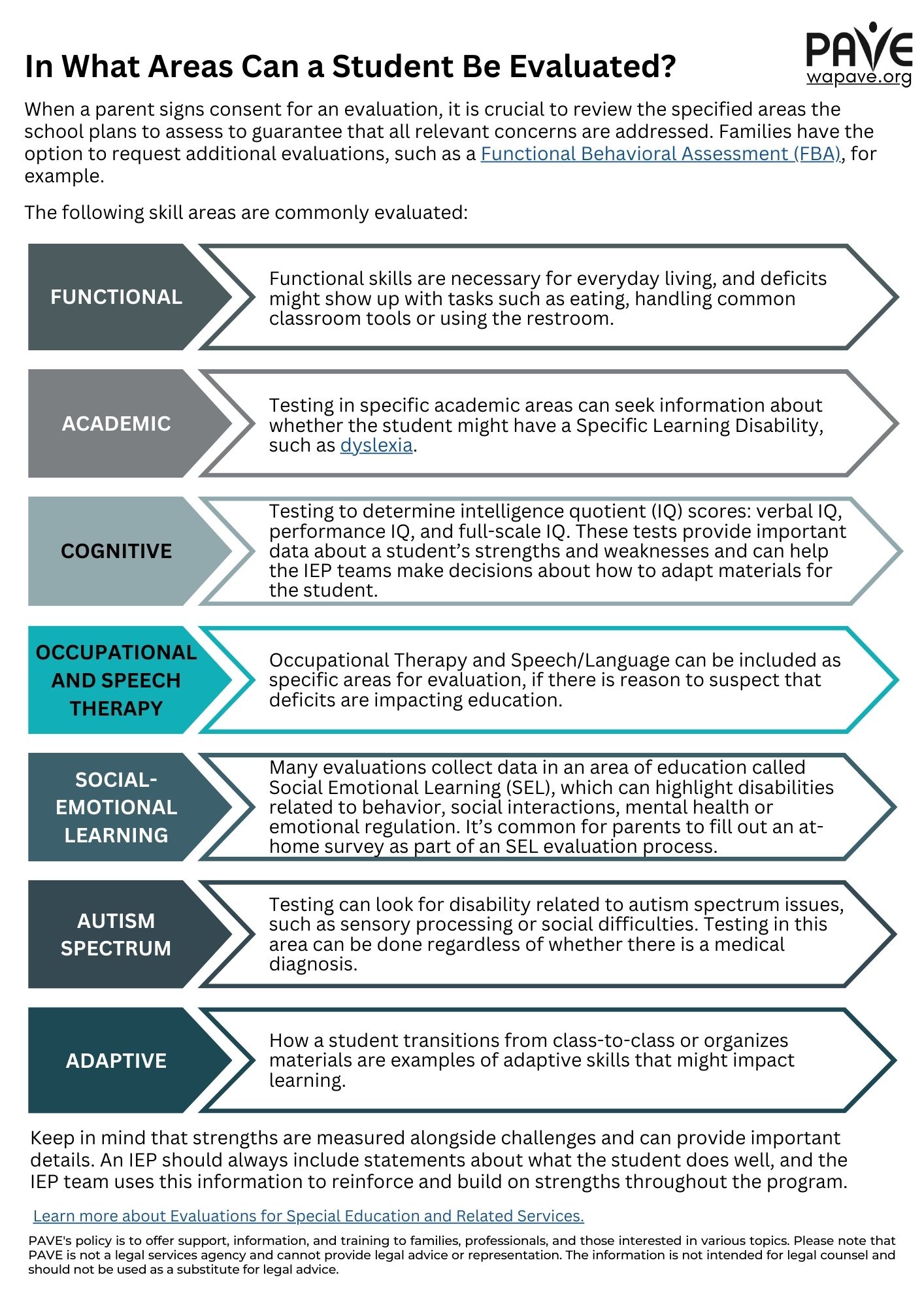
Areas of evaluation

Download In What Areas Can a Student Be Evaluated?:
English | Chinese (Simplified) 中文 (Zhōngwén) | Korean 한국어 (Hangugeo) | Russian Русский (Russkiy) | Somali Soomaali | Spanish Español | Tagalog | Ukrainian українська | Vietnamese Tiếng Việt

Eligibility Categories for Special Education

Once a student’s evaluation confirms a disability that impacts learning, the next step is to determine whether the disability fits one of 14 federally recognized categories. These categories are outlined in Washington’s Administrative Code (WAC 392-172A-01035):

  • Autism
  • Emotional Disturbance
  • Multiple Disabilities
  • Specific Learning Disability
  • Visual Impairment / Blindness
  • Deaf-Blindness
  • Hearing Impairment
  • Orthopedic Impairment
  • Speech/Language Impairment
  • Developmental Delay (ages 0-8)
  • Deafness
  • Intellectual Disability
  • Other Health Impairment
  • Traumatic Brain Injury

These categories are intentionally broad to reflect the diverse ways disabilities can affect learning. The IEP team may discuss which category best fits the student’s unique situation. While a medical diagnosis can help inform the process, eligibility is determined by how the disability impacts the student’s education. This impact can be assessed with or without a formal diagnosis.

There is no such thing as a “behavior IEP” or an “academic IEP.” Once a student qualifies, the school is responsible for addressing all identified areas of need. The IEP is personalized to include programming, services, and placement designed to support the whole child.

In Washington State, children through age 9 may be eligible for services under the category of Developmental Delay. Full definitions for each category are available in WAC 392-172A-01035 and are also reproduced in this PAVE article: Washington Special Education Categories.

Timeline of Evaluation and Development of an IEP

The school follows specific deadlines for an evaluation process. They have 25 school days to respond to the referral in writing. If they proceed with the evaluation they have 35 schools days to complete the assessment. For an eligible student, an IEP must be developed within 30 calendar days.

Track your student’s progress from the point of referral for evaluation to the development of the IEP with the infographic below.
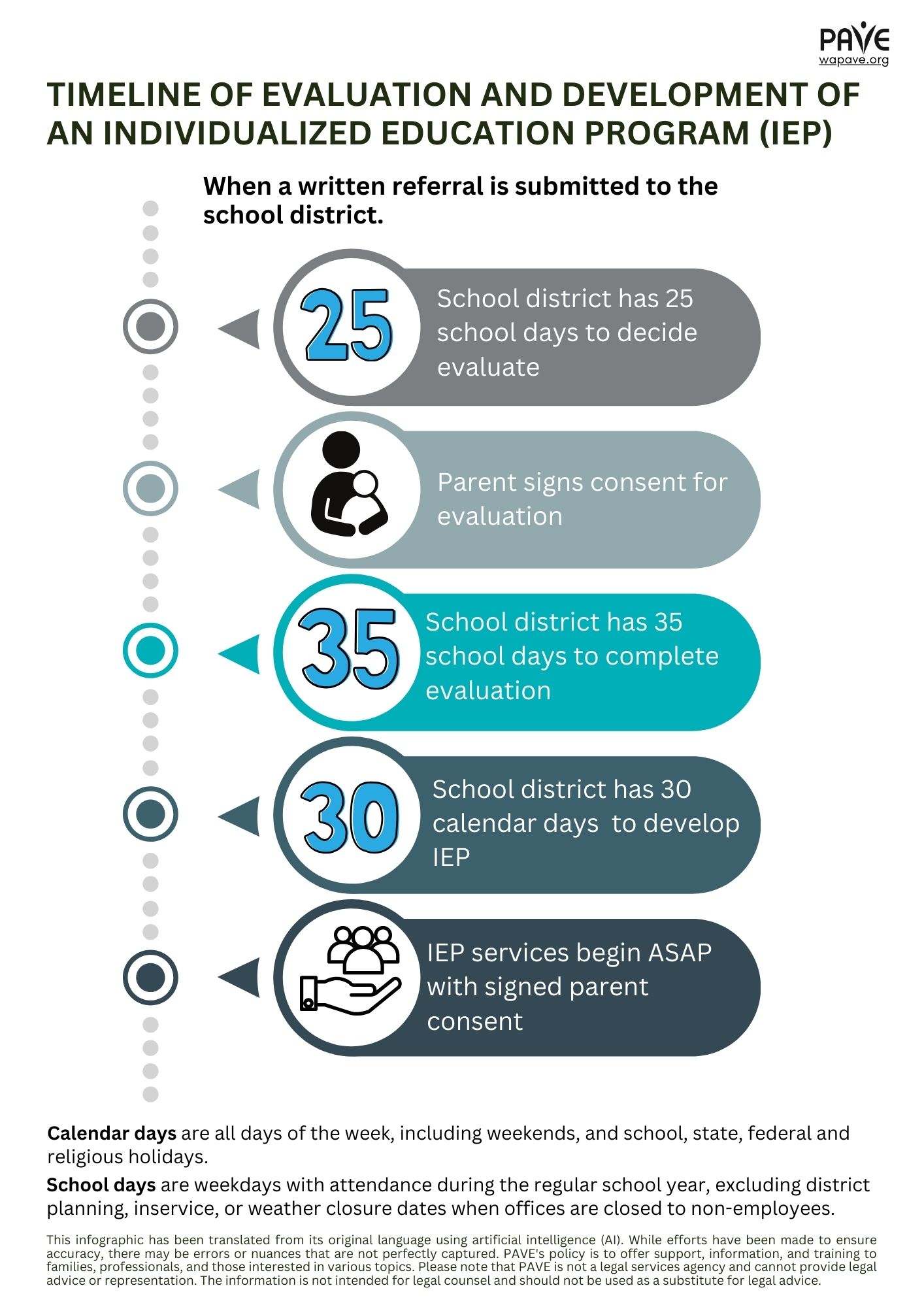
Timeline of Evaluation and development of an individualized education program (IEP)

Download the Timeline of Evaluation and Development of an IEP:
English | Chinese (Simplified) 中文 (Zhōngwén) | Korean 한국어 (Hangugeo) | Russian Русский (Russkiy) | Somali Soomaali | Spanish Español | Tagalog | Ukrainian українська | Vietnamese Tiếng Việt

Sample Letter to Request an Evaluation

Washington law requires that referrals for special education evaluation be made in writing. If a verbal request was previously denied, start again with a formal written letter sent by email, certified mail, or delivered in person.

OSPI provides a downloadable referral form on its Making a Referral for Special Education page. The person making the referral can use this form or any other written format that clearly communicates the request to evaluate.

Address the referral to the district special education director or program coordinator, and include an administrator at the student’s school. Be sure to include the student’s full name and birthdate, a clear statement requesting evaluation in all areas of suspected disability, and specific concerns. Supporting documents or letters from doctors, therapists or other providers may be attached. Include complete contact information and a statement that the parent or guardian is prepared to sign consent for the evaluation to begin.

Download the Sample Letter to Request an Evaluation:
English | Chinese (Simplified) 中文 (Zhōngwén) | Korean 한국어 (Hangugeo) | Russian Русский (Russkiy) | Somali Soomaali | Spanish Español | Tagalog | Ukrainian українська | Vietnamese Tiếng Việt

Options When Families and Schools Disagree

Families can ask school staff to explain their decisions in writing. If a parent or guardian disagrees with something the school decides, they have rights to informal and formal dispute resolution options that are protected by the IDEA. Schools must provide a document called procedural safeguards, which outlines these options and explains the rights of both students and families. PAVE continues this topic in an article: Evaluations Part 2: Next Steps if the School Says ‘No.’

Eligibility for Section 504 Protections

Section 504 of the Rehabilitation Act of 1973 is a federal civil rights law that helps protect students with disabilities from discrimination in schools that receive federal funding. It applies to individuals whose disabilities significantly affect major life activities—such as learning, breathing, walking, or concentrating. Because the law is broadly written, it can apply to a wide range of conditions and circumstances.

Students who receive services through an IEP also benefit from protections under Section 504, which are built into the IEP process. In some cases, students who don’t qualify for an IEP may still be eligible for support through a Section 504 Plan.

Protections against bullying and discriminatory discipline are aspects of Section 504. PAVE provides articles about Bullying at School: Resources and the Rights of Students with Special needs and What Parents Need to Know when Disability Impacts Behavior and Discipline at School.

Learn More

PAVE provides downloadable toolkits ready for you, including Where to Begin When a Student Needs Help. For the full list of toolkits, type “toolkit” in the search bar at the top of this page.

Click on Get Support at the top of this page to submit a Support Request and receive individually tailored support, training, information, and resources.

Evaluations Part 2: Next Steps if the School Says ‘No’

Families may feel uncertain or discouraged when a school denies a request for special education evaluation or finds a student ineligible for services. Fortunately, there are steps families can take to respond, seek clarification, and continue advocating for their child’s needs. Understanding available options and protections can help families take informed action and make decisions that support their child’s access to appropriate educational services.

A Brief Overview

  • If the school denies a request for a special education evaluation or does an evaluation and determines a student is ineligible for services, families have options.
  • Schools must issue a Prior Written Notice (PWN) explaining their decision to evaluate or deny a request.
  • Students who do not qualify for an IEP may still be eligible for a Section 504 Plan.
  • Procedural Safeguards provide a specific process for special education and offer families the right to file formal complaints when they disagree with school decisions.
  • When there is a dispute about a district’s evaluation, one option is to request an Independent Educational Evaluation (IEE) from a provider outside of the school district. This article includes a downloadable sample letter in multiple languages to help with that process.
  • PAVE supports students and families navigating educational services. Click Get Support at wapave.org to request 1:1 support.

Introduction

Parents have a variety of choices if the school denies a request to evaluate a student for special education, or if the school does an evaluation and finds the student ineligible for services through an Individualized Education Program (IEP). These decisions can feel discouraging, but they do not mark the end of the road. Under the Individuals with Disabilities Education Act (IDEA) and its implementation through Washington Administrative Code (WAC 392-172A), families have the right to challenge decisions, seek clarification, and request further evaluation. Understanding these options can help families take informed next steps and ensure that their concerns are heard and addressed.

Ask for the Decision in Writing

The school is required to respond through a formal letter, called Prior Written Notice (PWN), to explain its rationale for moving forward with an evaluation or denying the request. If the explanation is unclear or lacks detail, families can ask for a more complete written response. Schools may not deny an evaluation based on internal resource limitations or staffing challenges. According to the Child Find Mandate of IDEA, schools are obligated to evaluate any student with a known or suspected disability, regardless of whether other classroom supports are being used. For example, schools may implement approaches like Response to Intervention (RTI) to support learning, but these methods cannot be used to postpone or deny assessment when a disability is suspected.

Request a Meeting

Discussing a student’s difficulties in a meeting, in-person or virtually, can help school staff understand a parent’s level of concern. A district representative, such as a director of special education, can provide insight about the process and additional options. Parents can invite anyone they would like to attend who has knowledge of the student, including a support person to take notes and help track the conversation.

Is a Section 504 Plan Appropriate?

If a student has a known disability, with some educational impacts, but there is no documented need for Specially Designed Instruction (SDI) and/or related services, the student might qualify for accommodations provided through a Section 504 Plan.

Section 504, which is part of the Rehabilitation Act of 1973, defines disability as an impairment that impacts a major life activity. A formal evaluation is helpful but not required, and parent involvement is best practice. The team asks:

  1. Does the student have a disability?
  2. Does the disability limit one or more major life activities?

If the answer to these two questions is yes, the school can develop a plan to support the student within the general education setting. Assistive technology and modifications to the curriculum can be part of the plan, which includes individualized accommodations to ensure the student is able to access school in ways that are equitable. PAVE provides an article with more information about Section 504.

Options When Resolution Requires More Support

Families are protected by Procedural Safeguards, which outline a specific processes for resolving disagreements in special education. When informal conversations don’t lead to resolution, options such as mediation, community complaint, and due process may be appropriate. PAVE’s article, When Parents and Schools Disagree: Navigating Special Education Disputes, offers clear guidance on these pathways and what to expect. 

If a school denies a request for a specific evaluation, such as a Functional Behavioral Assessment (FBA) or an assistive technology evaluation, families can still pursue dispute resolution options. These types of assessments may be essential for understanding a student’s behavioral needs or identifying tools that support access to learning. Requests for these evaluations are protected under the same legal framework as other special education decisions, specifically the procedural safeguards.

The Office of Superintendent of Public Instruction (OSPI) provides assistance to navigate these processes through a Special Education Parent Liaison, and families may also seek help from the Governor’s Office of the Education Ombuds for collaborative problem-solving. For personalized assistance, PAVE supports students with disabilities and their families. Click Get Support at wapave.org to request 1:1 support.

Request an Independent Education Evaluation (IEE)

Families who disagree with a school district’s evaluation results have the right to request an Independent Educational Evaluation (IEE) conducted by a qualified professional outside the district. An IEE can offer additional information that may support the need for Specially Designed Instruction (SDI) and/or related services.

If the school district denies a request for an IEE at public expense, the district must initiate a due process hearing within 15 calendar days to show that its evaluation was appropriate.

When an IEE request is accepted, the school district provides a list of independent evaluators. Parents have discretion to call each one or to seek an alternative evaluator at their own expense before choosing who will evaluate the student. The school must consider the results of the IEE when deciding whether the student qualifies for special education programming.

Sample Letter to Request an IEE

Download the Sample Letter to Request a Functional Behavioral Assessment (FBA) in:
English | Chinese (Simplified) 中文 (Zhōngwén) | Korean 한국어 (Hangugeo) | Russian Русский (Russkiy) | Somali Soomaali | Spanish Español | Tagalog | Ukrainian українська | Vietnamese Tiếng Việt

Families can email the IEE request letter, send it by certified mail (and keep the receipt), or hand carry it to the district office and request a date/time receipt. It is important to keep a copy of this letter and all school-related correspondence in the student’s home records. Organizing with a binder or a filing system helps with keeping track of all letters, meetings, conversations, etc. These documents will be important for student throughout their educational career and beyond, including when they transition out of school.

Final Thoughts

When a school says “no,” it can feel like a door has closed—but that moment can also mark the beginning of a more empowered path forward. Each action a family takes is a meaningful expression of care and commitment. Family caregivers should trust their instincts, lean on trusted resources, and reach out for support. Persistence paired with informed choices can lead to real change and this journey is about more than advocacy—it’s about championing a child’s right to thrive.

Learn More

PAVE Provides Sample Letters to Support Families in their Advocacy

PAVE offers a collection of downloadable sample letters, available in multiple languages, to help families advocate for their children’s educational needs. These letters support clear and effective communication between families and schools, making it easier to request evaluations, meetings, or behavioral support. Whether you’re just getting started or need help with a specific concern, these tools can guide your next steps.

What is an Advocate?

An advocate is someone who works toward a cause or goal. While professional advocates may be trained to support others, family caregivers often become advocates themselves when they speak up for a child’s needs. Sometimes the hardest part of advocacy is figuring out what to do next. When a child has unmet needs at school, students and family advocates can request evaluations, meetings, or behavioral assessments to help improve services. Putting these requests in writing helps formalize the process and ensures that everyone involved is accountable.

PAVE helps families get started with a collection of sample letters, available for download in multiple languages. We’ve bundled links to those letter templates here for easy reference. Each link takes you to a short article with key information to help you understand the process of special education and how your customized letter can move you forward in that process.

Always Keep Your “Why” in Mind

Why are you taking action? Because you want something to improve for your child! PAVE’s short video, Quick Start Your Advocacy in Two Steps, might help you get ready to craft a letter. The video helps you ask two key questions:

  • What do you want?
  • Who has the power to work with you and make that happen?

As you write your letter, keep those questions and your “why” top of mind.

Request an Evaluation

Sample Letter to Request Evaluation: Schools are required to evaluate students to determine eligibility for a Section 504 Plan or an Individualized Education Plan (IEP). A referral can come from anyone with knowledge of the student and must be in writing. This article provides a sample letter and a link to an alternative form provided by the Office of Superintendent of Public Instruction (OSPI).

Download the Sample Letter to Request an Evaluation in:
English | Chinese (Simplified) 中文 (Zhōngwén) | Korean 한국어 (Hangugeo) | Russian Русский (Russkiy) | Somali Soomaali | Spanish Español | Tagalog | Ukrainian українська | Vietnamese Tiếng Việt

Request an IEP Meeting

Sample Letter to Request an IEP Meeting: Family members can request an IEP team meeting anytime there are concerns about how the IEP is being implemented and whether a student may have unmet needs. This article includes information about who is required to attend an IEP meeting and the rights of parents to participate in educational decision making.

Download the Sample Letter to Request an IEP Meeting in:
English | Chinese (Simplified) 中文 (Zhōngwén) | Korean 한국어 (Hangugeo) | Russian Русский (Russkiy) | Somali Soomaali | Spanish Español | Tagalog | Vietnamese Tiếng Việt

Request a Functional Behavioral Assessment

Sample Letter to Request a Functional Behavioral Assessment: If a child’s behavior is getting in the way of their education, the school is responsible to assess the problematic behaviors and develop a support plan to teach the student what to do instead. In addition to a sample letter, this article provides a link to a video to help families and schools work together through this process.

Download the Sample Letter to Request a Functional Behavioral Evaluation in:
English | Chinese (Simplified) 中文 (Zhōngwén) | Korean 한국어 (Hangugeo) | Russian Русский (Russkiy) | Somali Soomaali | Spanish Español | Tagalog | Ukrainian українська | Vietnamese Tiếng Việt

Request an Independent Educational Evaluation (IEE)

Evaluations Part 2: Next Steps if the School Says ‘No’: If the school evaluates a student and says they aren’t eligible for an IEP or a specific area of service, parents have steps they can take if they disagree. One option is to request an Independent Educational Evaluation (IEE) from an outside provider. This article provides a sample letter for requesting an IEE at school district expense. If the family requests an IEE because they disagree with the school’s evaluation or its conclusions, then the district must pay for the IEE or deny the request through Due Process: IEE denials are evaluated by an Administrative Law Judge.

Download the Sample Letter to Request an Independent Educational Evaluation (IEE) in:
English | Chinese (Simplified) 中文 (Zhōngwén) | Korean 한국어 (Hangugeo) | Russian Русский (Russkiy) | Somali Soomaali | Spanish Español | Tagalog | Ukrainian українська | Vietnamese Tiếng Việt

Final Thoughts

Families who want individualized assistance can reach out to PAVE by completing the Get Support  form. Check out the PAVE Calendar for upcoming trainings and events.

Sample Letter to Request Evaluation

Anyone with knowledge of a student may request a special education evaluation, and Washington State law requires that referrals be made in writing. Schools must respond within specific timelines and provide language access and support throughout the process. Families have the right to participate in all decisions and may dispute outcomes if they disagree. Special education is a service designed to meet individual needs, not a predetermined placement.

A Brief Overview

  • Washington State requires special education referrals to be in writing (WAC 392-172A-03005). Schools must assist individuals who cannot write.
  • Anyone with knowledge of a student can write a referral.
  • The state provides a Referral for Special Education Evaluation form for making a special education referral, available for download in multiple languages from the Office of Superintendent of Public Instruction (OSPI) website. The form is not required—any written request is valid.
  • Another option is to write a referral using the sample letter at the end of this article.
  • Schools are responsible to provide families with a referral form in their native language and to provide qualified interpreters so families can participate in all meetings to discuss their student’s special education eligibility and services.
  • Schools must respond to a referral within 25 school days and provide a Prior Written Notice (PWN) explaining their decision.
  • If the school agrees to evaluate, parent consent is required before the process begins. The evaluation must be completed within 35 school days, and an IEP developed within 30 calendar days if the student qualifies.
  • If a student is found ineligible for an IEP or the school refuses to evaluate, families may dispute the decision using procedural safeguards, request an Independent Educational Evaluation (IEE), or pursue evaluation for a Section 504 Plan.

Introduction

When a student is struggling in school and there is reason to suspect the challenges are disability related, anyone can refer the student for an educational evaluation. If the evaluation shows that the student is eligible, services are provided through an Individualized Education Program (IEP). Washington State requires special education referrals to be in writing, as specified in Washington Administrative Code (WAC 392-172A-03005).

What Schools Must Do After a Referral

If someone who knows the student asks for an evaluation, the school is responsible for:

  • Documenting the request
  • Recording the date the referral was made
  • Providing a referral form in the person’s native language
  • Responding to the request within 25 school days

If the person asking for the evaluation cannot write, the school is responsible for supporting them to complete the referral.

The school must provide a referral form in the native language of the person making the request. Schools are required to provide qualified interpreters to support parent participation in the referral process and for all meetings where a student’s eligibility and/or educational services are discussed. The Office of Superintendent of Public Instruction (OSPI) provides Parent Rights Information Sheets, downloadable in many languages on the Interpretation and Translation Services webpage.

Evaluation Process and Timelines

When a student is referred for a special education evaluation, the school has 25 school days to decide if they will do the evaluation. These are days when students are actually in school. The school must tell the family their decision in writing. This letter is called a Prior Written Notice (PWN), and it follows rules from WAC 392-172A-05010.

Usually, the school and family meet to talk about the referral and how the student is doing. If everyone agrees to move forward, the parents or caregivers sign a form giving permission for the evaluation to begin. Families can ask questions about what the evaluation will include. The school will look at all areas where the student might need help. This helps them understand the student’s strengths and challenges. If the student qualifies for special education, the results will help create a plan called an Individualized Education Program (IEP).

If the school decides not to evaluate and the family disagrees, the family has the right to take steps to solve the disagreement. These steps are explained in the procedural safeguards.

When the school agrees to evaluate the student, staff must promptly seek parent consent to begin the evaluation process (WAC 392-172A-03005).

Generally, parents sign a form that lists what the school will include in its evaluation. Parents can ask for additional areas to be evaluated to make sure the school gets data for all areas of concern. Families can ask for more information about what the evaluation will look like, where it will take place, how long it will take, and who will participate. The school and family can creatively plan the evaluation process if accommodations are needed. For example, if a student isn’t able to attend in-person school, the evaluation can be done in alternative locations.

After a parent signs consent, the school has 35 school days to finish the evaluation and meet with the family to talk about the results. The deadline may be extended if the family agrees, particularly to accommodate needs of the family or student.

The 35-day deadline does not apply if the student is unavailable for the evaluation or enrolls in another school district before the evaluation is finished (WAC 392-172A-03005).

For students found eligible for services, the school develops an IEP within 30 calendar days and requests parent consent for services to begin. The school and family meet to review a DRAFT version of the IEP and write a final version together before consent is signed. School staff provide a Prior Written Notice (PWN) with a summary of the meeting, agreements, and timelines before services start. PWN requirements are described in WAC 392-172A-05010.

How to Refer a Student for Evaluation for Special Education

The Office of Superintendent of Public Instruction (OSPI) is the guidance agency for Washington State. OSPI provides a Referral for Special Education Evaluation form, downloadable in multiple languages from a website page titled, Model Forms for Services to Students in Special Education. Families may use OSPI’s form, a form provided by their school, or their own choice of format to write their request for a student to be evaluated.

Further explanation of the referral and evaluation process is provided on the OSPI website page, Making a Referral for Special Education.

A non-discriminatory evaluation is part of the protections for a student with a known or suspected disability that may significantly impact their access to education (Child Find Mandate). Child Find protections are part of the federal Individuals with Disabilities Education Act (IDEA). Child Find applies whether there are academic and/or non-academic school impacts.

PAVE provides more detail about IEP eligibility and evaluation process: Evaluations Part 1: Where to Start When a Student Needs Special Help at School.

Sample Letter to Request an Evaluation

Below is a sample letter to write a request for a special education evaluation. You can copy and paste the text of this sample letter into your word processor to build your own letter.

Download the Sample Letter to Request an Evaluation in:
English | Chinese (Simplified) 中文 (Zhōngwén) | Korean 한국어 (Hangugeo) | Russian Русский (Russkiy) | Somali Soomaali | Spanish Español | Tagalog | Ukrainian українська | Vietnamese Tiếng Việt

The state provides an alternative form, downloadable from OSPI’s website page titled, Making a Referral for Special Education. Your school district is responsible to provide a form, in your language, for you to submit your written request. These formats are your choice—any written request is valid. If you cannot write, you can ask for an evaluation by telling the school and they can write the request with you.

Submit your written request through email, by mail, or by hand delivery, to the special education/special services manager at your school’s district office. You may submit additional copies to school administrators and/or a school psychologist—the person who manages evaluations for your school. Be sure to keep copies of all of your communications with the school in an organized, safe place.

Special Education is a Service, Not a Location

A request for a special education evaluation is NOT a recommendation to remove a student from the regular classroom and move them into an exclusive learning environment. Federal and state laws require that students receive education and services in the Least Restrictive Environment (LRE) to the maximum extent possible to meet their needs. Special Education is a service, while LRE refers to placement. You can read more about this in the PAVE article, Special Education is a Service, Not a Place. Decisions about placement are made by the IEP team, which includes the family. The IEP team is responsible to consider the child’s circumstances and capacities as its top priority—not pre-built programs or district resources. The PAVE article, Parent Participation in Special Education Process is a Priority Under Federal Law, provides detail about parent participation in special education process.

Parents Can Appeal Decisions and/or Seek a 504 Plan

If a student is evaluated and found not eligible for an IEP (or if the school refuses to do an evaluation), the family has the right to dispute the decision using Procedural Safeguards.

If they disagree with the district’s evaluation or its findings, the family may seek an Independent Educational Evaluation (IEE), which is done by an agency outside of the school district. The district must pay for an IEE or deny the request using Due Process. See PAVE’s article: Evaluations Part 2: Next Steps if the School Says ‘No’ to Your RequestThe article includes a sample letter to request an IEE.

Another option if a student doesn’t get an IEP is to develop a Section 504 Plan, which accommodates a person with a disability that impacts a major life activity (learning, walking, speaking, writing, socializing…). Section 504 is part of the Rehabilitation Act of 1973, which protects the civil rights of individuals with disabilities against discrimination throughout their lives. See PAVE’s article about Section 504 rights, which also protect students who qualify for an IEP: Section 504: A Plan for Equity, Access and Accommodations.

Final Thoughts

Requesting a special education evaluation is a straightforward process that begins with a written referral. By following the required steps and understanding your rights, you can help ensure your student receives the support they need. Whether you use a formal form or write your own letter, the request must be clear and submitted in writing. This step initiates the evaluation process and ensures the school is legally obligated to respond.

Learn More

Early Intervention: How to Access Services for Children Birth to 3 in Washington

New parents often worry about their child’s growth and development, especially when comparing with other children. Early intervention can be crucial for children with developmental delays or disabilities. In Washington, families can connect with a Family Resource Coordinator (FRC) for guidance and access free developmental screenings. The Department of Children, Youth and Families (DCYF) offers services through Early Support for Infants and Toddlers (ESIT), providing evaluations and individualized plans (IFSP) to support eligible children from birth to age three. These services, protected under the Individuals with Disabilities Education Act (IDEA), are typically free and aim to help children thrive in various settings. 

A Brief Overview

  • PAVE provides downloadable toolkits specifically designed for parents and families of young children, including From Birth to Three Toolkit and Transition Toolkit for Ages 3-5
  • Families concerned about a child’s development can call the Family Health Hotline at 1-800-322-2588, with support in multiple languages. Parents can complete a free developmental screening online at Parent Help 123. 
  • Washington’s Department of Children, Youth and Families (DCYF) administers family-focused services for eligible children from birth to age 3 through Early Support for Infants and Toddlers (ESIT). 
  • The Individualized Family Service Plan (IFSP), funded by Part C of the Individuals with Disabilities Education Act, is a whole family plan developed with input from caregivers and professionals. It includes goals, services, and progress monitoring, and is reviewed regularly. 
  • To qualify, a parent must provide written permission for ESIT to conduct an early intervention evaluation of their child. If the evaluation results indicate that the child has a developmental delay or disability, ESIT will develop an IFSP. PAVE provides a Next Steps Checklist: When Your Child is Found Eligible for Early Intervention Services (EIS)
  • Early intervention services (EIS) are designed to meet the child’s individual needs, including various therapies and support services. Services are typically provided in the child’s home or other natural environments. 
  • Various dispute resolution options are available, including mediation and due process. Parents can contact their ESIT Family Resource Coordinator (FRC) if they have concerns or disagreements. 
  • Most early intervention services are provided at no cost to families. Some services may be billed to insurance with family consent, but certain services are always free under IDEA. 
  • Active-duty servicemembers whose dependents receive EIS must enroll in the Exceptional Family Member Program (EFMP) for their branch, or the Coast Guard’s Special Needs Program (SNP).  

Introduction 

New parents may struggle to know whether their child’s growth and development are on track. They may have a feeling that a milestone is missed, or they may observe siblings or other children learning and developing differently. Sometimes a parent just needs reassurance. Other times, a child has a developmental delay or a disability. In those cases, early interventions can be critical to a child’s lifelong learning. 

Seek guidance from a Family Resource Coordinator (FRC) 

Washington families concerned about a young child’s development can call the Family Health Hotline at 1-800-322-2588 (TTY 1.800.833.6384) to connect with a Family Resource Coordinator (FRC). Support is provided in English, Spanish and other languages. Families can access developmental screening online for free at HelpMeGrow Washington

Several state agencies collaborated to publish Early Learning and Development Guidelines. The booklet includes information about what children can do and learn at different stages of development, focused on birth through third grade. Families can purchase a hard copy of the guidelines from the State Department of Enterprise Services. A free downloadable version is available in English, Spanish, and Somali from DCYF’s Publication Library. Search by title: Washington State Early Learning and Development Guidelines, or publication number: EL_0015. 

Washington early intervention services are provided by ESIT 

In Washington, the Department of Children, Youth and Families (DCYF) administers services for eligible children from birth to age 3 through Early Support for Infants and Toddlers (ESIT). Families can contact ESIT directly, or they can reach out to their local school district to request an evaluation to determine eligibility and consider what support a child might need. The ESIT website includes videos to guide family caregivers and a collection of Parent Rights and Leadership resources, with multiple language options. 

Early intervention services (EIS) are provided in the child’s “natural environment,” which includes home and community settings where children would be participating if they did not have a disability. According to ESIT, “Early intervention services are designed to enable children birth to 3 with developmental delays or disabilities to be active and successful during the early childhood years and in the future in a variety of settings—in their homes, in childcare, in preschool or school programs, and in their communities.” 

Early services are delivered through an IFSP 

Children who qualify receive services through an Individualized Family Service Plan (IFSP). The right to an IFSP is protected by Part C of the Individuals with Disabilities Education Act (IDEA). The IDEA is a federal grant program that provides funding for states to implement early learning and special education programs. Part B of the IDEA protects an eligible school-age student’s right to an Individualized Education Program (IEP). Part A includes general guidance about the educational rights of children 0-22. 

Family caregivers, childcare professionals, teachers, or anyone else can refer a child for an early learning evaluation if there is reason to suspect that a disability or developmental delay may be impacting the child’s growth and progress. The school district’s duty to seek out, evaluate and potentially serve infants, toddlers or school-aged students with known or suspected disabilities is guaranteed through the IDEA’s Child Find Mandate

First Step: Evaluate to determine eligibility 

Early intervention is intended for infants and toddlers who have a developmental delay or disability. Eligibility is determined by evaluating the child (with parental consent) to see if the little one does, in fact, have a delay in development or a disability. Eligible children can receive early intervention services from birth to the third birthday. PAVE provides an article that describes What Happens During an Early Intervention Evaluation, and a checklist for When Your Child is Found Eligible for Early Intervention Services (EIS)

Next Step: Develop a service plan 

If an infant or toddler is eligible, early intervention services are designed to meet the child’s individual needs. Options might include, but are not limited to:   

  • Assistive technology (devices a child might need) 
  • Audiology or hearing services 
  • Speech and language services 
  • Counseling and training for a family 
  • Medical services 
  • Nursing services 
  • Nutrition services 
  • Occupational therapy 
  • Physical therapy 
  • Psychological services 

Services are typically provided in the child’s home or other natural environment, such as daycare. They also can be offered in a medical hospital, a clinic, a school, or another community space.  

Individualized Family Service Plan (IFSP): What is the plan? 

The IFSP is a whole family plan, with the child’s primary caregivers as major contributors to its development and implementation. Parents/custodial caregivers must provide written consent for services to begin. In Washington, Family Resource Coordinators (FRCs) help write the IFSP. Team members may include medical professionals, therapists, child development specialists, social workers, and others with knowledge of the child and recommendations to contribute.  

The IFSP includes goals, and progress is monitored to determine whether the plan is supporting appropriate outcomes. The plan is reviewed every six months and is updated at least once a year but can be reviewed at any time by request of parents or other team members. The IFSP includes: 

  • The child’s current developmental levels and needs in physical, cognitive, communication, social/emotional, and adaptive areas 
  • Family information: resources, priorities, and concerns of parents/caregivers. 
  • Major results/outcomes expected from the child and family 
  • Specific services: 
  • Where services are provided—any services provided outside the child’s “natural environment” of home/daycare/community require a statement explaining the rationale for the placement 
  • When the child receives services—the number of days or sessions for each service, and how long each session will last 
  • Who pays for the services 
  • Name and contact information for the Family Resource coordinator (FRC) responsible for IFSP implementation 
  • Steps to begin at age 2.5 to support the child’s transition out of early intervention and perhaps into school-based services. 
  • If relevant, additional services or information for the family—such as financial guidance or parenting support 

PAVE provides a downloadable checklist to help parents familiarize themselves with the IFSP.  

Dispute resolution options are available 

If parents have a concern or disagree with any part of the early intervention process, they can contact their Family Resource Coordinator (FRC). If issues remain unresolved, families may choose from a range of dispute resolution options that include mediation, due process, and more. ESIT provides access to a downloadable parent rights brochure with information about dispute resolution options in multiple languages. 

Most services are free to families 

Washington State provides most early intervention services at no cost to families of eligible children. Some services covered by insurance are billed to a child’s health insurance provider, with the signed consent of a family caregiver. The early intervention system may not use health care insurance (private or public) without express, written consent. 

Part C of the IDEA requires states to provide the following services at no cost to families: Child Find (outreach and evaluation), assessments, IFSP development and review, and service coordination. 

Early intervention services for military families 

Military-connected infants and toddlers receiving early intervention services must be enrolled in the Exceptional Family Member Program (EFMP) while their servicemember is on active-duty orders. The Exceptional Family Member Program (EFMP) is a mandatory program for all branches of the U.S. Armed Forces that helps military dependents with special medical or educational needs. The Army, Navy, Air Force, Marine Corps, and Space Force each have an EFMP and the Coast Guard, which operates under the authority of the Department of Homeland Security, has a similar program called the Special Needs Program (SNP). 

The Early Childhood Technical Assistance Center (ECTA), funded by the U.S. Department of Education’s Office of Special Education (OSEP), builds state and local capacity to improve outcomes for young children with disabilities and their families. Military-connected families and others relocating or living outside of Washington State can contact the early intervention services program in their new state with the help of ECTA’s Early Childhood Contacts by State directory

Military families moving from or to installations that have Department of Defense Education Activity (DoDEA) schools will receive their early intervention services from Educational and Developmental Intervention Services (EDIS). Referrals may come to EDIS from any military medical provider or the parents. Upon receipt of a referral to EDIS, an initial service coordinator is assigned to contact and assist the Family. The initial service coordinator gathers information to understand the family’s concern, shares information about early intervention, and makes arrangements to proceed with the process. In EDIS, any member of the early intervention team can serve as an initial service coordinator. EDIS is provided in locations where DoDEA is responsible for educational services, including some installations on the eastern side of the United States.  

Learn More 

PAVE provides downloadable toolkits specifically designed for parents and families of young children: 

  • From Birth to Three Toolkit: This toolkit provides places to begin if caregivers suspect that a baby or young child may need services due to a developmental delay or disability. 
  • Transition Toolkit for Ages 3-5: This toolkit encompasses a collection of our informative articles, complemented by sample letters to provide you with a solid foundation as you navigate through this crucial transition period. 

For additional information: 

  • The Learn the Signs. Act Early. website provides tools for tracking milestones and materials for families to learn more and plan home-based activities that promote skill development. “Early intervention services can change a child’s developmental path and improve outcomes for children, families, and communities,” the CDC encourages. “Help your child, help your family! Families benefit from early intervention by being able to better meet their children’s needs from an early age and throughout their lives.” 
  • Check the PAVE calendar for trainings and events, including the Starting Strong webinar about how IDEA supports the rights of infants and toddlers with developmental delays or disabilities and their families. 

Special Education Blueprint: The Six Principles of IDEA 

Navigating the education system can be challenging for students with special needs and their families. Fortunately, the Individuals with Disabilities Education Act (IDEA) provides a robust framework to ensure that eligible students receive the support they need. IDEA is a federal law built on six key principles that guarantee specific rights and protections. 

The six principles of IDEA are: 

1. Free Appropriate Public Education (FAPE) 

Students with disabilities have the right to a free and appropriate education (FAPE) tailored to their needs. This means they get special education services, accommodations, and modifications at no cost to their families. To better understand what FAPE entails, let’s break down its key components: 

  • Free: Education for children with disabilities is provided at no cost to parents, except for incidental fees like club memberships, which are the same as for general education students. 
  • Appropriate: Each child with a disability is entitled to an education tailored to their individual needs, including suitably challenging goals and supporting progress in the general education curriculum. Depending on the unique needs of the student, appropriate services may include transition services that continue through the school year in which the student turns 21 years of age. 
  • Public: Children with disabilities have the same right to attend public schools as their non-disabled peers. Public schools must accommodate their individual needs and help them plan for the future. 
  • Education: All children in the state between the ages of 5 and 18 are entitled to a public education. Eligible children with disabilities will receive a public education that includes special education and related services, preparing them for further education, employment, and independent living. 

2. Appropriate Evaluation 

IDEA requires schools to take a closer look at children with potential disabilities (Child Find Mandate). Before a student can receive special education services, an appropriate evaluation must be conducted. This comprehensive assessment is designed to identify the child’s specific educational needs. The evaluation must be free of bias, use multiple methods of assessment, and be conducted by a team of qualified professionals. Parents and guardians have the right to be involved in this process. The results provide information that the school and parents use to make decisions about how the child’s education can be improved. 

The school follows specific deadlines for an evaluation process. They have 25 school days to respond to the referral in writing. If they proceed with the evaluation, they have 35 school days to complete the assessment. 

3. Individualized Education Program (IEP) 

The IEP is a critical component of IDEA. The IEP is developed collaboratively by a team that includes the student, parent(s) or guardian(s), teachers, school administrators, and other specialists. The program is reviewed at least once a year. Every student on an IEP gets some extra help from teachers, but the rest of the program depends on what a student needs to learn. Areas of need may be academic, social and emotional skills, and/or general life skills.  

Washington State requires schools to start IEP services within 30 calendar days of the eligibility finding. That means school staff generally start drafting the IEP right after the school and family meet to talk about the evaluation and the student’s eligibility. A family member can ask to extend the 30-day deadline, but schools cannot delay the process without parental consent. 

4. Least Restrictive Environment (LRE) 

IDEA emphasizes that children should be educated alongside their non-disabled peers “to the maximum extent appropriate.” This principle ensures that children with disabilities have access to the same educational opportunities as their peers. General education classrooms and school spaces are the least restrictive. If the school has provided extra help in the classroom but the special education student still struggles to access FAPE, then the IEP team considers other options. The school explains placement and LRE in writing on the IEP document.  

5. Parent and Student Participation 

The IDEA and state regulations about IEP team membership make it clear that parents or legal guardians are equal partners with school staff in making decisions about their student’s education. This includes participation in IEP meetings, access to educational records, and the ability to provide input on educational goals and services. As a child matures, they are also encouraged to participate in the decision-making process, promoting self-advocacy and independence.  When the student turns 18, educational decision-making is given to the student. The school does its best to bring parents and students into the meetings, and there are specific rules about how the school provides written records and meeting notices (WAC 392-172A-03100). 

6. Procedural Safeguards 

Procedural safeguards are designed to protect parent and student rights by ensuring that they receive a written explanation of their rights at the time of referral for special educational evaluation and every year after. When parents and schools disagree, these rights describe the actions a parent can take informally or formally. 

A copy of the procedural safeguards is downloadable in multiple languages from the Office of Superintendent of Public Instruction (OSPI), the guidance agency for Washington schools. Parents may receive procedural safeguards from the school any time they request them. They also may receive a copy if they file a complaint with the state. Procedural safeguards are offered when a school removes a student for more than 10 days in a school year through exclusionary discipline.  

Learn more about IDEA 

IDEA ensures that individuals with disabilities receive support and education throughout their lives, from early childhood through adulthood.  It drives how states design their own special education policies and procedures. In Washington State, rules for the provision of special education are in Chapter 392-172A of the Washington Administrative Code (WAC). 

PAVE provides training on a variety of topics, including IDEA. Trainings are live and on-demand, in person and online. Register for an upcoming training on the PAVE calendar

Additional Information: 

Starting School: When and How to Enroll a Student in School

A Brief Overview

  • Compulsory attendance begins at 8 years of age and continues until the age of 18 unless the student qualifies for certain exceptions.
  • Infants and toddlers receiving early intervention services may be eligible to start preschool as early as 3 years old to continue receiving specialized instruction and related services.
  • A student aged 4 years old by August 31 may be screened for Transition to Kindergarten (TK), a state program designed for students who need additional support to be successful in kindergarten the following year.
  • A child must have turned 5 years old by August 31 to enroll in kindergarten, and 6 years old to enroll in first grade.
  • When registering your student for school, contact the school to find out what documents are required in addition to those listed in this article.
  • Students with a condition that may require medication or treatment

Full Article

If your child has never enrolled in school, back to school season can be a confusing time. This article answers frequently asked questions about school entrance age, compulsory education, and the enrollment process.  Note that “enrollment” and “registration” are used interchangeably regarding the steps leading up to a student starting school and within the OSPI (Office of Superintendent of Public Instruction) website.

At what age are children required to attend school?

Federal law protects the rights of children and youth to receive a publicly funded education. This is called compulsory education, or compulsory attendance. The age at which a child must begin school varies by state. In Washington state, children must begin attending school full-time at the age of 8 and continue attending regularly until the age of 18 (RCW 28A.225.010).

There are some exceptions to compulsory attendance, including if a child is –

  • enrolled in a private school, extension program, or residential school operated by the Department of Social and Health Services (DSHS) or the Department of Children, Youth, and Families (DCYF).
  • enrolled in home-based instruction that meets State supervision requirements.
  • excused by the school district superintendent for physical or mental incapacity.
  • incarcerated in an adult correctional facility.
  • temporarily excused upon the request of the parents when the excused absences meet additional requirements under Washington state law (RCW 28A.225.010).

Compulsory attendance is required in Washington until the age of 18, unless the student is 16 years or older and meets additional criteria for emancipation, graduation, or certification (RCW 28A.225.010).

At what age can a student begin attending school?

Students with special needs or disabilities may qualify for early education programs. An infant or toddler with a disability or developmental delay receiving early intervention services may be eligible to start preschool between the ages of 3-5 to continue receiving specialized instruction and related services through the public school district until they reach the minimum enrollment age for kindergarten. Washington’s Transition to Kindergarten (TK) program screens 4-year-olds with a birthday by August 31st to identify those in need of additional preparation to be successful in kindergarten.

Parents may choose to enroll a child in kindergarten at 5 years old, if the birthday occurred before August 31st of the same year, but kindergarten is not required under compulsory education. Similarly, a child must be 6 years of age to enroll in first grade.

Families have the right to choose whether to enroll their students in school until the child turns 8 years old and compulsory attendance applies.

How do I enroll my student in school?

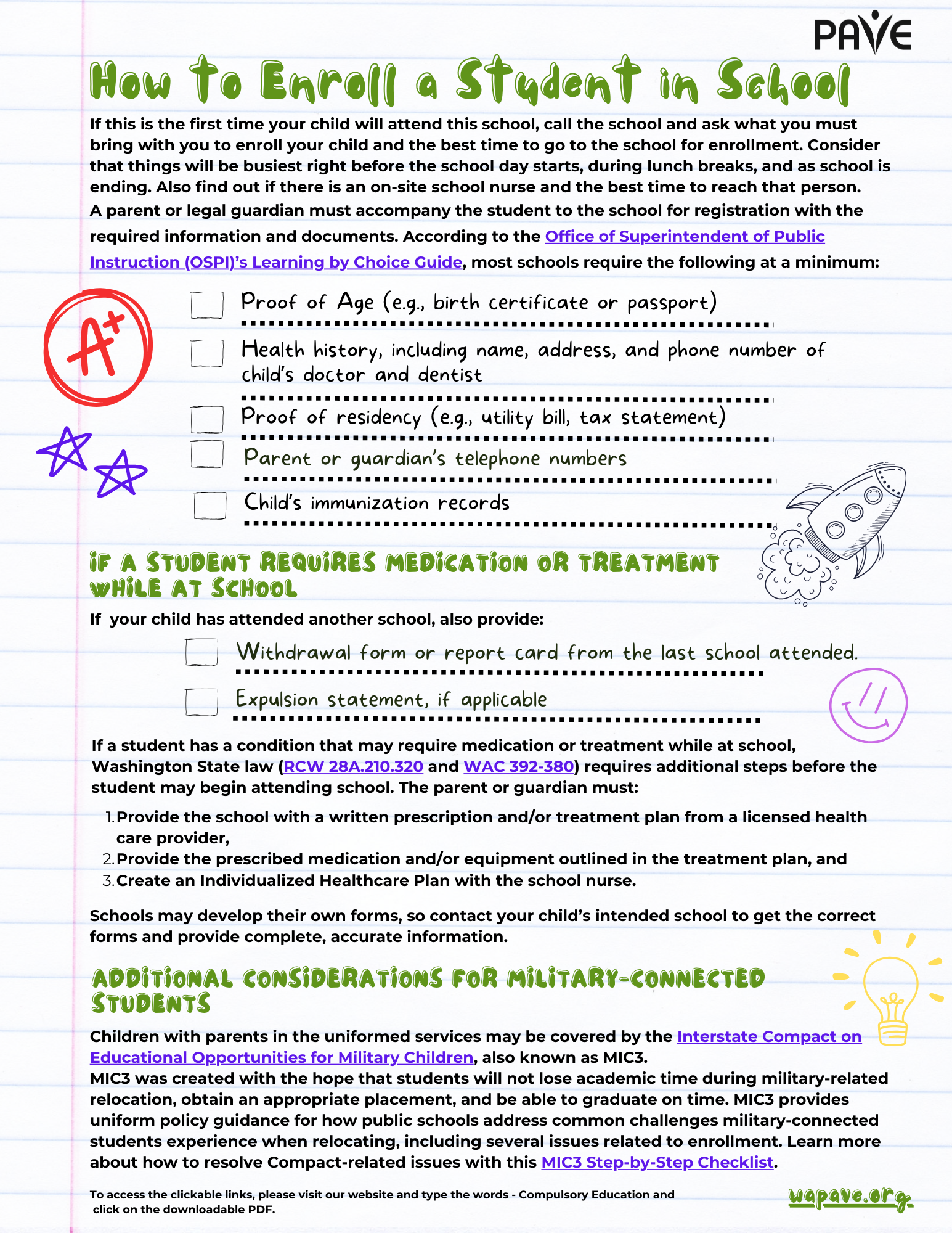
If this is the first time your child will attend this school, call the school and ask what you must bring with you to enroll your child and the best time to go to the school for enrollment. Consider that things will be busiest right before the school day starts, during lunch breaks, and as school is ending. Also find out if there is an on-site school nurse and the best time to reach that person.

A parent or legal guardian must go with the student to the school for registration with the required information and documents. According to the Office of Superintendent of Public Instruction (OSPI)’s Learning by Choice Guide, most schools require the following at a minimum:

  • Proof of age (e.g., birth certificate or passport).
  • Health history, including name, address, and phone number of child’s doctor and dentist.
  • Proof of residency (e.g., utility bill, tax statement).
  • Parent or guardian’s telephone numbers.
  • Child’s immunization records.

If your child has attended another school, also provide:

  • Withdrawal form or report card from the last school attended.
  • Expulsion statement.

Enrollment for Military-Connected Students

A Washington law passed in 2019 (HB 1210-S.SL, School Enrollment-Nonresident Children from Military Families) allows advance enrollment of children of active-duty service members with official military orders transferring or pending transfer into the state. This means that qualifying children must be conditionally enrolled in a specific school and program and registered for courses. The parent must provide proof of residence within fourteen days of the arrival date listed in the military orders before the school will finalize the enrollment. The address on the proof of residency may be a temporary on-base detailing facility; a purchased or leased residence, or a signed purchase and sale or lease agreement; or military housing, including privatized and off-base housing. The child will be conditionally enrolled and registered for courses.

Schools are responsible for the health and safety of students during all school-related activities. If a student has a condition that may require medication or treatment while at school, Washington state law (RCW 28A.210.320 and WAC 392-380) requires additional steps before the student may begin attending school. The parent or guardian must:

  1. Provide the school with a written prescription and/or treatment plan from a licensed health care provider,
  2. Provide the prescribed medication and/or equipment outlined in the treatment plan, and
  3. Create an Individualized Healthcare Plan with the school nurse.

Schools may develop their own forms, so contact your child’s intended school to get the correct forms and provide complete, accurate information.

Download How to Enroll a Student in School Handout

How to Enroll a Student in School Checklist To download the fillable form and get access to the clickable links, download the PDF

Additional Considerations for Military-Connected Students

Children with parents in the uniformed services may be covered by the Interstate Compact on Educational Opportunities for Military Children, also known as MIC3, was created with the hope that students will not lose academic time during military-related relocation, obtain an appropriate placement, and be able to graduate on time. MIC3 provides uniform policy guidance for how public schools address common challenges military-connected students experience when relocating, including several issues related to enrollment. Learn more about how to resolve Compact-related issues with this MIC3 Step-by-Step Checklist.

Families who are new to Washington can learn more about navigating special education and related services in this article, Help for Military Families: Tips to Navigate Special Education Process in Washington State.

Additional Information

Infant Early Childhood Mental Health

A Brief Overview

  • Infant and Early Childhood Mental Health (IECMH) is a term that describes how young children develop socially and emotionally. They learn about their emotions form close and secure relationships with their caregivers and family members. They learn and explore the environment – all in the context of family, community, and culture.
  • Families concerned about a child’s development can call the Family Health Hotline at 1-800-322-2588, with support in multiple languages. Parents can complete a developmental screening online for free at Parent Help 123.
  • PAVE provides an article for next steps after age 3: What’s Next when Early Childhood Services End at Age 3? Another PAVE article for families new to special education: Steps to Read, Understand, and Develop an Initial IEP.
  • PAVE’s Parent Training and Information (PTI) staff help families understand and navigate service systems for children 0-26. Click Get Help on the PAVE website or call 800-572-7368.
  • Early Support for Infants and Toddlers (ESIT) helps young children with disabilities or delays to learn and supports their unique development.

Full Article

New parents may struggle to know whether their child’s emotional development is on track. They may have a feeling that a milestone is missed, or they may observe siblings or the emotional well-being of other children and notice their child is developing differently. Sometimes a parent just needs reassurance. Other times, a child may have a developmental delay or a disability. In those cases, early support, including Infant Early Childhood Mental Health (IECMH) can be critical to a child’s lifelong learning and development.

IECMH is a term that describes how very young children develop socially and emotionally. They form relationships with other people. They learn about their emotions and how to control them. This happens in the settings of their family, community, and culture. (Zero to Three, Basics of Early Childhood Mental Health, 2017).

According to Best Starts for Kids, relationships are at the heart of human development and thriving for infants, toddlers, and young children. Relationships with parents and caregivers give very young children the social and emotional foundations they need to learn and thrive.

The Washington Health Care Authority reports around 1 in 6 young children has a diagnosed mental, behavioral, or developmental condition (Cree et al., 2018). These conditions may be treated with infant early childhood mental health (IECMH) services.

Services work to improve the quality of the child’s relationship with parents or caregivers. They can:

  • Help the distress of the mental health concern.
  • Support the return to healthy development and behavior.

When families receive Early Support for Infants and Toddlers (ESIT) services for a child, the child is tested as part of an Individualized Family Service Plan (IFSP).

The evaluation looks at the child’s ability to:

  • Identify and understand their own feelings;
  • Accurately notice and understand other people’s emotional states.
  • Manage strong emotions in a positive way.
  • Control their behavior.
  • Develop empathy (understand how people feel based on the child’s own experience)
  • Make and support relationships.

The evaluation may show the child is not developing well in some of these areas.  IECMH services may help.

Some examples of Infant and Early Childhood Mental Health services include:

  • Early Childhood Mental Health Consultation
  • Parent training
  • Childcare provider training
  • Group training
  • Parent Behavioral Therapy
  • Cognitive Behavioral Therapy
  • Infant/Child – Parent Psychotherapy
  • Play therapy

If you are concerned about a child’s development:

  • To learn about typical development, read the birth-to-6 pre-screening chart in English or Spanish
  • Please Ask is a three-minute video that shows the importance of referring infants and toddlers for early intervention. ESIT is a part if the Department of Children, Youth and Families
  • Families can call the ESIT local lead agency: Local Lead Agencies by County
  • Family Health Hotline: 1-800-322-2588. This statewide, toll-free number offers help in English, Spanish, and other languages.
  • Early Learning Transition: When Birth-3 Services End

More Resources:

Traumatic Brain Injury in Youth

A Brief Overview

  • A traumatic brain injury (TBI) is an injury that affects how the brain works.
  • Approximately 1.7 million people receive traumatic brain injuries every year. Of children 0-19 years old, TBI results in 631,146 trips to the emergency room annually, 35,994 hospitalizations, and nearly 6,169 deaths.
  • Children have the highest rate of emergency department visits for traumatic brain (TBI) injury of all age groups. TBI affects children differently than adults.
  • Although TBI is quite common, many medical and education professionals may not realize that some difficulties can be caused by a childhood TBI. Often, students with TBI are thought to have a learning disability, emotional disturbance, or an intellectual disability. As a result, they may not receive the type of educational help and support really needed.
  • Students with TBI who are not eligible for special education might be eligible for a Section 504 plan.
  • TBI is a category of eligibility for special education under the Individuals with Disabilities Education Act (IDEA) and the Washington State Administrative Code (WAC)
  • Washington law requires evaluation referrals in writing. The state provides a form for referrals, downloadable from a website page titled, Making a Referral for Special Education. The person making the referral can use the form or any other format for their written request.
  • PAVE provides a Sample Letter to Request Evaluation.

Full Article

A traumatic brain injury (TBI) is an injury that affects how the brain works. TBI can affect people of all ages and backgrounds. The exact definition of TBI, according to special education law, is referenced later. This injury can change how the person thinks, behaves, and moves. A traumatic brain injury can also change how a student learns and behaves in school. The term TBI is used for head injuries that can cause changes in one or more areas, such as:

  • thinking and reasoning,
  • understanding words,
  • remembering things,
  • paying attention,
  • solving problems,
  • thinking abstractly,
  • talking,
  • behaving,
  • walking and other physical activities,
  • seeing and/or hearing, and
  • learning.

The term TBI is not used for a person who is born with a brain injury or for brain injuries that happen during birth.

How is TBI Defined?

The definition of TBI below comes from the Individuals with Disabilities Education Act (IDEA). The IDEA is the federal law that guides how schools provide special education and related services to children and youth with disabilities.

IDEA’s Definition of TBI

The Individuals with Disabilities Education Act (IDEA) defines traumatic brain injury as

“…an acquired injury to the brain caused by an external physical force, resulting in total or partial functional disability or psychosocial impairment, or both, that adversely affects a student’s educational performance. The term applies to open or closed head injuries resulting in impairments in one or more areas, such as cognition; language; memory; attention; reasoning; abstract thinking; judgment; problem-solving; sensory, perceptual, and motor abilities; psycho-social behavior; physical functions; information processing; and speech. The term does not apply to brain injuries that are congenital or degenerative, or to brain injuries induced by birth trauma.” [34 Code of Federal Regulations §300.8(c)(12)]

Washington State’s Definition of TBI

“Traumatic brain injury means an acquired injury to the brain caused by an external physical force, resulting in total or partial functional disability or psychosocial impairment, or both, that adversely affects a student’s educational performance. Traumatic brain injury applies to open or closed head injuries resulting in impairments in one or more areas, such as cognition; language; memory; attention; reasoning; abstract thinking; judgment; problem solving; sensory, perceptual, and motor abilities; psychosocial behavior; physical functions; information processing; and speech. Traumatic brain injury does not apply to brain injuries that are congenital or degenerative, or to brain injuries induced by birth trauma.” (WAC 392-172A-01035)

What Are the Signs of Traumatic Brain Injury?

The signs of brain injury can be quite different depending on where the brain is injured and how severely. Students with TBI may have one or more difficulties, including:

Physical disabilities: Individuals with TBI may have problems speaking, seeing, hearing, and using their other senses. They may have headaches and feel tired a lot. They may also have trouble with skills such as writing or drawing. Their muscles may suddenly contract or tighten (this is called spasticity). They may also have seizures. Their balance and walking may also be affected. They may be partly or completely paralyzed on one side of the body, or both sides.

Difficulties with thinking: Because the brain has been injured, it is common that the person’s ability to use the brain changes. For example, students with TBI may have trouble with short-term memory (being able to remember something from one minute to the next, like what the teacher just said). They may also have trouble with their long-term memory (being able to remember information from a while ago, like facts learned last month). People with TBI may have trouble concentrating and only be able to focus their attention for a brief time. They may think slowly. They may have trouble talking and listening to others. They may also have difficulty with reading and writing, planning, understanding the order in which events happen (called sequencing), and judgment.

Social, behavioral, or emotional problemsThese difficulties may include sudden changes in mood, anxiety, and depression. Students with TBI may have trouble relating to others. They may be restless and may laugh or cry a lot. They may not have much motivation or much control over their emotions.

A student with TBI may not have all the above difficulties. Brain injuries can range from mild to severe, and so can the changes that result from the injury. This means that it is hard to predict how an individual will recover from the injury. Early and ongoing help can make an enormous difference in how the student recovers. This help can include physical or occupational therapy, counseling, and special education.

It is also important to know that, as children and youth grow and develop, parents and teachers may notice new problems. This is because, as young people grow, they are expected to use their brain in new and different ways. The damage to the brain from the earlier injury can make it hard for them to learn new skills that come with getting older. Sometimes families and teachers may not even realize that the student’s difficulty comes from the earlier injury.

How to Access Support

If a student is having a tough time at school and has a known or suspected disability, the school evaluates to see if the student qualifies for special education. A student is protected in their right to be evaluated by the Child Find Mandate, which is part of the federal Individuals with Disabilities Education Act (IDEA). if they do have a disability and, because of the disability, need special services under IDEA. These services can include:

Early Supports for Infants and Toddlers (ESIT): A system of family centered services to support infants and toddlers with disabilities (before their 3rd birthday).

Special education and related services: Services available through the public school system for school-aged children and youth, including preschoolers (ages 3-21). It is important to remember that the IEP is intended to be flexible. It can be changed as the family, school, and the student learns more about what support and services are needed at school.

If the student is not eligible for special education, a Section 504 Plan may help. Under Section 504, students with disabilities can access the accommodations, aids, and services they need to access and benefit from education. It also protects students from discrimination based on disability.

When students with TBI return to school, their educational and emotional needs are often quite different than before the injury. Their disability has happened suddenly and traumatically. They can often remember how they were before the brain injury. This can bring on many emotional and social changes which may result in mental and/or behavioral health needs. The student’s family, friends, and teachers also recall what the student was like before the injury. These and other people in the student’s life may have trouble changing or adjusting their expectations of the student. Therefore, it is important to plan carefully for the return to school.

Tips for Families and Caregivers

  • Learn about TBI. The more you know, the more you can help yourself and your student.
  • Work with the medical team to understand your loved one’s injury and treatment plan. Ask questions. Share what you know or think. Make suggestions.
  • Keep track of your loved one’s treatment. A 3-ring binder or a box can help you store this history. As your youth recovers, you may meet with many doctors, nurses, and others. Write down what they say. Put any paperwork they give you in the notebook or place it in a box.
  • Plan for your student’s return to school after the injury. Contact the school. Ask the principal about an evaluation for special education or a Section 504 plan. You may also consider asking the medical team to share information with the school.
  • Talk to other families whose loved ones have TBI.
  • Stay connected with your student’s teacher. Tell the teacher about how your student is doing at home. Ask how your student is doing in school.
  • Sometimes students who do not qualify for the IEP will qualify for accommodations and other support through a Section 504 Plan. PAVE has an article about Section 504, which provides an individual with protections throughout the lifespan.
  • Protections against bullying and discriminatory discipline are aspects of Section 504. Watch PAVE’s video, Behavioral Health and School: Key Information for Families.

Help from PAVE

PAVE’s Parent Training and Information (PTI) team provides 1:1 support and additional resources. Click Get Help or Call 1-800-5PARENT (572-7368) and select extension 115, English or Spanish available, to leave a dedicated message.

For information, help during a crisis, emotional support, and referrals:  

  • Suicide Prevention Lifeline (1-800-273-TALK): After July 16, 2022, call 988.
  • Text “HEAL” to 741741 to reach a trained Crisis Text Line counselor.
  • TeenLink (1-866-833-6546; 6pm-10pm PST)
  • Seattle Children’s Hospital has a referral helpline. Families can call 833-303-5437, Monday-Friday, 8-5, to connect with a referral specialist. The service is free for families statewide.

Further information on TBI:  

Family Support

  • PAVE’s Family-to-Family Health Information Center provides technical assistance to families navigating health systems related to disability. Click Get Help at wapave.org or call 800-572-7368 for individualized assistance. Family Voices of Washington provides further information and resources.
  • Department of Health and Human Services (DSHS) has a link to Washington TBI Support Groups.
  • Brain Injury Association of America works to create a better future through brain injury prevention, research, education, and advocacy.

Navigating Special Education in Private School

A Brief Overview

  • When a family chooses to enroll their student with disabilities in a private school, they have different rights. Those rights are summarized in this article and further explained by U.S. Department of Education guidance issued in February 2022.
  • School districts are responsible to seek out and evaluate all students suspected of having disabilities impacting their education, including those who are home schooled or placed in private schools by their parents. That right is mandated by Child Find.
  • Public schools are responsible to re-evaluate students eligible for services at least every 3 years and to include them in their “child count,” regardless of where they attend school and whether they receive any services.
  • Upon recommendation by an IEP team, a school might place a student with specific needs into a private school in order to provide a Free Appropriate Public Education (FAPE). Private placement based on an IEP team process is different, and this article is not about those placements.

Full Article

When a family chooses to enroll their student with disabilities in a private school, they have different rights. The vocabulary is also different. Here are some key terms:

  • Equitable Services: Special education services provided to privately enrolled students. Equitable services are the responsibility of the public district where the student’s private school is located.
  • Services Plan: The arrangement agreed upon by the private school, the public school, and the family. A Services Plan can include services at the private school, a public school, or somewhere else; transportation necessary to access services is generally the responsibility of the public district. 
  • Consultation: Federal law requires public school district staff to meet consistently with private school providers and parents/stakeholders in the community to discuss which services to prioritize for children with disabilities placed by their families into private schools in the area.
  • Proportionate Share: Federal law requires public school districts to set aside funds to serve students with disabilities enrolled by their parents in private schools. The amount of the set-aside funds is determined through a calculation called “proportionate share.” Families/stakeholders can ask for specific details about the local requirements for proportionate share by attending a consultation (see above definition).

Evaluation rights are upheld

Like all children in the United States, students placed in private schools are protected in their right to be evaluated if there is reason to believe a disability condition might impact how they learn and participate in school.

That protection is mandated by Child Find, which is part of the federal Individuals with Disabilities Education Act (IDEA). A comprehensive evaluation determines whether a student is eligible for special education services because of a disability that impacts the student’s access to education to the extent that Specially Designed Instruction (SDI) is needed.

A parent has the right to request an Independent Educational Evaluation (IEE) at public district expense if they disagree with an evaluation conducted by the public district.

Private school students have an Equitable Services plan, not an IEP

If their parents choose to enroll them in private school, a student eligible for services under IDEA is not served through an Individualized Education Program (IEP). They instead are served through a plan for Equitable Services.

What those services provide depends on what the student needs, resources available, and priorities identified within the local community. They might include special education services in a specific area of learning and/or related services provided by a professional, such as an occupational, physical, or speech-language therapist.

What rights to parents have?

Federal law protects parents in their right to participate in the development of an Equitable Services plan. According to federal guidance (question E-3), “Given the emphasis on parent involvement in IDEA, the Department believes that parents should have the opportunity to participate in meetings to review and develop the services plan for their child.”

Parents have the right to file complaints if they disagree with the way services are provided. In Washington State, that process is called filing a Community Complaint. Other dispute resolution options are somewhat limited. For example, the right to file Due Process is limited to complaints related to Child Find. Mediation is offered only for complaints related to Child Find or a Community Complaint, and a family cannot demand compensatory services if a district has run out of proportionate share funds. Compensatory services are additional services provided when a student was available to receive services as written by a program or plan; however, the school failed to provide them.

Where services are provided depends on a range of circumstances. The U.S. Department of Education advises public school districts to serve students at their private schools. Here is language from the February 2022 guidance (Section F):

“The Department generally believes that, unless there is a compelling rationale for these services to be provided off-site, [Lead Education Agencies/public school districts] should provide services on-site, at the child’s private school, to not unduly disrupt the child’s educational experience.”

It’s possible that students with disabilities in private schools may not receive any special education services. One reason might be that their family doesn’t want them. In those situations, the local public district is still responsible to keep track of that student and include them in their records—called a “child count.” The district is also responsible to re-evaluate those students for eligibility at least every 3 years.

Not all needs must be met through Equitable Services

The public school district or “lead education agency/LEA” responsible for services to privately enrolled students is the LEA where the private school is located, not necessarily the district where the student lives. This includes situations where a student goes to school in another county, state, or even country (a Canadian student attending a U.S. private school, for example, may access Equitable Services).

The local district is not responsible to provide services that cost more than the funds they have available through their “proportionate share” formula. Another reason certain services are not provided may be that stakeholders in the community decide to prioritize certain services over others during their “consultation” process. For example, a consultation may result in a district choosing to fund speech/language services but not occupational therapy.

In summary, there is not a guarantee of equitable access to all aspects of school and learning within a voluntary private school placement.

Keep in mind that the word “equity” does not mean equal. In general, equity is provided when a person who needs assistance gets the help they need to access an opportunity that people who don’t have disabilities can access without that assistance. In the case of Equitable Services, the term suggests equity but does not guarantee equity.

Parentally placed private school students do not have IEPs or receive FAPE

Equity is guaranteed for public school students with disabilities who are eligible for IEPs. The public-school student’s IEP is designed to support their access to a Free Appropriate Public Education (FAPE). Equity and help that enables appropriate access to school are part of FAPE. So is an individualized education designed to enable progress appropriate in light of the child’s circumstances.

Private school students are not entitled to FAPE or its specific entitlements and protections.

What if a child attends a private school as part of their IEP placement?

This article is about IDEA protections for students who are placed in private schools by their parents/caregivers because of a family preference. Under different circumstances, a student might go to a private school because their IEP team decides they need to be there in order to receive a Free Appropriate Public Education (FAPE). Those students retain all of the rights of a public education student under special education law.

Reminder: A student placed in private school by their parents does not have an IEP and is not entitled to FAPE.

All students with disabilities have the right to accommodations

Private schools are required to provide accommodations to children who qualify for them under Section 504 of the Rehabilitation Act of 1973 and the Americans with Disabilities Act (ADA). Examples might include a ramp for a child in a wheelchair, Braille texts or audible books, additional time or an alternative space for testing. Each school has a staff member assigned to support compliance with these federal requirements.

PAVE provides on demand video trainings: Student Rights, IEP, Section 504 and More.

Disability Rights for Littles: Key Information for Families of Babies, Preschoolers, and Primary-School Children

This two-part video series provides information about the rights of babies, toddlers, and young children with developmental delays or disabilities.

Part 1 provides information about early support services for babies through age 3. An interactive exercise is included to help families better understand how to participate in development of functional outcomes as part of the Individualized Family Service Plan (IFSP). The video includes information about how early support services are provided and delivered in Washington State and where to begin. Keep in mind that early services are provided in the natural environment—places where babies and toddlers would spend their days if there was no disability.

Part 2 includes information about the transition from early services into preschool and primary school. Families will learn how decisions are made about eligibility for an Individualized Education Program (IEP) and how to participate in educational decision-making for their child. Inclusion in general education is covered, with information about federal requirements for services in the Least Restrictive Environment, to the maximum extent appropriate. The video explains the components of an IEP and provides advocacy tips to support parents and children throughout their educational years.

Families can reach out for individualized assistance from our Parent Training and Information (PTI) staff at PAVE. Click Get Help or call 800-572-7368.

After you view the video, please take a quick moment to complete our survey. Your feedback is valuable!

Child Find: Schools Have a Legal Duty to Evaluate Children Impacted by Disability

A Brief Overview

  • School districts have an affirmative duty to locate, evaluate and potentially serve any infant, toddler or school-aged student impacted by disability under the Child Find Mandate — part of special education law.
  • The duty to evaluate is based on a known or suspected disability that may significantly impact access to learning. Data from evaluation then determines eligibility. Washington’s Office of Superintendent of Public Instruction (OSPI) has state specific information about Child Find.
  • PAVE recommends making referrals in writing and provides a sample letter.
  • Public school districts provide evaluations and special education services at no cost to the family.
  • Child Find is intact during the pandemic, as are all student rights and protections. For more information, PAVE provides a training video: Student Rights: Special Education During COVID-19 and Beyond.

Full Article

Family caregivers, teachers, or anyone else can refer a child for an educational evaluation if there is reason to suspect that a disability is impacting that child’s ability to learn. The local school district provides a comprehensive evaluation, free to the family, if there is a known or suspected disability and reason to believe that appropriate early learning or school success requires intervention.

The school district’s duty to seek out, evaluate and potentially serve infants, toddlers or school-aged students is guaranteed through the Individuals with Disabilities Act (IDEA), as part of the Child Find Mandate. The law says that this obligation to evaluate exists for all children ages 0-21, regardless of whether they:

  • Attend private or public school
  • Are housed in a stable way or are homeless
  • Live with a birth or adopted family or are a ward of the state

Receiving adequate marks and “passing from grade to grade” does not erase the school’s responsibility to evaluate. Impacts to all areas of school and learning are considered. Academic challenges might trigger an evaluation. So can school refusal, communication deficits, missing social skills, trouble with emotional regulation and behavior challenges.

Children in private and home-based schools are protected by Child Find

Parents have the right to request an evaluation from the public-school district regardless of whether a child attends public school. If the child is found eligible, the local district is responsible to provide services unless the family does not want them. In some cases, families arrange to have a child attend private or home-based school but receive special-education services through the public school. Private schools do not have to evaluate children or provide special education, but they are responsible to provide equitable services and to comply with the Americans with Disabilities Act. See PAVE’s article about navigating private school.

The IDEA includes categories of disability that might qualify a student for special education services at a public school. PAVE has an article about IDEA and additional articles with information about evaluation process.

Request an evaluation in writing

PAVE’s Parent Training and Information (PTI) staff recommend that families request evaluation formally—in writing. Specific deadlines apply in the evaluation process. Washington districts have 25 school days to decide whether to evaluate. After parents sign consent, staff have 35 school days to complete the evaluation.

sample letter to request evaluation is available on PAVE’s website. The Office of Superintendent of Public Instruction (OSPI) provides more detail about state requirements. A national agency called Wrightslaw has additional information about Child Find.

The Child Find Mandate requires states to implement programs to locate children who might need more support, particularly those who might need services as infants or toddlers. Child Find is written into the IDEA in “Part C,” which protects children 0-3 with known or suspected disabilities in need of early intervention. However, Child Find applies to all children who might need services—through age 21 or until high-school graduation.

Testing determines whether the child has a disability that is causing learning delays. For very young children, this includes a known or suspected disability that might delay learning. For a child younger than 3 in Washington State, early intervention is provided with an Individualized Family Service Plan (IFSP). PAVE’s website includes an article with more information about early intervention services and the transition to school-aged services at age 3.

For a child ages 3-21, an evaluation determines whether a disability is significantly impacting access to school and whether specially designed instruction is necessary for the student to access learning at school.

Schools use data to determine whether a child is eligible for services

The duty to evaluate is based on a known or suspected disability that may significantly impact access to learning. Data from evaluation then determines eligibility. Washington’s Office of Superintendent of Public Instruction (OSPI) has state specific information about Child Find.

The referral process includes a review of existing data about a student. Existing data might include information from families, medical providers and anyone who can discuss a child’s performance at public school, preschool, private school, at home or in another setting. Based on this data, the district decides whether to evaluate. Often the decision is discussed at a “referral meeting” with school staff and parents. If a school district refuses to evaluate, family caregivers can request an explanation in writing and have the right to dispute that decision by exercising Procedural Safeguards.

Child Find requires schools to do outreach

School districts operate Child Find programs in a variety of ways. For example, a school might:

  • Train teachers to recognize signs that a student might need to be screened
  • Publish, post and distribute information for parents so they can understand how to request evaluation and why a child might benefit from services
  • Offer workshops or other trainings to parents about evaluation, early intervention and special education

When should the caregiver for a young child be concerned?

If parents do not think their child is growing or developing like other children the same age, they can request an educational evaluation, even if a pediatrician says there is no cause for concern. The national Center for Parent Information and Resources (CPIR website: ParentCenterHub.org) provides a list of developmental milestones to help parents recognize potential delays.

Early intervention can be critical. Parents can contact their local school district or seek more information and assistance from Early Support for Infants and Toddlers (ESIT), managed by Washington’s Department of Children, Youth, and Families (DCYF).

To determine whether early intervention is needed, an evaluator considers:

  • Physical skills (reaching, crawling, walking, drawing, building)
  • Cognitive skills (thinking, learning, solving problems)
  • Communication skills (talking, listening, understanding others)
  • Self-help or adaptive skills (eating, dressing)
  • Social or emotional skills (playing, interacting with others)
  • Sensory processing skills (handling textures, tastes, sounds, smells)

The evaluator uses natural situations to look at these skills while a child stacks blocks, draws, counts, cuts with scissors, jumps, or performs other activities. Testing time varies, and parents can ask how much time was spent, which settings were reviewed, and who conducted the review.

Parents can decide whether they agree with the results and whether they believe the evaluation was appropriate. “Appropriate evaluation” is protected by special education law, the IDEA, as a primary principle. Parents who disagree with the results of an evaluation—or a school’s decision to not evaluate—have the right to dispute decisions through a variety of informal and formal processes, described in Procedural Safeguards.

Birth-3 services are provided through an IFSP

If an evaluation determines that a child requires early intervention, then those services are provided through an IFSP. Early intervention services might include speech and language therapy; physical therapy; psychological services; home visits; medical, nursing, or nutrition services; hearing or vision services.

In most cases, services are provided in the home or in a child-care setting. The goal is for services to take place in the child’s “natural environment.” Occasionally a child may visit a provider’s office for specialized services.

What does an older child’s evaluation look like?

Educational evaluations for children 3-21 are conducted in consultation with a team that includes parents, teachers, special education professionals and school district administrators and evaluation specialists who can interpret and explain the results.

The assessments can look like academic tests, questionnaires, or informal observations. There are no right or wrong answers, and the evaluators are looking for clues that might show an area of need for different or specialized instruction. A comprehensive evaluation can measure a child’s ability to:

  • Think, reason and problem-solve
  • Understand spoken language
  • Explain ideas and speak clearly
  • Understand facial expressions and body language
  • Use facial expressions and body language to express emotion
  • Remember what they hear and understand different sounds
  • See differences in pictures and designs, remember what they see, and understand those visual images
  • Use body parts with physical skill
  • Get along with other people
  • Read, write, spell, and do math
  • Hear and see

Parents can provide a health history and notes and diagnoses from medical providers that contribute outside information to be considered as part of the assessment.

The Down Syndrome Guild of Greater Kansas City provides a comprehensive list of commonly used assessments for a variety of disability conditions.

Help for children 3-5 years old

Children ages 3-5 with identified disabilities can receive free special education and related services at preschools run by the local public-school district or through federal Head Start or the state-run Early Childhood Education and Assistance Program (ECEAP). Often these preschools are specifically designed for children with disabilities, so inclusion with general education students may be limited.

Once a student enters the local public school for kindergarten, specialized instruction may be provided in general education by special educators who “push in” with support in the classroom. The IDEA requires education in the Least Restrictive Environment (LRE) to the greatest extent possible with typically developing peers. Special education is a service, not a place: See PAVE’s article with that slogan as its title.

Some children do not thrive in typical classrooms. The IEP team, including the parent, may determine that a smaller classroom or “pull out” instruction is needed for the student to make meaningful progress. These decisions are documented in the IEP.

Related services can support parent training

“Related services” might include speech-language therapy, occupational therapy, mental health counseling or special transportation to school or extracurricular activities. Training about positive behavior interventions for family caregivers, school staff and children also could be provided as a related service. Students who are enrolled in a private or home school may be dually enrolled in public school to access related services provided through an IEP.

During the pandemic, some extra attention has been paid to parent training as a related service in order for parents to understand how to support children learning from home.

What happens if a doctor or teacher refers a child for evaluation?

Any adult knowledgeable about a child’s condition can refer that child for evaluation. If a person outside the family makes the referral, parents get a formal written notification about the referral. Parents must sign consent for an evaluation process to begin.

Parents/guardians do not have to give permission. Parents who refuse to give permission have the right to request an evaluation later.

If school staff refer a student for an evaluation and parents do not want their child evaluated, the school district may ask parents to participate in mediation to further discuss the decision. If parents still refuse to sign consent, a school district can begin a legal procedure called Due Process to have the case considered by an administrative law judge. Through this process, a district may be allowed to screen a child for special education without parent consent.

If a student does not qualify for IEP services, a Section 504 Plan might help

A student who is evaluated and determined ineligible for special education might still qualify for some support with a Section 504 Plan. Section 504 defines disability much more broadly than the IDEA, and a student can qualify for support if an identified disability significantly impacts a major life activity, such as learning or socializing with peers.

Educational evaluations identify barriers to education, so schools can figure out how to help children make meaningful progress. Sometimes special education is provided to help with access to academic learning, and sometimes it is needed for a child to build functional skills or to develop more skill in Social Emotional Learning. When requesting a full and complete evaluation, parents can ask questions and provide feedback to make sure the school evaluates in all areas of suspected disability and that the tools for evaluation are comprehensive and varied.

Sometimes a child comes to the attention of the school because of unexpected behaviors that might lead to disciplinary actions. PAVE’s article, What Parents Need to Know when Behavior Impacts Discipline at School, has additional information for families who might be requesting an educational evaluation because of behavior incidents.