

Evaluations Part 1: Where to Start When a Student Needs Special Help at School

When a student is struggling in school and may have a disability, families can request a formal evaluation to explore eligibility for special education services. The process includes submitting a written referral, participating in a team-based assessment, and using the results to guide individualized supports. Even if a student doesn’t qualify for an IEP, other protections and accommodations may still be available. 

A Brief Overview 

  • Special Education is provided through the Individualized Education Program (IEP) for students with qualifying disabilities. 
  • Anyone with knowledge of a student’s needs can make a referral for evaluation. 
  • If a student is struggling and has a known or suspected disability, the school must evaluate to determine eligibility for special education. 
  • Referrals must be made in writing, and schools must support families in removing barriers to this process, including providing translation and interpretation. 
  • To qualify for an IEP, a student must meet three criteria: have a disability, experience adverse educational impact, and need Specially Designed Instruction (SDI). 
  • Families are active participants in the evaluation and IEP development process and may request revisions to evaluation summaries and IEP statements. 
  • Eligibility is determined based on how a disability affects learning, not solely on a medical diagnosis, and must fit one of 14 federally recognized categories. 
  • Schools follow specific timelines for responding to referrals, completing evaluations, and developing IEPs.  
  • PAVE provides Sample Letters to Support Families in Their Advocacy, including a Sample Letter to Request an Evaluation

Introduction

When a student is struggling in school and may have a disability, families have the right to ask for an evaluation to better understand their child’s needs. This process helps identify learning challenges and guides decisions about supports that can make school more accessible. Starting with a referral for evaluation, families and schools can work together to identify what a student needs to thrive with individually tailored school-based supports. 

Who Can Make the Referral?

Anyone with knowledge of a student’s learning or developmental needs can make a referral for special education evaluation. This includes parents, guardians, family members, teachers, school staff, counselors, early learning providers, and even community members. Referrals can be made for students ages 3–21 who are suspected of having a disability and may need special education services.

School districts are required to actively seek out and evaluate students who may need support. This responsibility is called Child Find, and it is part of the federal Individuals with Disabilities Education Act (IDEA). Districts must have procedures in place to locate, identify, and evaluate students, including those who are unhoused, in foster care, highly mobile, or attending private schools within district boundaries.

Removing the Barriers to Evaluation

Schools must support individuals who are unable to write by helping them complete the referral in another format. This includes offering assistance in drafting the referral or providing alternative methods such as verbal requests or translated forms. The goal is to remove barriers that might prevent a family from initiating the evaluation process.

Schools are legally required to provide evaluation materials and meeting support in the family’s native language or preferred mode of communication. This includes oral translation, sign language interpretation, Braille, or other formats when written language is not used. During the evaluation process, districts must ensure that parents understand all documents and decisions, and must document that translation or interpretation was provided. For example, prior written notice must be translated orally or by other means, and the district must keep written evidence that the parent understood the content. These protections are outlined in the statewide Procedural Safeguards developed by the Office of Superintendent of Public Instruction (OSPI).

Appropriate Evaluation

The IDEA requires schools to use “technically sound” instruments in evaluation. Generally, that means the tests are evidence-based as valid and reliable, and the school recruits qualified personnel to administer the tests. A single assessment tool, such as an Intelligence Quotient (IQ) test, is not enough to determine eligibility for special education services. Instead, schools must conduct a comprehensive, unbiased evaluation using multiple methods to understand a student’s unique educational needs. This process involves a team approach and includes parents or guardians as active participants. The results help guide decisions about how best to support the student’s learning.

Evaluation Criteria as a 3-part Process

Not every student who has a disability and receives an evaluation will qualify for an IEP. The school district’s evaluation asks 3 primary questions in each area of learning that is evaluated:

  1. Does the student have a disability?
  2. Does the disability adversely impact education?
  3. Does the student need Specially Designed Instruction (SDI)?

If the answer to all three questions is Yes, the student qualifies for an IEP.

Family Role in Evaluation

Keep in mind that a student does not need to meet all three criteria to be evaluated. Under the Child Find Mandate of IDEA, the school district must evaluate a child if there is a known or suspected disability that may have significant impact on learning. 

Families are active participants in the evaluation process. After the evaluation is reviewed, the IEP team meets to talk about how to build a program to meet the needs that were identified in the evaluation. Key findings are summarized in the Adverse Educational Impact Statement, which guides the rest of the IEP. Additional findings become part of the present levels statement, which are matched with IEP goal setting and progress monitoring.

Read the Adverse Educational Impact Statement carefully to make sure it captures the most important concerns. The rest of the IEP is responsible to serve the needs identified in this statement. Families can request changes to this statement at IEP meetings. PAVE’s article, Advocacy Tips for Parents, provides information to help families prepare for and participate in meetings.

From Evaluation Results to IEP

Information, or data, collected during the evaluation is essential for developing the IEP. One of the most important outcomes of the evaluation is determining whether the student needs Specially Designed Instruction (SDI), which is the “special” in special education. The evaluation determines whether SDI is needed to help a student overcome barriers and access learning in ways that work best for them.

SDI is tailored instruction that helps a student overcome barriers caused by a disability and access learning in ways that work best for them. This may include changes in content, teaching strategies, or learning environments. For example, SDI might involve breaking tasks into smaller steps, using visual supports, or providing extra time for assignments. These supports are designed to help the student make meaningful progress in school.

Understanding how SDI works can help families participate more fully in IEP development. Asking questions about SDI can lead to more effective planning and collaboration. For example:

  • What specific instruction will be provided?
  • Who will deliver it?
  • How will progress be measured?

These questions can guide meaningful conversations during IEP meetings and ensure that the IEP reflects the student’s strengths, challenges, and learning needs.

To learn more, watch PAVE’s three-part video series: Student Rights, IEP, Section 504, and More.

In What Areas Can a Student Be Evaluated?

When a parent signs consent for an evaluation, looking through the list of areas the school intends to evaluate is important to ensure that all concerning areas are included. Families can request additional areas to include in the evaluation, including a Functional Behavioral Assessment, for example.

Keep in mind that strengths are measured alongside challenges and can provide important details. An IEP should always include statements about what the student does well, and the IEP team uses this information to reinforce and build on strengths throughout the program.

Below is an infographic showing skill areas that are commonly evaluated:
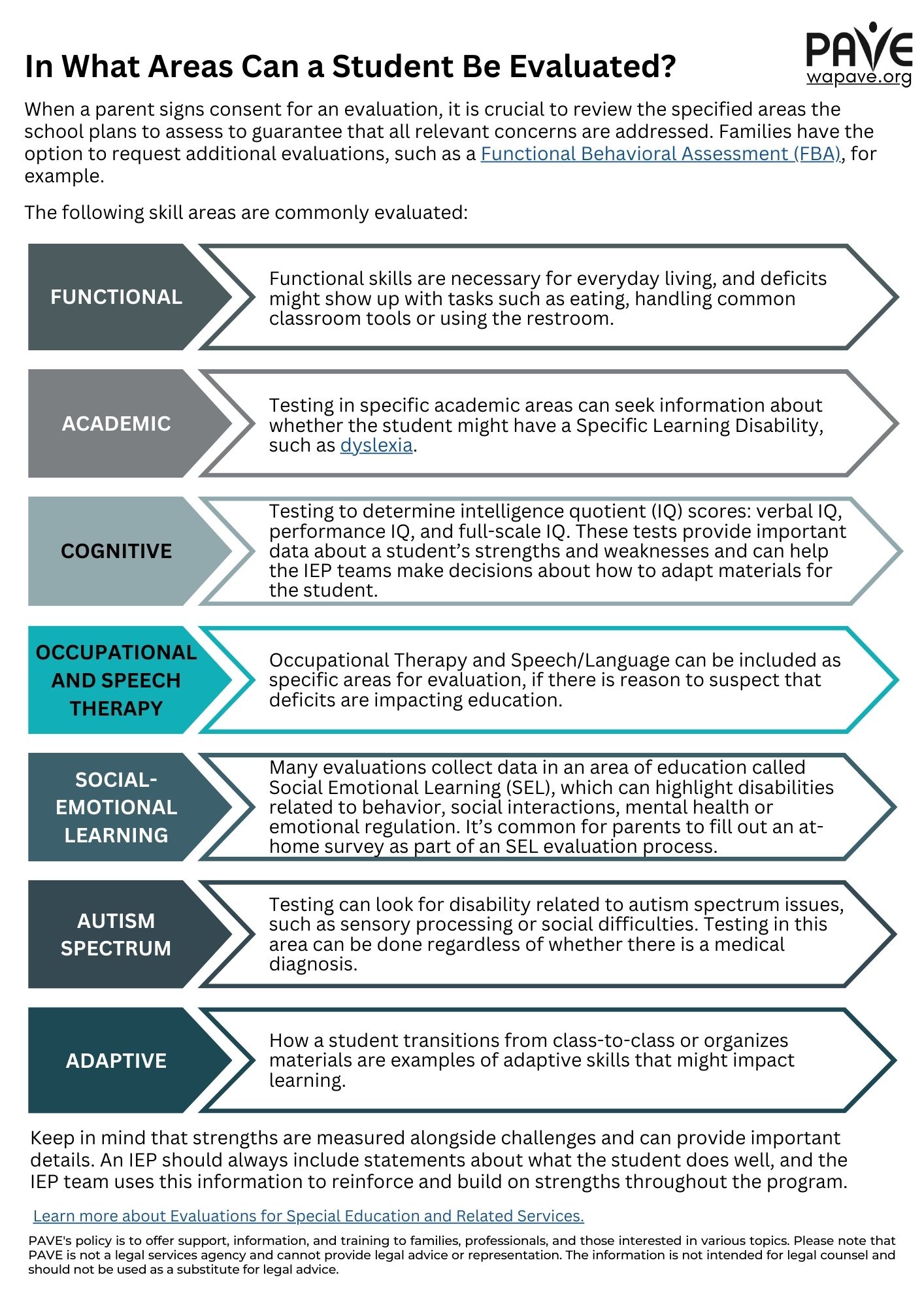
Areas of evaluation

Download In What Areas Can a Student Be Evaluated?:
English | Chinese (Simplified) 中文 (Zhōngwén) | Korean 한국어 (Hangugeo) | Russian Русский (Russkiy) | Somali Soomaali | Spanish Español | Tagalog | Ukrainian українська | Vietnamese Tiếng Việt

Eligibility Categories for Special Education

Once a student’s evaluation confirms a disability that impacts learning, the next step is to determine whether the disability fits one of 14 federally recognized categories. These categories are outlined in Washington’s Administrative Code (WAC 392-172A-01035):

  • Autism
  • Emotional Disturbance
  • Multiple Disabilities
  • Specific Learning Disability
  • Visual Impairment / Blindness
  • Deaf-Blindness
  • Hearing Impairment
  • Orthopedic Impairment
  • Speech/Language Impairment
  • Developmental Delay (ages 0-8)
  • Deafness
  • Intellectual Disability
  • Other Health Impairment
  • Traumatic Brain Injury

These categories are intentionally broad to reflect the diverse ways disabilities can affect learning. The IEP team may discuss which category best fits the student’s unique situation. While a medical diagnosis can help inform the process, eligibility is determined by how the disability impacts the student’s education. This impact can be assessed with or without a formal diagnosis.

There is no such thing as a “behavior IEP” or an “academic IEP.” Once a student qualifies, the school is responsible for addressing all identified areas of need. The IEP is personalized to include programming, services, and placement designed to support the whole child.

In Washington State, children through age 9 may be eligible for services under the category of Developmental Delay. Full definitions for each category are available in WAC 392-172A-01035 and are also reproduced in this PAVE article: Washington Special Education Categories.

Timeline of Evaluation and Development of an IEP

The school follows specific deadlines for an evaluation process. They have 25 school days to respond to the referral in writing. If they proceed with the evaluation they have 35 schools days to complete the assessment. For an eligible student, an IEP must be developed within 30 calendar days.

Track your student’s progress from the point of referral for evaluation to the development of the IEP with the infographic below.
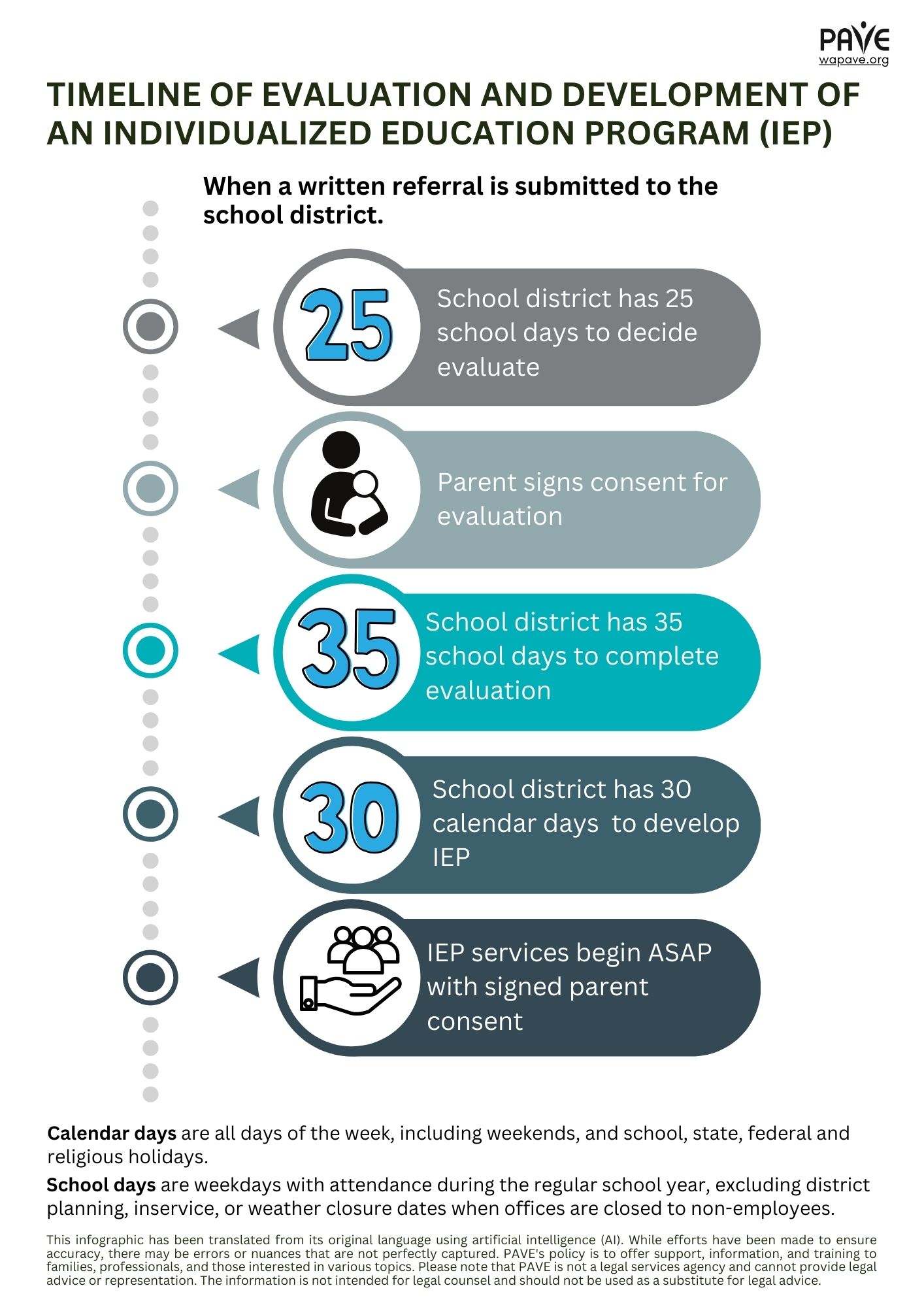
Timeline of Evaluation and development of an individualized education program (IEP)

Download the Timeline of Evaluation and Development of an IEP:
English | Chinese (Simplified) 中文 (Zhōngwén) | Korean 한국어 (Hangugeo) | Russian Русский (Russkiy) | Somali Soomaali | Spanish Español | Tagalog | Ukrainian українська | Vietnamese Tiếng Việt

Sample Letter to Request an Evaluation

Washington law requires that referrals for special education evaluation be made in writing. If a verbal request was previously denied, start again with a formal written letter sent by email, certified mail, or delivered in person.

OSPI provides a downloadable referral form on its Making a Referral for Special Education page. The person making the referral can use this form or any other written format that clearly communicates the request to evaluate.

Address the referral to the district special education director or program coordinator, and include an administrator at the student’s school. Be sure to include the student’s full name and birthdate, a clear statement requesting evaluation in all areas of suspected disability, and specific concerns. Supporting documents or letters from doctors, therapists or other providers may be attached. Include complete contact information and a statement that the parent or guardian is prepared to sign consent for the evaluation to begin.

Download the Sample Letter to Request an Evaluation:
English | Chinese (Simplified) 中文 (Zhōngwén) | Korean 한국어 (Hangugeo) | Russian Русский (Russkiy) | Somali Soomaali | Spanish Español | Tagalog | Ukrainian українська | Vietnamese Tiếng Việt

Options When Families and Schools Disagree

Families can ask school staff to explain their decisions in writing. If a parent or guardian disagrees with something the school decides, they have rights to informal and formal dispute resolution options that are protected by the IDEA. Schools must provide a document called procedural safeguards, which outlines these options and explains the rights of both students and families. PAVE continues this topic in an article: Evaluations Part 2: Next Steps if the School Says ‘No.’

Eligibility for Section 504 Protections

Section 504 of the Rehabilitation Act of 1973 is a federal civil rights law that helps protect students with disabilities from discrimination in schools that receive federal funding. It applies to individuals whose disabilities significantly affect major life activities—such as learning, breathing, walking, or concentrating. Because the law is broadly written, it can apply to a wide range of conditions and circumstances.

Students who receive services through an IEP also benefit from protections under Section 504, which are built into the IEP process. In some cases, students who don’t qualify for an IEP may still be eligible for support through a Section 504 Plan.

Protections against bullying and discriminatory discipline are aspects of Section 504. PAVE provides articles about Bullying at School: Resources and the Rights of Students with Special needs and What Parents Need to Know when Disability Impacts Behavior and Discipline at School.

Learn More

PAVE provides downloadable toolkits ready for you, including Where to Begin When a Student Needs Help. For the full list of toolkits, type “toolkit” in the search bar at the top of this page.

Click on Get Support at the top of this page to submit a Support Request and receive individually tailored support, training, information, and resources.
Evaluations Part 2: Next Steps if the School Says ‘No’

Families may feel uncertain or discouraged when a school denies a request for special education evaluation or finds a student ineligible for services. Fortunately, there are steps families can take to respond, seek clarification, and continue advocating for their child’s needs. Understanding available options and protections can help families take informed action and make decisions that support their child’s access to appropriate educational services.

A Brief Overview

  • If the school denies a request for a special education evaluation or does an evaluation and determines a student is ineligible for services, families have options.
  • Schools must issue a Prior Written Notice (PWN) explaining their decision to evaluate or deny a request.
  • Students who do not qualify for an IEP may still be eligible for a Section 504 Plan.
  • Procedural Safeguards provide a specific process for special education and offer families the right to file formal complaints when they disagree with school decisions.
  • When there is a dispute about a district’s evaluation, one option is to request an Independent Educational Evaluation (IEE) from a provider outside of the school district. This article includes a downloadable sample letter in multiple languages to help with that process.
  • PAVE supports students and families navigating educational services. Click Get Support at wapave.org to request 1:1 support.

Introduction

Parents have a variety of choices if the school denies a request to evaluate a student for special education, or if the school does an evaluation and finds the student ineligible for services through an Individualized Education Program (IEP). These decisions can feel discouraging, but they do not mark the end of the road. Under the Individuals with Disabilities Education Act (IDEA) and its implementation through Washington Administrative Code (WAC 392-172A), families have the right to challenge decisions, seek clarification, and request further evaluation. Understanding these options can help families take informed next steps and ensure that their concerns are heard and addressed.

Ask for the Decision in Writing

The school is required to respond through a formal letter, called Prior Written Notice (PWN), to explain its rationale for moving forward with an evaluation or denying the request. If the explanation is unclear or lacks detail, families can ask for a more complete written response. Schools may not deny an evaluation based on internal resource limitations or staffing challenges. According to the Child Find Mandate of IDEA, schools are obligated to evaluate any student with a known or suspected disability, regardless of whether other classroom supports are being used. For example, schools may implement approaches like Response to Intervention (RTI) to support learning, but these methods cannot be used to postpone or deny assessment when a disability is suspected.

Request a Meeting

Discussing a student’s difficulties in a meeting, in-person or virtually, can help school staff understand a parent’s level of concern. A district representative, such as a director of special education, can provide insight about the process and additional options. Parents can invite anyone they would like to attend who has knowledge of the student, including a support person to take notes and help track the conversation.

Is a Section 504 Plan Appropriate?

If a student has a known disability, with some educational impacts, but there is no documented need for Specially Designed Instruction (SDI) and/or related services, the student might qualify for accommodations provided through a Section 504 Plan.

Section 504, which is part of the Rehabilitation Act of 1973, defines disability as an impairment that impacts a major life activity. A formal evaluation is helpful but not required, and parent involvement is best practice. The team asks:

  1. Does the student have a disability?
  2. Does the disability limit one or more major life activities?

If the answer to these two questions is yes, the school can develop a plan to support the student within the general education setting. Assistive technology and modifications to the curriculum can be part of the plan, which includes individualized accommodations to ensure the student is able to access school in ways that are equitable. PAVE provides an article with more information about Section 504.

Options When Resolution Requires More Support

Families are protected by Procedural Safeguards, which outline a specific processes for resolving disagreements in special education. When informal conversations don’t lead to resolution, options such as mediation, community complaint, and due process may be appropriate. PAVE’s article, When Parents and Schools Disagree: Navigating Special Education Disputes, offers clear guidance on these pathways and what to expect. 

If a school denies a request for a specific evaluation, such as a Functional Behavioral Assessment (FBA) or an assistive technology evaluation, families can still pursue dispute resolution options. These types of assessments may be essential for understanding a student’s behavioral needs or identifying tools that support access to learning. Requests for these evaluations are protected under the same legal framework as other special education decisions, specifically the procedural safeguards.

The Office of Superintendent of Public Instruction (OSPI) provides assistance to navigate these processes through a Special Education Parent Liaison, and families may also seek help from the Governor’s Office of the Education Ombuds for collaborative problem-solving. For personalized assistance, PAVE supports students with disabilities and their families. Click Get Support at wapave.org to request 1:1 support.

Request an Independent Education Evaluation (IEE)

Families who disagree with a school district’s evaluation results have the right to request an Independent Educational Evaluation (IEE) conducted by a qualified professional outside the district. An IEE can offer additional information that may support the need for Specially Designed Instruction (SDI) and/or related services.

If the school district denies a request for an IEE at public expense, the district must initiate a due process hearing within 15 calendar days to show that its evaluation was appropriate.

When an IEE request is accepted, the school district provides a list of independent evaluators. Parents have discretion to call each one or to seek an alternative evaluator at their own expense before choosing who will evaluate the student. The school must consider the results of the IEE when deciding whether the student qualifies for special education programming.

Sample Letter to Request an IEE

Download the Sample Letter to Request a Functional Behavioral Assessment (FBA) in:
English | Chinese (Simplified) 中文 (Zhōngwén) | Korean 한국어 (Hangugeo) | Russian Русский (Russkiy) | Somali Soomaali | Spanish Español | Tagalog | Ukrainian українська | Vietnamese Tiếng Việt

Families can email the IEE request letter, send it by certified mail (and keep the receipt), or hand carry it to the district office and request a date/time receipt. It is important to keep a copy of this letter and all school-related correspondence in the student’s home records. Organizing with a binder or a filing system helps with keeping track of all letters, meetings, conversations, etc. These documents will be important for student throughout their educational career and beyond, including when they transition out of school.

Final Thoughts

When a school says “no,” it can feel like a door has closed—but that moment can also mark the beginning of a more empowered path forward. Each action a family takes is a meaningful expression of care and commitment. Family caregivers should trust their instincts, lean on trusted resources, and reach out for support. Persistence paired with informed choices can lead to real change and this journey is about more than advocacy—it’s about championing a child’s right to thrive.

Learn More

PAVE Provides Sample Letters to Support Families in their Advocacy

PAVE offers a collection of downloadable sample letters, available in multiple languages, to help families advocate for their children’s educational needs. These letters support clear and effective communication between families and schools, making it easier to request evaluations, meetings, or behavioral support. Whether you’re just getting started or need help with a specific concern, these tools can guide your next steps.

What is an Advocate?

An advocate is someone who works toward a cause or goal. While professional advocates may be trained to support others, family caregivers often become advocates themselves when they speak up for a child’s needs. Sometimes the hardest part of advocacy is figuring out what to do next. When a child has unmet needs at school, students and family advocates can request evaluations, meetings, or behavioral assessments to help improve services. Putting these requests in writing helps formalize the process and ensures that everyone involved is accountable.

PAVE helps families get started with a collection of sample letters, available for download in multiple languages. We’ve bundled links to those letter templates here for easy reference. Each link takes you to a short article with key information to help you understand the process of special education and how your customized letter can move you forward in that process.

Always Keep Your “Why” in Mind

Why are you taking action? Because you want something to improve for your child! PAVE’s short video, Quick Start Your Advocacy in Two Steps, might help you get ready to craft a letter. The video helps you ask two key questions:

  • What do you want?
  • Who has the power to work with you and make that happen?

As you write your letter, keep those questions and your “why” top of mind.

Request an Evaluation

Sample Letter to Request Evaluation: Schools are required to evaluate students to determine eligibility for a Section 504 Plan or an Individualized Education Plan (IEP). A referral can come from anyone with knowledge of the student and must be in writing. This article provides a sample letter and a link to an alternative form provided by the Office of Superintendent of Public Instruction (OSPI).

Download the Sample Letter to Request an Evaluation in:
English | Chinese (Simplified) 中文 (Zhōngwén) | Korean 한국어 (Hangugeo) | Russian Русский (Russkiy) | Somali Soomaali | Spanish Español | Tagalog | Ukrainian українська | Vietnamese Tiếng Việt

Request an IEP Meeting

Sample Letter to Request an IEP Meeting: Family members can request an IEP team meeting anytime there are concerns about how the IEP is being implemented and whether a student may have unmet needs. This article includes information about who is required to attend an IEP meeting and the rights of parents to participate in educational decision making.

Download the Sample Letter to Request an IEP Meeting in:
English | Chinese (Simplified) 中文 (Zhōngwén) | Korean 한국어 (Hangugeo) | Russian Русский (Russkiy) | Somali Soomaali | Spanish Español | Tagalog | Vietnamese Tiếng Việt

Request a Functional Behavioral Assessment

Sample Letter to Request a Functional Behavioral Assessment: If a child’s behavior is getting in the way of their education, the school is responsible to assess the problematic behaviors and develop a support plan to teach the student what to do instead. In addition to a sample letter, this article provides a link to a video to help families and schools work together through this process.

Download the Sample Letter to Request a Functional Behavioral Evaluation in:
English | Chinese (Simplified) 中文 (Zhōngwén) | Korean 한국어 (Hangugeo) | Russian Русский (Russkiy) | Somali Soomaali | Spanish Español | Tagalog | Ukrainian українська | Vietnamese Tiếng Việt

Request an Independent Educational Evaluation (IEE)

Evaluations Part 2: Next Steps if the School Says ‘No’: If the school evaluates a student and says they aren’t eligible for an IEP or a specific area of service, parents have steps they can take if they disagree. One option is to request an Independent Educational Evaluation (IEE) from an outside provider. This article provides a sample letter for requesting an IEE at school district expense. If the family requests an IEE because they disagree with the school’s evaluation or its conclusions, then the district must pay for the IEE or deny the request through Due Process: IEE denials are evaluated by an Administrative Law Judge.

Download the Sample Letter to Request an Independent Educational Evaluation (IEE) in:
English | Chinese (Simplified) 中文 (Zhōngwén) | Korean 한국어 (Hangugeo) | Russian Русский (Russkiy) | Somali Soomaali | Spanish Español | Tagalog | Ukrainian українська | Vietnamese Tiếng Việt

Final Thoughts

Families who want individualized assistance can reach out to PAVE by completing the Get Support  form. Check out the PAVE Calendar for upcoming trainings and events.

Disability History Month Provides Opportunities for Reflection

The history of disability rights shows how people with disabilities have worked hard to get equitable access, fair treatment, and meaningful inclusion. Key laws and strong community voices have helped shape education and civil rights. Today, it is as crucial as ever to learn, speak up, and work together to build a more inclusive society.

A Brief Overview

  • October is Disability History and Awareness Month in Washington State (RCW 28A.230.158). This month helps people learn about disabilities, raise awareness, promote respect and acceptance, and build pride among individuals with disabilities.
  • Federal and state laws, along with court decisions, have helped students with disabilities go to public school, get the services they need, and be included in general education whenever possible.
  • State law requires public schools to teach students about disability history and help them understand what it means to live with a disability.
  • Parent Centers like PAVE help families and individuals understand disability rights. To find a Parent Center outside of Washington State, visit Find My Center on the Center for Parent Information and Resources (CPIR) website.

Celebrating the History of Disability Rights

Disability History and Awareness Month in October is a time for students, families, teachers, and community leaders to remember and learn about the disability rights movement. Equity and access are protected by law, but there is still work to be done to make sure that laws are followed so that everyone has fair access to opportunities.

Organizations like PAVE help families and individuals understand disability rights. They also explain how history has shaped today’s laws, including the words we use when we talk about disability rights.

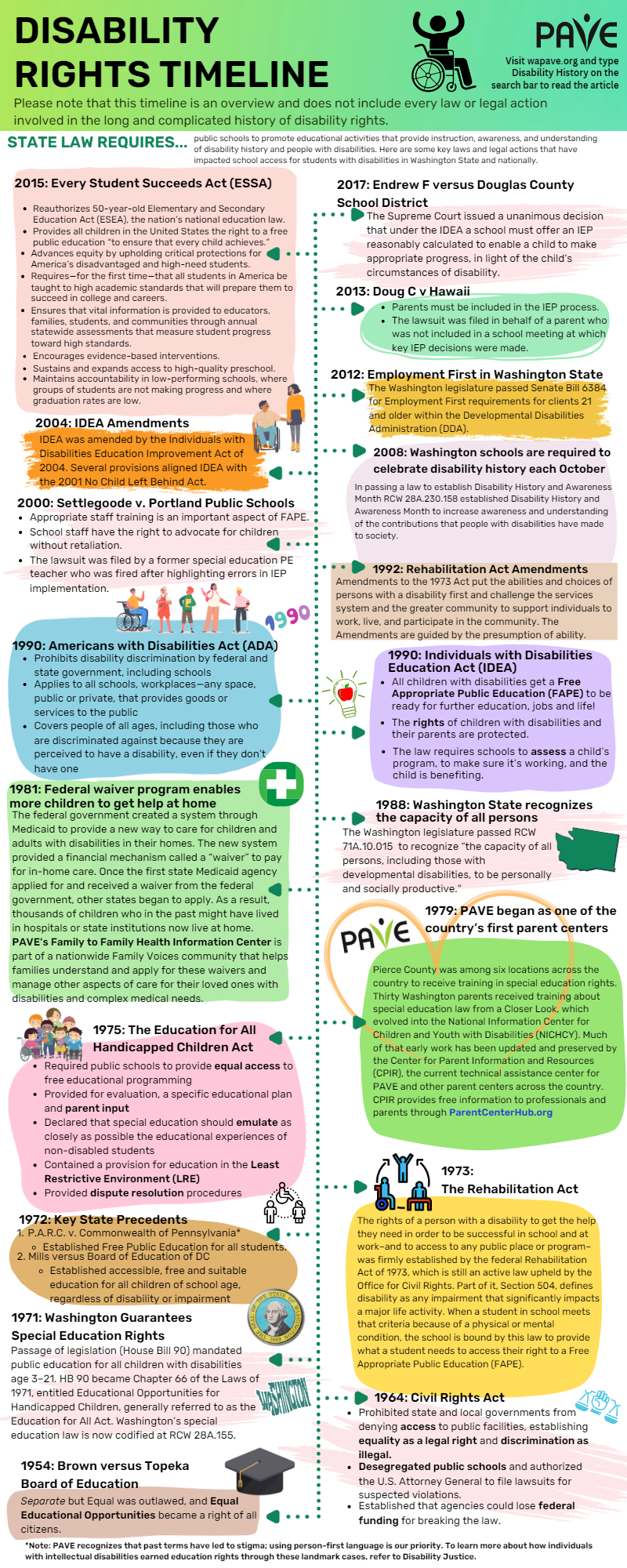
Below is a timeline of key actions at the state and federal level.

Please note that this article is an overview and does not include every law or court case from the long history of disability rights.

1954​: Brown v. Board of Education​ of Topeka

This landmark Supreme Court case was brought by families who challenged racial segregation in public schools. In Brown v. Board of Education of Topeka (1954), the Court ruled that separating students by race was unfair and violated the 14th Amendment’s promise of equal protection under the law.

‘Separate but equal’was outlawed, and equal educational opportunities became a right of all citizens. ​

The decision helped establish the principle that all students deserve equal educational opportunities. It became a foundation for future disability rights cases. Advocates used this ruling to argue that students with disabilities also have the right to attend public schools and receive a fair education.

1964​: Civil Rights Act​

The Civil Rights Act of 1964 was a major law that helped protect people from discrimination. It made it illegal for state and local governments to deny access to public places, like schools, parks, and libraries. This law confirmed that equality is a legal right, and that discrimination is against the law.

It also helped desegregate public schools and gave the U.S. Attorney General the power to take legal action against schools or other public agencies suspected of breaking the law. It also stated that agencies that didn’t follow the law could lose their federal funding.

1971: Washington guarantees special education rights

In 1971, the small but fierce Education for All Committee — Evelyn Chapman, Katie Dolan, Janet Taggart, Cecile Lindquist — worked with two law students to craft and advocate for passage of legislation (House Bill 90) to mandate public education for all children with disabilities age 3–21. HB 90 became Chapter 66 of the Laws of 1971, entitled Educational Opportunities for Handicapped Children, generally referred to as the Education for All Act. Washington’s special education law is now codified at RCW 28A.155

1972: Key precedents are established in other states

In P.A.R.C. v. Commonwealth of Pennsylvania (1971)*, a group of parents went to court to fight for their children’s right to go to public school. At the time, some schools didn’t allow children with disabilities to attend. The court decided that all children, no matter their abilities, have the right to a free public education.

A few months later, Mills v. Board of Education of the District of Columbia (1972) built on the P.A.R.C. decision. In Mills, the court found that education should not only be free and accessible to all students, but also suitable for each child’s needs. These two cases helped establish the principle that all children, regardless of ability, have the right to attend public school and receive an education suited to their individual needs.

To learn more about how individuals with intellectual disabilities gained education rights through these landmark cases, visit Disability Justice.

*Note: PAVE recognizes that past terminology has contributed to stigma. We are committed to using inclusive, disability-affirming language that reflects the preferences of individuals and communities, including identity-first and person-first approaches.

1973: The Rehabilitation Act

The rights of people with disabilities to get the help they need in order to be successful in school, at work, and in any public place or program was firmly established by the federal Rehabilitation Act of 1973. This federal law that is still active today and enforced by the Office for Civil Rights at the U.S. Department of Education. Part of it, Section 504, defines a disability as any condition that seriously affects a major life activity. If a student has a physical or mental condition that meets this definition, the school must follow the law and provide support to help the student access their education and participate in school activities.

1975: The Education for All Handicapped Children Act

In 1975, the U.S. passed the Education for All Handicapped Children Act, the first federal law focused on the education of children with disabilities. It required public schools to give students with disabilities equal access to free educational programming, along with evaluations, a specific learning plan, and input from parents. The law said that special education should emulate the learning experiences of students without disabilities as closely as possible. This means that students with disabilities have the right to a school experience that looks as much like a typical student’s program as possible. It also introduced the idea of the Least Restrictive Environment (LRE), encouraging schools to work harder to include students of many abilities in general education classrooms. To help families resolve disagreements with the school, the law outlined required dispute resolution procedures. Parents are given information about their rights through Procedural Safeguards that are shared at IEP and other official meetings.

1979: PAVE began as one of the country’s first six parent centers

Pierce County was among six locations across the country to receive training in Special Education rights. In 1979, thirty Washington parents received training on Special Education law. The goal was for those parents to share information throughout the state. To help this movement, a clearinghouse named Closer Look provided intense training for these pioneering parents about the laws. Closer Look evolved in the National Information Center for Children and Youth with Disabilities (NICHCY), and much of that work has been updated and preserved by the Center for Parent Information and Resources (CPIR), the current technical assistance center for PAVE and other parent centers across the country. CPIR continues to provide free information to professionals and parents about education rights under federal law.

To connect with a Parent Center outside Washington State, visit Find My Center on the Center for Parent Information and Resources (CPIR) website.

1981: Federal waiver program enables more children to get help at home

The federal government created a system through Medicaid to provide a new way to care for children and adults with disabilities in their homes. This system introduced a funding option called a waiver, which helps pay for in-home support. Once the first state Medicaid agency applied for and received a waiver from the federal government, other states began to apply. As a result, thousands of children who might have lived in hospitals or institutions in the past are now able to live at home. PAVE’s Family to Family Health Information Center is part of a nationwide Family Voices community that helps families understand and apply for these waivers and manage other aspects of care for their loved ones with disabilities and complex medical needs.

1988: Washington State recognizes the capacity of all persons

The Washington legislature passed RCW 71A.10.015 to recognize “the capacity of all persons, including those with developmental disabilities, to be personally and socially productive.

“The legislature further recognizes the state’s obligation to provide aid to persons with developmental disabilities through a uniform, coordinated system of services to enable them to achieve a greater measure of independence and fulfillment and to enjoy all rights and privileges under the Constitution and laws of the United States and the state of Washington.”

1990: Americans with Disabilities Act (ADA)

The Americans with Disabilities Act (ADA) protects people from disability discrimination by the federal and state governments, including public schools. It also applies to all schools, workplaces, and any public or private place that offers goods or services to the public. The law covers people of all ages, including those who are treated unfairly because they are perceived to have a disability, even if they don’t have one.

Many ADA protections are like those found in Section 504 of the Rehabilitation Act of 1973. Both laws focus on equity and access, and they protect people with disabilities throughout their lifespan.

Understood.org offers resources for parents to learn about ADA protections in schools, including printable fact sheets. The U.S. Department of Justice provides an ADA Information Line to answer questions and help people report possible violations of the law. The Office for Civil Rights also provides guidance for students with disabilities as they plan for post-high school education programs.

1990: Individuals with Disabilities Education Act (IDEA)

The Education for All Handicapped Children Act was renamed and enacted as the Individuals with Disabilities Education Act (IDEA) in 1990. Free Appropriate Public Education (FAPE)came into being, which is still key to how schools support students with disabilities. FAPE means that every child with a disability has the right to an education that helps prepare them for further learning, work, and life. The law also protects the rights of students and their parents or guardians. Schools are required to check if a student’s program is working and make sure the student is making progress.

IDEA is an entitlement law, which means students with unique needs must get support based on their individual situation—not just what’s already available. This federal law guides how each state creates its own special education rules. In Washington State, those rules are found in the Washington Administrative Code (WAC), specifically in chapter 392-172A. Title 34, Part 104, is a federal rule that protects people from discrimination and is enforced by the Office for Civil Rights. 

1992: Rehabilitation Act Amendments

Amendments to the 1973 Rehabilitation Act focus on the abilities and choices of persons with disabilities. These changes challenge service systems and communities to support individuals as they work, live, and participate in the community. The Amendments are guided by the idea of a presumption of ability. This means that every person with a disability, regardless of the severity of the disability, can achieve employment and other rehabilitation goals, if they have the right services and support.

The primary responsibilities of the vocational rehabilitation system include:

  • Help individuals with disabilities make informed choices about jobs that lead to integration and inclusion in the community.
  • Develop an individualized rehabilitation program with the full participation of the person with a disability.
  • Match a person’s needs and interests with appropriate services and supports.
  • Work closely with other agencies and programs, including school districts, to build a strong and unified support system.
  • Focus on quality services and ensure service representatives honor the dignity, participation, and growth of each person as they explore employment options.

2000: Settlegoode v. Portland Public Schools

In 2000, the case of Settlegoode v. Portland Public Schools helped bring attention to the rights of teachers who work in special education. A former special education PE teacher filed the lawsuit after being fired for speaking up about problems with how IEPs were being followed. The court ruled that appropriate staff training is an important part of FAPE and that school staff have the right to stand up for students without being punished.

2004: IDEA Amendments

Congress updated IDEA by passing the Individuals with Disabilities Education Improvement Act (IDEIA) in 2004. Some parts of the law were changed to match the goals of the 2001 No Child Left Behind Act. Here are a few examples of updates:

  • IDEIA allowed 15 states to try out 3-year IEPs when parents agreed every year as a pilot program.
  • Based on a report of the President’s Commission on Excellence in Special Education, the law changed the requirements for evaluating children with learning disabilities.
  • New rules were added about how schools handle discipline for students in special education. These updates continue to shape discipline policies in Washington State.
  • The law strengthened the idea of Least Restrictive Environment (LRE), saying students should learn in regular classrooms with extra help and services, “to the maximum extent appropriate.”

2008: Washington schools are required to celebrate disability history each October

Washington State passed a law to create Disability History and Awareness Month (RCW 28A.230.158), which takes place every October. The legislature explained that: “annually recognizing disability history throughout our entire public educational system, from kindergarten through grade twelve and at our colleges and universities, during the month of October will help to increase awareness and understanding of the contributions that people with disabilities in our state, nation, and the world have made to our society. The legislature further finds that recognizing disability history will increase respect and promote acceptance and inclusion of people with disabilities. The legislature further finds that recognizing disability history will inspire students with disabilities to feel a greater sense of pride, reduce harassment and bullying, and help keep students with disabilities in school.”

2012: Employment First in Washington State

The Washington legislature passed Senate Bill 6384 to create Employment First requirements people age 21 and older who receive services through the Developmental Disabilities Administration (DDA). The law states, “The program should emphasize support for the clients so that they are able to participate in activities that integrate them into their community and support independent living and skills.”

The legislation:

  • Supports employment as the first choice for adults of working age.
  • Incorporates the right to transition to a community access program after nine months in an employment service.
  • Clarifies that a client receive only one service option at a time (employment or community access).

DDA Policy Document describes the history behind the law and the rules for how it would be implemented.

2013: Doug C. v Hawaii

In Doug C. v. Hawaii (2013), the court ruled that parents must be included in the IEP. The lawsuit was filed in behalf of a parent who was not included in a school meeting at which important decisions were made about their child’s IEP. The decision confirmed that families have a legal right to be part of planning their child’s education and that schools must make sure parents and guardians are involved.

2015: Every Student Succeeds Act (ESSA)

In 2015, Congress passed the Every Student Succeeds Act (ESSA) to update the Elementary and Secondary Education Act (ESEA), which had been the nation’s main education law for over 50 years. ESSA says that every child in the United States has the right to a free public education “to ensure that every child achieves.”

The law:

  • Protects the rights of disadvantaged and high-need students.
  • Requires for the first time that all students be taught to high academic standards that prepare them for college and careers.
  • Provides important information to families, educators, and communities through yearly statewide tests that show student progress toward high standards.
  • Encourages schools to use evidence-based strategies to support learning.
  • Expands access to high-quality preschool.
  • Keeps schools accountable when student groups are not making progress or graduation rates are low.

2017: Endrew F v. Douglas County School District

In Endrew F., the Court ruled that schools must offer an IEP that is reasonably calculated to enable a child to make progress, based on their individual circumstances of disability. The decision rejected the old “de minimis standard,” which allowed schools to offer only minimal progress. Trivial progress is no longer enough.

The ruling emphasized:

  • Grade-level goals for students who can learn in the general education classroom.
  • Parent participation in the IEP process.
  • Higher expectations for student growth under IDEA.

Writing for the Court, Chief Justice John G. Roberts explained that a child making only small gains would be like “sitting idly… awaiting the time when they were old enough to drop out.” The case continues to influence how schools and agencies support students with disabilities, and many professionals encourage families to hold schools accountable to these higher standards.

PAVE provides more information about parent and guardian rights to participate in their child’s education in this article: Parent Participation in Special Education Process is a Priority Under Federal Law .

Download the Disability Rights Timeline

A visual version of the timeline is available as a downloadable infographic to support learning and reflection.

Infographic of the Disability Rights Timeline. Visit wapave.org and type disability History on the search bar to read the article and receive accessible information included  in this infographic

View this infographic in PDF form

Sample Letter to Request Evaluation

Anyone with knowledge of a student may request a special education evaluation, and Washington State law requires that referrals be made in writing. Schools must respond within specific timelines and provide language access and support throughout the process. Families have the right to participate in all decisions and may dispute outcomes if they disagree. Special education is a service designed to meet individual needs, not a predetermined placement.

A Brief Overview

  • Washington State requires special education referrals to be in writing (WAC 392-172A-03005). Schools must assist individuals who cannot write.
  • Anyone with knowledge of a student can write a referral.
  • The state provides a Referral for Special Education Evaluation form for making a special education referral, available for download in multiple languages from the Office of Superintendent of Public Instruction (OSPI) website. The form is not required—any written request is valid.
  • Another option is to write a referral using the sample letter at the end of this article.
  • Schools are responsible to provide families with a referral form in their native language and to provide qualified interpreters so families can participate in all meetings to discuss their student’s special education eligibility and services.
  • Schools must respond to a referral within 25 school days and provide a Prior Written Notice (PWN) explaining their decision.
  • If the school agrees to evaluate, parent consent is required before the process begins. The evaluation must be completed within 35 school days, and an IEP developed within 30 calendar days if the student qualifies.
  • If a student is found ineligible for an IEP or the school refuses to evaluate, families may dispute the decision using procedural safeguards, request an Independent Educational Evaluation (IEE), or pursue evaluation for a Section 504 Plan.

Introduction

When a student is struggling in school and there is reason to suspect the challenges are disability related, anyone can refer the student for an educational evaluation. If the evaluation shows that the student is eligible, services are provided through an Individualized Education Program (IEP). Washington State requires special education referrals to be in writing, as specified in Washington Administrative Code (WAC 392-172A-03005).

What Schools Must Do After a Referral

If someone who knows the student asks for an evaluation, the school is responsible for:

  • Documenting the request
  • Recording the date the referral was made
  • Providing a referral form in the person’s native language
  • Responding to the request within 25 school days

If the person asking for the evaluation cannot write, the school is responsible for supporting them to complete the referral.

The school must provide a referral form in the native language of the person making the request. Schools are required to provide qualified interpreters to support parent participation in the referral process and for all meetings where a student’s eligibility and/or educational services are discussed. The Office of Superintendent of Public Instruction (OSPI) provides Parent Rights Information Sheets, downloadable in many languages on the Interpretation and Translation Services webpage.

Evaluation Process and Timelines

When a student is referred for a special education evaluation, the school has 25 school days to decide if they will do the evaluation. These are days when students are actually in school. The school must tell the family their decision in writing. This letter is called a Prior Written Notice (PWN), and it follows rules from WAC 392-172A-05010.

Usually, the school and family meet to talk about the referral and how the student is doing. If everyone agrees to move forward, the parents or caregivers sign a form giving permission for the evaluation to begin. Families can ask questions about what the evaluation will include. The school will look at all areas where the student might need help. This helps them understand the student’s strengths and challenges. If the student qualifies for special education, the results will help create a plan called an Individualized Education Program (IEP).

If the school decides not to evaluate and the family disagrees, the family has the right to take steps to solve the disagreement. These steps are explained in the procedural safeguards.

When the school agrees to evaluate the student, staff must promptly seek parent consent to begin the evaluation process (WAC 392-172A-03005).

Generally, parents sign a form that lists what the school will include in its evaluation. Parents can ask for additional areas to be evaluated to make sure the school gets data for all areas of concern. Families can ask for more information about what the evaluation will look like, where it will take place, how long it will take, and who will participate. The school and family can creatively plan the evaluation process if accommodations are needed. For example, if a student isn’t able to attend in-person school, the evaluation can be done in alternative locations.

After a parent signs consent, the school has 35 school days to finish the evaluation and meet with the family to talk about the results. The deadline may be extended if the family agrees, particularly to accommodate needs of the family or student.

The 35-day deadline does not apply if the student is unavailable for the evaluation or enrolls in another school district before the evaluation is finished (WAC 392-172A-03005).

For students found eligible for services, the school develops an IEP within 30 calendar days and requests parent consent for services to begin. The school and family meet to review a DRAFT version of the IEP and write a final version together before consent is signed. School staff provide a Prior Written Notice (PWN) with a summary of the meeting, agreements, and timelines before services start. PWN requirements are described in WAC 392-172A-05010.

How to Refer a Student for Evaluation for Special Education

The Office of Superintendent of Public Instruction (OSPI) is the guidance agency for Washington State. OSPI provides a Referral for Special Education Evaluation form, downloadable in multiple languages from a website page titled, Model Forms for Services to Students in Special Education. Families may use OSPI’s form, a form provided by their school, or their own choice of format to write their request for a student to be evaluated.

Further explanation of the referral and evaluation process is provided on the OSPI website page, Making a Referral for Special Education.

A non-discriminatory evaluation is part of the protections for a student with a known or suspected disability that may significantly impact their access to education (Child Find Mandate). Child Find protections are part of the federal Individuals with Disabilities Education Act (IDEA). Child Find applies whether there are academic and/or non-academic school impacts.

PAVE provides more detail about IEP eligibility and evaluation process: Evaluations Part 1: Where to Start When a Student Needs Special Help at School.

Sample Letter to Request an Evaluation

Below is a sample letter to write a request for a special education evaluation. You can copy and paste the text of this sample letter into your word processor to build your own letter.

Download the Sample Letter to Request an Evaluation in:
English | Chinese (Simplified) 中文 (Zhōngwén) | Korean 한국어 (Hangugeo) | Russian Русский (Russkiy) | Somali Soomaali | Spanish Español | Tagalog | Ukrainian українська | Vietnamese Tiếng Việt

The state provides an alternative form, downloadable from OSPI’s website page titled, Making a Referral for Special Education. Your school district is responsible to provide a form, in your language, for you to submit your written request. These formats are your choice—any written request is valid. If you cannot write, you can ask for an evaluation by telling the school and they can write the request with you.

Submit your written request through email, by mail, or by hand delivery, to the special education/special services manager at your school’s district office. You may submit additional copies to school administrators and/or a school psychologist—the person who manages evaluations for your school. Be sure to keep copies of all of your communications with the school in an organized, safe place.

Special Education is a Service, Not a Location

A request for a special education evaluation is NOT a recommendation to remove a student from the regular classroom and move them into an exclusive learning environment. Federal and state laws require that students receive education and services in the Least Restrictive Environment (LRE) to the maximum extent possible to meet their needs. Special Education is a service, while LRE refers to placement. You can read more about this in the PAVE article, Special Education is a Service, Not a Place. Decisions about placement are made by the IEP team, which includes the family. The IEP team is responsible to consider the child’s circumstances and capacities as its top priority—not pre-built programs or district resources. The PAVE article, Parent Participation in Special Education Process is a Priority Under Federal Law, provides detail about parent participation in special education process.

Parents Can Appeal Decisions and/or Seek a 504 Plan

If a student is evaluated and found not eligible for an IEP (or if the school refuses to do an evaluation), the family has the right to dispute the decision using Procedural Safeguards.

If they disagree with the district’s evaluation or its findings, the family may seek an Independent Educational Evaluation (IEE), which is done by an agency outside of the school district. The district must pay for an IEE or deny the request using Due Process. See PAVE’s article: Evaluations Part 2: Next Steps if the School Says ‘No’ to Your RequestThe article includes a sample letter to request an IEE.

Another option if a student doesn’t get an IEP is to develop a Section 504 Plan, which accommodates a person with a disability that impacts a major life activity (learning, walking, speaking, writing, socializing…). Section 504 is part of the Rehabilitation Act of 1973, which protects the civil rights of individuals with disabilities against discrimination throughout their lives. See PAVE’s article about Section 504 rights, which also protect students who qualify for an IEP: Section 504: A Plan for Equity, Access and Accommodations.

Final Thoughts

Requesting a special education evaluation is a straightforward process that begins with a written referral. By following the required steps and understanding your rights, you can help ensure your student receives the support they need. Whether you use a formal form or write your own letter, the request must be clear and submitted in writing. This step initiates the evaluation process and ensures the school is legally obligated to respond.

Learn More

Childcare-What to Know When Your Child has a Disability 

When a parent or family caregiver needs care for their child with a disability, finding safe, appropriate, and affordable care will be a priority. There are resources for children with disabilities and their families in Washington State to find safe and affordable childcare. For providers which take federal funds, civil rights laws protect access and appropriate services for children with disabilities and their families. 

A Brief Overview 

  • Two reliable sites with lists of childcare providers in Washington State are WA State Department of Children, Youth, and Families at findchildcarewa.org, and Childcare Aware of Washington Family Center, which is also by phone at 1-800-446-1114. 
  • Childcare takes place in many different settings, licensed and unlicensed. A state license for childcare can help you decide if a childcare setting is safe. This article tells you how to find out if a provider is licensed. 
  • It’s good to ask certain questions before enrolling a child with a childcare provider. This article offers a sample list. 
  • Three laws protect the rights of children with disabilities in childcare settings that accept federal funding: Americans with Disabilities Act (ADA), Individuals with Disabilities Education Act (IDEA) Part C (Birth to Age 3) and Part B (Age 3 through high school graduation) and Section 504 of the Rehabilitation Act of 1972. 
  • Childcare can be expensive. This article explains about tax credits and state programs that help working families, free early learning programs and preschool, and financial help when family, friends, or neighbors provide childcare for your child. 

How can I find listings for childcare in WA State?

 Use this link for listings on the Washington State Department of Children, Youth, and Families (DCYF): findchildcarewa.org 

Washington State partners with Child Care Aware of Washington Family Center. The phone number for individual assistance with your childcare search is 1-800-446-1114 

How can I find out if a childcare center, program, or family home childcare is safe? 

By law, Washington State licenses certain childcare settings. Licensing sets standards that childcare programs and providers must meet. State inspections help ensure that licensed programs and providers meet the standards, which cover a wide range of topics, from the safety and cleanliness of the physical setting through number of staff per child, staff training, and age-and-ability appropriateness of activities and education. 
Links to Washington’s licensing rules are on DCYF’s page on Becoming a Licensed Child Care and Early Learning Provider. 

Licenses are required for: 

  • Family home early learning programs: 
    An early learning program licensed by the department where a family home licensee provides childcare or education services for 12 or fewer children in the family living quarters where the licensee lives. 
  • Childcare center early learning programs: 
    A facility providing regularly scheduled care for a group of children aged from birth through 12-years-old for periods of less than 24 hours a day. 
  • School-age programs (might provide before and after-school childcare and school vacation care): 
    A facility providing regularly scheduled care for a group of children 5 through 12-years-old for periods less than 24 hours a day, when children are not attending school. 
  • Outdoor Nature-Based program: 
    An early learning program that offers regularly scheduled care for preschool-age children, school-age children, or mixed-age children for periods less than 24 hours a day, when children are not attending school. 

What types of childcare don’t need a license? 

  • A nanny or babysitter in your family’s home 
  • Informal parent cooperatives (example: “babysitting exchange”) 
  • Play groups 
  • Educational preschools that operate less than four hours a day 
  • Parks and Recreation programs run by cities and towns 
  • Family members, friends, and neighbors who provide occasional care (If friends or neighbors are providing childcare for multiple children on a regular basis, they are required to have a state license.) 

Programs operated by cities and towns may have standards set by the local government. Contact your local Parks and Recreation Departments to find out what standards their facilities need to meet, how staff are chosen and background checked, and any other questions you have about whether a program will be safe and appropriate for your child. 

Programs that operate on federal or state funding must meet Washington State licensing requirements, such as Head Start and Early Childhood Education and Assistance Program 
(ECEAP). 

More on Head Start and ECEAP under “How to pay for childcare.” 

Find out if a program or provider is licensed by: 

This search tool lets you search for licensing history (has the home or center ever lost its license?), state monitoring reports (did the inspectors find anything to worry about?) status of staff background checks (are they being done?) and more. The tool finds information in Washington State’s database of all licensed childcare facilities and home childcare providers. 

Here is a downloadable, printable checklist of questions to ask when you visit a childcare setting. It’s from ChildCare Aware of Washington: Child Care Quality Checklist 

Questions to ask a provider:  

Questions to ask a provider when enrolling a child with disabilities into a childcare program. It’s important for parents to ask questions to ensure the provider can meet their child’s unique needs.  

  • What experience do you have caring for children with disabilities? 
  • Do you have staff trained in special education or disability support? 
  • What is your adult-to-child ratio, and how flexible is it for children needing more support? 
  • Are staff trained in administering medications or managing medical devices (e.g., feeding tubes, EpiPens, inhalers)? 
  • How do you support children with behavioral challenges? 
  • What is your approach to discipline, and how is it adapted for children with developmental or emotional disabilities? 
  • Can you create or follow an Individualized Care Plan or IEP? 
  • Are you willing to make reasonable modifications to activities, routines, or environments? 
  • Do you allow assistive technology or support items (e.g., communication devices, wheelchairs, noise-canceling headphones)? 

Are there laws that support my child with disability and protect their rights in a childcare setting? 

There are three laws that may apply to childcare settings: 

  • Americans with Disabilities Act (ADA)  
  • Individuals with Disabilities Education Act (IDEA), Part C (Birth to Age 3) and Part B (Age 3 through high school graduation) 
  • Section 504 of the Rehabilitation Act of 1972, usually referred to as “Section 504” or “504” 

Title III of the Americans with Disabilities Act (ADA) applies to: 

  • Federal, state, and local government-agency programs. Examples of this are Head Start, ECEAP (preschools operated by local school districts), summer programs, and extended day school programs. 
  • Privately run childcare centers such as those licensed by Washington State. “Even small, home-based centers are covered by title III of ADA”  
  • Private childcare centers that operate on the property of a religious organization, leasing or renting space on that property. 

ADA does NOT apply to childcare centers that are RUN by religious organizations, such as a church, temple, mosque, or synagogue. 

ADA requires childcare providers to give both children and parents with disabilities an equal opportunity to participate in the provider’s programs and services. 

  • Centers cannot exclude children with disabilities from their programs unless their presence poses a direct threat to the health or safety of others or requires a fundamental alteration of the program. 
  • Centers must make reasonable modifications to their policies and practices to integrate children, parents, and guardians with disabilities into their programs unless doing so would constitute a fundamental alteration
  • Centers must provide appropriate auxiliary aids and services needed for effective communication with children or adults with disabilities, when doing so would not constitute an undue burden
  • Centers must generally make their facilities accessible to persons with disabilities. Existing facilities are subject to the readily achievable standard for barrier removal, while newly constructed facilities and any altered portions of existing facilities must be fully accessible

This website has many examples of situations to help parents and childcare providers understand what the law requires: Commonly Asked Questions about Child Care Centers and the Americans with Disabilities Act. 

Individuals with Disabilities Education Act (IDEA), Part C (Birth to Age 3): 

Children aged birth to 3 who have a disability or are at risk for certain disabilities may be eligible for services under IDEA. For children who qualify, Part C of IDEA authorizes services to support and promote a child’s development “in their natural environment.” This usually means the family home and often, the child’s childcare setting.  
 
Parents can request their child be evaluated (tested) to see if they are reaching expected developmental stages. If evaluators find that a child needs support, a Family Resource Coordinator (FRC) will help the family create an Individualized Family Services Plan (IFSP). Family members have important roles in that plan, and professional staff provide services and help the family to use natural learning opportunities like playtime, meals, or baths to create opportunities for a child to practice and develop delayed skills. 

Services in an IFSP may include, but are not limited to:  

  • Specialized instruction 
  • Speech therapy 
  • Occupational therapy 
  • Physical therapy 

If childcare is a part of your child’s regular schedule, services may be able to be provided in the childcare setting, such as a scheduled time for a speech therapist to work with your child during childcare hours, and for childcare staff to include your family’s daily “practice time” to help your child meet their development goals. 

 If you are just beginning to look for childcare, your FRC may be a good resource to advise you on things to look for and questions to ask to find a childcare setting that can support your family’s IFSP. 

You can check out these resources for much more information on Birth-to-3 programs: 
 
Disability Rights for Littles: Key Information for Families of Babies, Preschoolers, and Primary-School Children (videos) -all the basics you need to know 

PAVE: From Birth to Three Toolkit Basics and beyond! Read online or download, includes FAQ sheet and “cheat sheets”, summaries of important information at-a-glance.  

WA State Department of Children, Youth and Families (DCYF) Early Intervention Services page: Includes contact information and links to apply for an evaluation for ESIT services to find out if your child qualifies. 

Individuals with Disabilities Education Act (IDEA), Part B (Age 3 through high school graduation): 

IDEA Part B applies to preschool and school-age children, and exists to ensure schools, preschools, and kindergartens provide eligible children with disabilities a Free, Appropriate Public Education (FAPE). When disabilities affect how a child is doing in preschool or school, IDEA Part B states that schools and preschools are required to evaluate the child to see if they qualify for special education and related services and supports. This article from PAVE has important background on this law: IDEA: The Foundation of Special Education. 

If a child is eligible for special education, a team is brought together that includes parents, and an Individualized Education Program (IEP) is created for the child, listing the goals, education, and other supports the school or preschool will provide to meet the child’s learning needs. 

For childcare settings, IDEA Part B will apply for these types of childcare settings: 

This PAVE resource explains the differences in services between Part B and Part C of IDEA. 

Section 504 of the Rehabilitation Act of 1973 

Often called “Section 504” for short, this federal law administered by the Office of Civil Rights prohibits discrimination based on disability. To be protected under Section 504, a child must have a physical or mental impairment that substantially limits one or more major life activities, have a record of such an impairment, or be regarded as having such an impairment. 

Section 504 applies to individuals 3-22 years of age. The law requires childcare centers, camps, and any other recreational programs that receive federal funding to provide preschool children with disabilities equal access to the program, with reasonable accommodations and modifications. 

It also includes programs like Head Start, summer programs, and extended school day programs.  

Requirements for childcare centers: 

  • Non-discrimination: Childcare centers cannot refuse to admit a child with a disability.  
  • Reasonable Accommodations: They must provide reasonable accommodations to enable children with disabilities to participate in the program.  
  • Individualized Assessments: Childcare providers must make an individualized assessment of a child’s needs.  
  • Modifications to Policies and Practices: They must make reasonable modifications to their policies and practices.  
  • Accessible Facilities: Childcare centers must ensure that physical spaces are accessible.  

Help paying for childcare:  

Federal Tax Credit: The child and dependent care credit is a tax credit that may help you pay for the care of eligible children or dependents. This credit is based on your income and the cost of caring for your children or eligible dependents to work, look for work, or attend school.  

Seattle has a Child Care Assistance Program

Washington State offers a program through the Department of Children, Youth, and Families (DCYF): 

Working Connections Child Care (WWCC) helps working families pay for childcare. If a family qualifies and chooses an eligible provider, Washington State will pay part of childcare costs. Parents are responsible for any copayment of childcare fees not covered by the state, and those are payable to the provider every month. 

  • The child or children must live in Washington State 
  • The family with whom the child lives must live in Washington State 
  • The family’s income must be at or below 60% of the State Median Income 
  • The family must have less than $1 million in resources 
  • Parent or parents must be participating in an approved activity, such as self-employment, employment, or being in high school or post-secondary education or taking part in the WorkFirst or BFET program. 
  • Families experiencing homelessness are eligible. 
  • If a parent or parents are seasonal agricultural (farm) workers, and live in certain counties, they may be eligible for the Working Connections program. 

An additional up-to-date online resource is MomsRising.org. This site has brief, helpful information about the Working Families Child Care Program, especially when your child or children have a disability. It goes over issues such as: 

  • How families and family size are defined for this program 
  • Children with physical, intellectual and/or developmental disabilities 
  • Children and families experiencing homelessness 
  • Families where the parent or parents are high school or college students 
  • What types of childcare are available 
  • Getting financial assistance when a family member, friend, or neighbor can take care of your child or children 
  • You can check details of your eligibility, including income requirements, on DCYF’s Working Connections Child Care website page.  
  • Apply by calling the Child Care Subsidy Contact Center 1-844-26-8687 or online at Washington Connection.  
  • Get help applying for this program and help finding childcare that meets your family’s needs through ChildCare Aware of WA

Free state-licensed early learning childcare or preschool: 

Head Start programs are federally funded and Early Childhood Education and Assistance Program (ECEAP) is a Washington State-funded program for children aged three and four, and in some locations, infants and toddlers younger than age three. Head Start offers services to pregnant women in some locations.  

Your local school district will have an ECEAP program available. 

Children are eligible for these programs based on their age and family incomes, with some children able to attend these free programs if they have multiple support needs. Visit the ECEAP & Head Start programs page on the DCYF website for more detail and contact information in English and Spanish. 

Financial help for childcare by family, friends, or neighbors

In Washington, this category is called Family, Friend and Neighbor Care. These settings are not required to have a license and are very common arrangements.  
Informal care for children in your home or the family’s home may involve some expenses, and Washington State recognizes this with financial assistance (subsidies). Visit the Family, Friend and Neighbor Care page on DCYF’s website for contact information to apply for subsidies. 

School Support Plans for Deployment-Tips for Parents

When a military parent deploys, children—especially those with disabilities—may show changes in behavior, emotions, or learning. With the right support at home and school, these transitions can become opportunities to build resilience, confidence, and connection.

A Brief Overview

  • Schools often notice changes in behavior when a parent deploys, and children with disabilities may feel deployment stress more deeply.
  • The Emotional Cycle of Deployment provides a glimpse into the emotional journey families experience, offering insight into how children’s needs and feelings may shift throughout each phase of a parent’s deployment.
  • Let the school know about an upcoming deployment as soon as possible. Sharing general information helps the school prepare while protecting mission details.
  • Federal and state laws protect the rights of military-connected children during deployments.
  • IEP or 504 supports may need updates to reflect emotional and behavioral changes.
  • A deployment support plan should include warning signs, coping strategies, and contacts.
  • School-based and at-home supports can help to support your child’s learning and emotional well-being during periods of service-related transitions.
  • Planning for medical decisions during deployment is essential for children with disabilities.
  • In Washington, some youth can make medical decisions starting at age 13; plan ahead for healthcare arrangements during and after deployment.
  • The Deployment School Support Checklist, included in this article with download links in several languages, helps families track key steps and information to support a smooth school experience before, during, and after deployment.
  • Teamwork between families and schools helps children feel safe, understood, and supported.

Why do schools need to know when a parent deploys?

Your children spend a large portion of their day in school, so teachers often notice changes or new behaviors. The value of parents and schools partnering to support military-connected children with the stressors of deployment is significant. As you know, having a parent away for a lengthy time places extra stress on children and the at-home parent, siblings and/or other care givers. No matter how often a military parent is deployed, and no matter how well-prepared a child might be for a parent’s absence, children with disabilities may be particularly vulnerable to the effects of stress on their physical and emotional well-being.

To ensure your child receives the appropriate support, it is important to communicate upcoming deployments with the school. Maintaining operational security (OPSEC) remains a priority during this process. The School Liaison and Exceptional Family Member Program (EFMP) Family Support office can provide guidance on how to share relevant information in a way that supports the child’s needs while safeguarding sensitive details. For National Guard families, your state’s Family Assistance Coordinator is also a valuable resource. You can find contact information for your School Liaison, EFMP Family Support office, and Family Assistance Coordinator by visiting Military Installations, a Military OneSource website.

What can you expect during deployment?

When a parent in the military gets ready to leave for deployment, it can be a big change for the whole family—especially for children. These changes often follow what’s called the Emotional Cycle of Deployment. This cycle includes different feelings that come and go before, during, and after a parent’s time away.

Here’s what that cycle looks like and how it might affect your child at school:

  1. Pre-Deployment: As families prepare for a parent’s departure, children may become anxious, clingy, or distracted. The change in routines can affect focus, emotional regulation, or behavior at school.
  2. Deployment: The first few weeks after a parent leaves are often the hardest. Children may show sadness, anger, or fear. They might miss their parent a lot and feel unsure about what’s happening. At school, this may appear as trouble paying attention, acting out, withdrawing, or feeling tired.
  3. Sustainment: As new routines form, children may feel more settled but still miss the deployed parent deeply. They might worry about their parent’s safety or feel left out when other kids talk about family events.
  4. Re-deployment: When the parent’s return nears, children may feel excited but nervous. Emotional ups and downs are common, and stress might spike again, making it hard to concentrate at school.
  5. Post-Deployment: Even joyful reunions can be stressful. Changes in rules or routines may cause confusion. It’s not uncommon for children to feel anxious or unsure about how to act around the returning parent.

Children with disabilities may experience these transitions more intensely. Changes in routine, caregivers, or emotional stability can significantly impact their learning and well-being. That’s why it’s essential for schools to be informed and prepared to offer consistent support throughout the deployment cycle. Teachers and staff can offer extra support, like checking in with the student, adjusting schoolwork, or helping them talk about their feelings in a safe way.

Know your student’s rights as a military child

Several laws—both federal and state—are in place to help protect the educational stability of military-connected students. These laws recognize the unique challenges your family may face during deployment or other transitions, and they’re designed to ensure that your child continues to receive the support they need when routines change or stress increases.

The Interstate Compact on Educational Opportunities for Military Children, commonly known as MIC3, allows schools to grant extra excused absences for children whose military parent is preparing for, returning from, or currently deployed in a combat or combat-support role. “Deployment” under MIC3 begins one month before the parent leaves and extends to six months after their return. You can request time off so your child can prepare, visit with the returning parent, or participate in family events. Approval is up to the school principal or superintendent and must balance academic needs with family well-being.

The federal Every Student Succeeds Act (ESSA) requires schools to identify students with a parent on active duty, including full-time National Guard or Reservists on Title 10 orders, using a Military Student Identifier. This helps educators make sure military-connected students don’t fall through the cracks by tracking academic progress and providing extra support when needed, such as during a deployment or family separation.

If your child has a disability, the Individuals with Disabilities Education Act (IDEA) and Section 504 of the Rehabilitation Act ensure that your child continues to receive appropriate services and accommodations, even when military life changes quickly. If deployment impacts your child’s behavior, emotions, or learning, their IEP or 504 team can work with you to update goals, supports, or strategies based on how your child is coping during this time. For example, if a child begins having more anxiety or difficulty with transitions due to a parent’s absence, breaks, visual supports, or check-ins with a counselor could be added to their services and supports.

Washington State law (RCW 28A.225.217) helps students stay in the same school during a parent’s deployment. If military orders require the custodial parent to relocate—including for deployment—the law allows the child to continue attending their current school, even if they temporarily live with a caregiver who isn’t the parent. This helps your child stay connected with familiar friends, teachers, and routines during a time of change.

Together, these laws help reduce disruption and protect your child’s education—keeping your family steady, supported, and connected wherever military life leads.

Communicate needs to the school

Communication about an upcoming deployment is key and setting up a meeting will help prepare the school. For example, you can request a meeting with your child’s teacher shortly after you find out about the upcoming deployment. If the separation is scheduled to start during summer vacation, you may want to book that conference as soon as possible after school begins. If your child is in middle or high school, meeting with every teacher might be a consideration as information may not reach each teacher who interacts with your child.

When meeting with your child’s teachers, you can let them know that there are some areas of information you won’t be able to share with them, due to operational security concerns regarding mission-related details.

Areas that can steer clear of mission-related operational security include:

  • Timeframe – A general idea of beginning and ending dates. For example, “sometime this fall” or “around the end of the school year” is sufficient without revealing exact dates.
  • Past experiences – If your child has experienced excessive stress during a previous deployment or their behavior reflects concern about the absence of a parent or changes in routine, this can help educators anticipate and respond to emotional or behavioral needs.
  • Coping mechanisms – Sharing strategies that have helped your child manage stress. For instance, if your child finds comfort in looking at a photo of the deployed parent, a teacher may allow them to keep a copy in their backpack or desk.
  • Temporary caregiving arrangements – Informing the school of any changes in guardianship, emergency contacts, or who is authorized to pick up your child during the deployment period.
  • Support needs – Requesting access to school counselors, military family support groups, or academic accommodations to help your child adjust during the deployment.
  • Reintegration preparation – Letting the school know that a parent will be returning soon (without specific dates) and that your child may need time to readjust emotionally or socially.

It can be helpful to keep a simple portfolio at home with samples of your child’s schoolwork, notes from teachers, and any behavior or support records from before, during, and after major changes—like a deployment or a Permanent Change of Station (PCS). This collection can help you and your child’s educators better understand how transitions affect learning and behavior over time. It also gives you a useful reference of what to expect and strategies that have been effective when preparing for future deployments or school meetings.

Consider sharing helpful resources with educators to deepen their understanding of military family challenges. The Military Family Research Institute at Purdue University developed a handout, How to Help Military & Veteran Families for Teachers, containing practical tips and information to support educators. The Department of Defense Education Activity (DoDEA) Office of Safety and Security developed a comprehensive tool for addressing the many challenges military children experience, called the Helping Hands Guide to Deployment for Educators.

Keeping a simple portfolio at home can be a valuable tool throughout your child’s deployment journey. Include samples of your child’s schoolwork, notes from teachers, and any records related to behavior or supports before, during, and after a deployment or move. This organized collection helps you and school staff track how your child is adjusting over time and better understand any challenges they face. It also provides a helpful reference when preparing for future deployments or school meetings, making it easier to spot patterns and share what strategies have worked well.

Develop a deployment support plan

Every child responds to stress in their own way—and those responses can look very different at home and at school. Your child may seem calm and well-adjusted at home, but still struggle emotionally or behaviorally in the classroom. That’s why it’s important to work with your child’s teachers and school staff to create a plan ahead of time.

A good plan should include:

Signs to Watch For
Work with teachers to identify behaviors that may signal your child is feeling overwhelmed, anxious, or upset. These might include sudden changes in mood, withdrawing from others, acting out, or difficulty focusing.

Steps to Take When Stress Shows Up
Decide together what actions the teacher or staff can take if your child appears to be struggling. This might include offering a break, using calming strategies, or allowing the child to visit a safe space like the counselor’s office or resource room.

Who to Contact
Make sure the school knows who to reach out to if your child needs extra support. This could be a parent, caregiver, School Liaison, or EFMP Family Support provider.

Tools and Strategies That Work
Share what helps your child at home—like using a fidget tool, listening to music, or looking at a photo of their deployed parent. Teachers may be able to use similar strategies in the classroom.

Check-Ins and Updates
Set up a regular time to check in with your child’s teacher or support team. This helps everyone stay on the same page and adjust the plan if needed.

School-Based Supports

Children with disabilities may qualify for extra support under an IEP or 504 Plan, especially during stressful transitions. Schools can provide services and supports to help students feel supported, stay focused, and succeed during a parent’s absence. Here are some examples:

Breaks and Safe Spaces

  • Calm-down areas give your child a quiet place to go when they feel overwhelmed.
  • Movement breaks or flexible seating can help kids who need to move or change positions during the day.
  • Check-in/check-out systems let your child talk to a trusted adult at school each day to share how they’re feeling.

Emotional Expression at School

  • School counselors or psychologists can meet with your child one-on-one or in small groups.
  • Deployment support groups let military kids talk with others who understand what they’re going through.
  • Creative activities like drawing, writing, or storytelling can help your child express feelings in a safe way.

Participation in School Activities

  • Clubs and extracurriculars like music, robotics, or art can help your child feel connected and confident.
  • Leadership opportunities such as student council or peer mentoring can build self-esteem.
  • Buddy systems pair your child with a classmate to help them feel less alone.

At-Home Supports

Your child’s needs don’t stop at the school gate. These resources and strategies families can help children cope with the challenges of deployment:

Mental Health & Counseling

Tutoring Help

  • Tutor.com for Military Families: Free, 24/7 online homework help in all subjects.
  • School Tutoring Programs: Ask your child’s school about after-school academic support.
  • Peer Tutoring or Study Groups: Older students may benefit from learning with classmates or mentors.

Activities and Recreation

  • Youth Sports and Recreation: On-base programs like soccer, dance, or swimming—often free or low-cost.
  • Family Walks or Outdoor Play: Simple daily activities to reduce stress and build connection.
  • Base or Community Centers: Offer structured physical activities like martial arts or fitness classes.

Family Support Tools

  • Sesame Street for Military Families: Videos, storybooks, and games to help young children understand deployment and other changes.
  • EFMP & Me: An online tool for families in the Exceptional Family Member Program to plan for services and transitions.
  • Military Child Care in Your Neighborhood (MCCYNPLUS): Helps families find affordable, high-quality child care when on-base care isn’t available. 
  • The Child Care in Your Home (CCYH) pilot program: In select areas (e.g., Seattle/Tacoma, WA), this program offers fee assistance for full-time, in-home care. Families can hire a caregiver, including nanny-sharing or live-in options. The pilot is funded through September 2027.

Medical Decision-Making Rights

For students with disabilities, planning for medical decision-making before deployment helps ensure continuity between health and school supports. In Washington State, youth age 13 and older can consent to certain types of care without a parent’s permission, such as outpatient or inpatient mental health treatment and substance use services. Before you deploy, set up legal tools like a medical power of attorney or healthcare proxy so caregivers can access care quickly. Coordinating with doctors, legal advisors, and school staff ahead of time helps avoid delays that could impact your child’s health and education.

When your child turns 18, they legally take control of most medical decisions. Without formal arrangements like guardianship, conservatorship, or power of attorney, parents lose access to medical records and the authority to make healthcare choices. Supported decision-making is another option that allows adults with disabilities to retain their rights while receiving help from trusted supporters to understand and communicate decisions—but it does not grant legal authority unless paired with additional agreements. For students with disabilities, who often rely on coordinated medical and educational supports, this transfer of rights can be especially challenging. If your child is approaching adulthood, begin planning early to ensure trusted adults can support their care.

Deployment School Support Checklist

The Deployment School Support Checklist is a practical tool to help families stay organized and proactive throughout each stage of a deployment. It outlines key steps and communication tips to support your child’s learning and well-being tips while giving you space to track tasks and make notes to share with your child’s school.

Download the Deployment School Support Checklist:
English | German Deutsch | French Français | Spanish Español | Tagalog

Final Thoughts

Supporting a child with disabilities during a parent’s deployment takes planning, flexibility, and teamwork. You don’t have to figure it all out on your own. Partnering with your child’s school, building a support network, and making a personalized plan can help your child feel secure, supported, and ready to learn.

To further support your child’s education during deployment, you can also connect with your state’s Parent Training and Information (PTI) Center. Every state has a PTI dedicated to helping individuals with disabilities, ages 0-26, and their families navigate education systems. Families living in Washington State—or those PCSing in or out of the state—can submit a Support Request to PAVE for personalized support. If you live in another state, you can find your local Parent Center at ParentCenterHub.org.

Learn More

Youth, Explore Adapted Physical Education in Your IEP or 504 Plan

Overview

  • Physical Education (PE) can be adapted (changed) in four main ways to support students with disabilities.
  • Federal and state law protects your rights to be taught PE. Adapted PE can be included in your Individualized Education Program (IEP). It can also be included in a Section 504 plan.
  • Adapted PE can be useful for post-high school transition plans.
  • Taking part in IEP and 504 meetings is important when looking at adapted physical education. It lets you share your needs, preferences, and goals. This helps create a physical education program that fits your abilities, supports your well-being, and creates a positive and inclusive environment. (Click on the links in the reference section to learn more about going to IEP and 504 meetings.)
  • Changes in WA State rules mean that more teachers will qualify to design and teach Adapted Physical Education. These rules are in effect as of May 1, 2024.
  • The Updated Guidance on Adapted Physical Education, from the Washington Office of Superintendent of Public Instruction (OSPI) quoted in this article gives more information about Adaptive PE and how it fits into special education in WA State. Download or read Updated Guidance on Adapted Physical Education.

Full article

Why is physical education important? How is it helpful to me, as an individual with a disability?

Classes can teach you to care for your body and learn physical, mental, and emotional skills that include:

  • Motor skills (training to use your muscles for certain things, such as swinging a baseball bat to hit a ball, or running very hard in a race)
  • Physical fitness (keeping healthy and strong by exercising your body)
  • Social-emotional skills, teamwork, social play skills
  • Skills for athletics like team sports like soccer or basketball or individual athletics like gymnastics or dance
  • Skills for recreation like biking, swimming, hiking, throwing frisbees, playing games with friends

How Adapted PE works:

Access or accessible means how easy it is to do, to get, or understand something.

There are four main areas where changing general PE curriculum (school courses) may help you access PE. Some of these changes will benefit ALL students using the general PE curriculum.

  • The physical space can be changed to work well for all students:
  • The size of the space and the number of other students can affect how accessible the PE class is for you.
  • Lighting, sound, and what you see can all affect your comfort in a class. Making thoughtful changes to these things can make a PE class more accessible.
  • Teaching: the teacher gathers information about individual students to make sure that they use teaching methods that are accessible to everyone. This might mean spoken instructions, movements, pictures, written words, showing how to do something, or videos.
  • Equipment: depending on your disability, you might need PE equipment to move more slowly, be bigger or smaller, easier to feel, be easier to see and other changes like those.
  • Rules: to make sure PE includes everyone, rules of the game may need to be added or taken away.

Examples of Adapted PE

The point of Adapted PE is to change the general PE curriculum so that it is accessible for you or any other student with a disability. The changes can be individualized, which means it is designed for one individual student with disability. Changes will depend on what your needs are and will be different from student to student. Here are some examples:

  • A third grader with autism spectrum disorder uses a play script on her communication device to invite other students to play tag with her.
  • A high-school senior with Down Syndrome is introduced to adult recreation choices in his community so he can continue building healthy habits after graduation.
  • A seventh grader with Cerebral Palsy attends general PE class. The Adapted PE teacher, general PE teacher, and the physical therapist work together to create an exercise plan to strengthen the student’s legs while using their walker.
  • Design a unified team for sport activities and competitions, so a high school student with disabilities can play in the same team with students without disabilities
  • Adapted Physical Education teachers are trained to make changes to the general education PE curriculum to make it accessible to students with disabilities.

IEPs can include Adapted PE as a service

To get an Individualized Education Program (IEP) you need an evaluation. This process helps to decide if a student has a disability, if the disability has a significant impact on (really affects) learning, and if you need Specially Designed Instruction (SDI) and/or related services to access a Free Appropriate Public Education (FAPE). FAPE is the right of any student, ages 3-21, who is eligible for school-based services delivered through an IEP.

If a student’s access to PE affects learning and needs the school’s PE course to be individualized, Adapted PE can be given as an IEP service. IEP teams discuss how Specially Designed Instruction (SDI) is delivered for each individual student.

If you have Adapted PE in your IEP, there is a range of options for placement. You might be in a general PE class, with or without accommodations. Additional aids, services, and modifications may be added depending on what you need. Get more details in the Updated Guidance on Adapted Physical Education.

You can go to IEP and 504 meetings to let the team know what you want and need.  Beginning at age 14, you can participate in IEP and 504 meetings. You do not have to be invited by the school or your parents, but it’s a good idea to let your parents know you want to go, and to get ready before the meeting. When you are at these meetings, you can show other team members what is important to you about your learning, including Physical education. (Click on the links in the reference section to learn more about going to IEP and 504 meetings.)

All of you on the team can work out a PE plan, which may include Adapted PE, and put it in your IEP. There are two articles in the References section at the end about going to your IEP meeting.

Post-High School Transition and Adapted PE

Physical education and/or Adapted PE can play a key role in your’ post-high school transition plans so you can be healthy and active in your adult life.

If you have Adapted PE in your IEP or 504 plan, you can work with your transition team to identify the sports and recreation activities, entertainments, and any after-school programs you enjoy or want to join. You can plan to continue favorite school PE activities out in the community and explore new options. The transition period is also an ideal time for you to create fitness plans or exercise routines to do independently. For this part of your transition planning, your PE/Adapted PE teacher can be invited to join the transition team, if they are not already a part of it.
Adapted PE teachers and physical and occupational therapists, if part of your IEP or 504 team, can work together on skills related to physical activities and recreation. Some examples might include using a locker room, showing ID or membership at a reception desk, registering for programs or classes, and care and proper use of your sports equipment at home.

Rules changed and removed some difficulties with getting Adapted PE

Until spring of 2024, Adapted PE was not accepted as a specialty that the state would endorse (add to the training listed on a teacher’s professional certificate). This caused a shortage of teachers who could design Adapted PE for students. It made it difficult for some students with disability in Washington State to get SDI in physical education.

As of May 1, 2024, qualifying[1] teachers in Washington State can be trained for and receive a specialty endorsement in Adapted Physical Education. The endorsement shows the teacher has specific skills and knowledge in both PE Learning Standards and special education competencies. As more teachers are taught this specialty, it will be easier to find teachers with Adapted PE training in Washington State.

The OSPI Updated Guidance says that in addition to teachers with an Adapted PE endorsement, SDI for physical education can be provided by “any other appropriately qualified special education endorsed teacher, or an “appropriately qualified Educational Staff Associate (ESA) such as an Occupational Therapist (OT) or a Physical Therapist (PT).”

Summary:

  • Physical Education (PE) is an important part of school. Students with disabilities have the right to be taught physical education.
  • Adapted PE is when the general PE school course (curriculum) is changed to accommodate (meet the needs) of an individual student with disability.
  • Adapted PE can be included in an Individualized Education Plan or a Section 504 plan.
  • If a student needs Adapted PE, it’s important to include someone on the IEP team who is qualified to design adapted PE, as well as the teacher or other school staff who will be teaching the student.
  • Only certain qualified education professionals can design and supervise other educators and school staff teaching Adapted PE. Changes in WA State rules in 2024 allow more education professionals to qualify in Adapted PE.

Resources:

Updated Guidance on Adapted Physical Education  (WA State Office of Superintendent of Public Instruction (OSPI))

Attention Students: Lead your own IEP meetings and take charge of your future (PAVE)

Students: Get Ready to Participate in Your IEP Meeting with a Handout for the Team (PAVE)

Who’s Who on the IEP Team (PAVE)

Student Rights, IEP, Section 504 and More (PAVE)

A previous version of this article was based on information provided by two experts in the field of Adapted Physical Education, Toni Bader, and Lauren Wood, who are Adapted Physical Education teachers in the Seattle area:

Toni Bader, M.Ed., CAPE – SHAPE Washington, Adapted Physical Education, Seattle Public Schools (tonibader24@hotmail.com)

Lauren Wood, NBCT, Adapted Physical Education Teacher, Highline Public Schools, and SHAPE Washington Board Member (lauren.wood@highlineschools.org)


[1] “Certificated teachers who hold any special education endorsement or a Health/Fitness endorsement are eligible to add the APE specialty endorsement to their certificate”  –OSPI Updated Guidance

Five Tips for a Smooth PCS

Planning ahead and staying organized can make a military move much smoother, especially for families with children who have special needs. These key strategies and ready-to-use tools can help reduce stress and support your child’s success at the next duty station.

Introduction

Military families are likely to switch schools more often than other families. This can require learning new rules and finding new resources. To help plan, here are five valuable tips for a smooth PCS (permanent change of station, which is the military language for “relocation”) with a special educational or medical needs child.

Tip 1: Organize your files.

Records are critical for planning and stability. Accessing records once you have left a duty station is far more complex than getting copies to take with you. Keeping track of your child’s records can make the transition to a new assignment far easier. With your child’s information and records organized and up to date, you can quickly find any new trends, needs, or program changes to consider when you PCS.

  • Save copies of evaluations, educational plans and programs, work samples, and behavior plans.
  • Monitor regression by comparing student work samples and grades before, during, and after your PCS.
  • Note what has worked to support your student through previous transitions and share these successes with the Individualized Family Service Plan (IFSP), Individualized Education Program (IEP), or Section 504 team.

If your student comes from a Department of Defense Education Activity (DoDEA) school, you may also have records and evaluations from a Student Support Team (SST) or Case Study Committee (CSC).

Tip 2: Know your resources.

When you are moving to a new place, it is important to know who can help you. Contact the School Liaison and Exceptional Family Member Program (EFMP) family service office as soon as possible. They have useful information about things that can support your child’s health, well-being, and quality of life, like assignment locations, schools, housing, and other essentials. In your new state, you can also reach out to the Family Voices program. They can help you apply for public benefits such as extra money (SSI) and healthcare (Medicaid). It is also good to know your child’s rights as a military student when switching schools between states. Learn about the protections under the Interstate Compact on Educational Opportunity for Military Children and use this Step-by-Step Checklist for resolving school issues with the Interstate Compact.

Download the Essential Contact Form
English | German Deutsch | French Français | Spanish Español | Tagalog

Tip 3: Keep open lines of communication.

Building strong communication links with your child’s teachers and other school officials can be critical. Remember to keep track of notes, emails, texts, and conversations. Always follow up on agreements with a note summarizing what was agreed to and any timelines. Building a solid relationship with your child’s teachers will help you address potential difficulties while they are minor issues and build trust among all team members. Discuss all the efforts that are helping your child. Keep communication lines open by responding promptly and respectfully, and reach out to school staff with positive feedback, as well as for problem-solving concerns.

Tip 4: Ask questions.

The Individualized Family Service Plan (IFSP) and Individualized Education Program (IEP), or Section 504 Accommodations Plan, are the heart of how your child will receive services, accommodations, and modifications tailored to their unique needs. Never feel that you shouldn’t ask questions. Terms can change from place to place, but what the service includes will follow strict guidelines set up through the Individuals with Disabilities Education Act (IDEA) and the Americans with Disabilities Act (ADA). Since you will be the single consistent factor in your child’s educational career, the more you know, the better you can collaborate and plan within the IEP or 504 teams. Locate and contact the Parent Training and Information (PTI) center in your new state to assist you in navigating this process. Students and families in Washington State may contact PAVE for one-on-one support, information, and training through our Get Help request form.

Tip 5: Include your student.

All people need the ability to understand and communicate their needs and wants. The ultimate goal for our children is to help them become self-advocates to the best extent they are capable and comfortable. Providing them with tools early and on an ongoing basis will help them plan for their future. In the long run, it will help them to be the driver of services they need and want.

It’s PCS Time! Social Story

This original social story, “It’s PCS Time!”, is made to help military kids understand and handle the feelings that come with moving. A PCS can be confusing and emotional for children who might not know why they have to leave their home, friends, and routines. This story uses simple words and pictures to explain what happens during a move, helping kids feel more ready and less worried. Parents can read this story with their child to talk about the move, help them feel understood, and make the change feel a little less scary. Reading it before, during, and after the move can help kids feel more comfortable in their new home.

Download It’s PCS Time! Social Story:
English | German Deutsch | French Français | Spanish Español | Tagalog

Learn More

These are just a few tips on navigating the special education and medical systems when PCS’ing. If you want to learn more, register for an upcoming STOMP workshop or webinar.

Understanding Epilepsy: Facts, History, and Support

Epilepsy is a brain condition that causes people to have seizures. There are many different types of seizures, and each person’s experience with epilepsy can be different. Today, doctors have better ways to treat epilepsy, and there are more resources to help families. Even though some people still don’t understand epilepsy, support and awareness are growing.

A Brief Overview

  • Epilepsy is a brain condition that affects people in different ways and can cause different types of seizures.
  • People with epilepsy may also have other health conditions, like Autism, depression, ADHD, learning disabilities, or migraines.
  • In the past, people with epilepsy were often kept away from others because of fear and misunderstanding.
  • New medicines like Phenobarbital and Dilantin have helped many people control their seizures and live more normal lives.
  • Parents and caregivers help children with epilepsy, get the help they need at school and with doctors.
  • Special epilepsy centers give full care, including tests, support, and sometimes surgery.

Introduction

Epilepsy is a brain condition that causes people to have seizures. There are many different types of seizures, and each person’s experience with epilepsy can be different. Today, doctors have better ways to treat epilepsy, and there are more resources to help families. Even though some people still don’t understand epilepsy, support and awareness are growing.

Understanding Epilepsy

Epilepsy is a neurological disease and a spectrum disorder.  A person diagnosed with epilepsy is at a higher risk of having a seizure. A seizure occurs when there is a sudden, temporary burst of electrical activity in the brain that changes or disrupts the messages to the brain cells. The electrical bursts result in involuntary changes in body movement or function, sensation, behavior, and possible loss of consciousness/awareness of surroundings.

As technology has become more advanced, the medical community has discovered that there are many distinct types of epilepsy and different causes. Each person diagnosed with epilepsy has a unique experience. Epilepsy includes many types of seizures, grouped into three main categories based on where abnormal electrical activity occurs in the brain. The most common seizures are:

  • Tonic-clonic seizure: A tonic-clonic seizure causes loss of consciousness and violent muscle contractions.
  • Absence seizure: An absence seizure causes brief losses of consciousness and looks like a person is staring into space.
  • Focal aware seizure: During a focal aware seizure, the person is alert and aware that the seizure is occurring. The person may feel tingling sensations or have body movements that they cannot control. Previously called, simple partial seizure.
  • Tonic seizure: In a tonic seizure the muscles contract making the arms and legs very rigid. The seizures usually occur at night when the person is sleeping.
  • Myoclonic seizure: A myoclonic seizure is a brief shock-like jerk of a muscle or muscle group. The person may not even realize it has occurred.
  • Atonic seizure: Atonic seizures cause the muscles to go limp. Sometimes the person’s eyes may droop, and their heads will nod forward. If a person is standing up, and all their muscles go limp, they will fall.

In addition to the variations in seizures, epilepsy has other common health conditions linked to the diagnosis of epilepsy. Young children diagnosed with epilepsy are now automatically evaluated for autism, as research has shown a connection between the two conditions. Depression is the most common co-occurring health condition with epilepsy. Other health conditions commonly linked to epilepsy include ADHD, Learning Challenges, Anxiety, Mood Disorders and Migraines.

A Look Back: The History of Epilepsy Treatment in the U.S.

In the 1940s, people with epilepsy were often treated very differently than they are today. At that time, people with epilepsy were called “victims.” Back then, many families kept their loved ones with epilepsy at home and away from others because they were afraid of how people would react to seizures.

Doctors sometimes sent people with epilepsy to live in special communities, often on farms. These places were made to be safe and self-sufficient. People grew their own food, and workers helped with cooking and cleaning to prevent injuries during seizures. But these communities also kept people with epilepsy separated from the rest of society.

Things started to change when new anticonvulsant medicines, like Phenobarbital and Dilantin, were discovered. These drugs helped many people control their seizures and return to living at home. Both drugs are still in use today. Even with treatment, it was still hard for people with epilepsy to find jobs because of fear and misunderstanding.

By the 1960s, most of the special communities had closed. While treatment improved, people with epilepsy still faced stigma. Today, there is more awareness and support, but work continues to make sure everyone with epilepsy is treated fairly.

Advocacy in Action – From National Organizations to Parent -Led movements

Many years ago, several epilepsy organizations across the United States recognized the need to work together to better support individuals living with epilepsy. Groups like the National Association to Control Epilepsy, American Epilepsy League, and the National Epilepsy League each had their own ideas about how to organize and share responsibilities. It took more than 20 years of discussion and collaboration before they successfully united to form a single national organization: the Epilepsy Foundation.

Today, the Epilepsy Foundation plays a leading role in supporting people with epilepsy and their families. It offers reliable information about epilepsy and seizures, connects families to local support groups and resources, and advocates for better care and services. The Foundation also funds research to improve treatments and works closely with local chapters to ensure families can access help in their own communities.

In its early years, the Foundation was led mostly by medical researchers focused on developing treatments. Over time, it expanded to include the voices of families, caregivers, and community advocates. This broader involvement helped shape the Foundation’s mission and made it more responsive to the needs of those it serves.

In 1998, Susan Axelrod and a small group of parents started CURE Epilepsy to support research aimed at finding a cure for epilepsy, motivated by their experiences with treatment-resistant seizures in their children. CURE stands for Citizens United for Research in Epilepsy, and it is the only nonprofit organization solely dedicated to funding research to find a cure by supporting innovative science that targets the root causes of epilepsy.

Educational Advocacy for Children with Epilepsy

Parents and family caregivers of children with epilepsy often play a key role in ensuring their child receives the support they need at school. Because epilepsy can affect learning, attention, memory, and behavior, especially when seizures are frequent or medications cause side effects, educational advocacy is essential.

Working with schools to develop individualized plans that support their child’s learning and safety, families may advocate for:

  • Section 504 Plans: These provide accommodation such as extra time on tests, rest breaks, or permission to carry and take medication at school.
  • Individualized Education Programs (IEPs): For students whose epilepsy significantly impacts learning, an IEP outlines specialized instruction and services tailored to their needs.
  • Medical Action Plans: Parents collaborate with school staff to create emergency plans that explain how to recognize and respond to their child’s seizures.

Modern Treatments and Family Support

Today, children with epilepsy can get care at special medical centers called pediatric epilepsy centers. These centers focus on both the child and their family. They are designed to help children who still have seizures after trying two different medicines for at least three months.

Some of the services these centers may offer include:

  • A place to stay for longer testing and care
  • Support from social workers for both the child and family
  • Help from other doctors and therapists who work with the child
  • Neurosurgery, if it might help reduce or stop seizures

In Washington State, some examples of these centers are:

Families can also get help outside of the hospital. For example, PAVE provides information, resources, and parents for parents and individuals with disabilities in Washington State. If your infant or toddler has just been diagnosed with epilepsy, they may be eligible for early intervention services. PAVE provides an article, Early Intervention: How to Access Services for Children Birth to 3 in Washington, to support families in understanding the steps to get started, what services are available, and how to advocate for their child’s needs. Students and their families can contact PAVE for personalized support and training with IEPs, 504 plans, and medical action plans by completing the online help request form.

Parents can also join online support groups specifically for parents of children with epilepsy, or be matched with another parent who has been through a similar experience through the Parent-to-Parent program. If you are a family living in Pierce County, PAVE offers family support activities, information, and referrals through the Pierce Parent to Parent Program.

Final Thoughts

Understanding and awareness of epilepsy has come a long way over the years. Thanks to better medicine, more knowledge, and strong support from families and organizations, people with epilepsy can live full and active lives. There are still some challenges, like helping others understand what epilepsy is and making sure everyone gets the care they need. But with continued support and awareness, the future looks brighter for people living with epilepsy.

Learn More

The Power of Data: Shaping IEPs and 504 plans for Student Success 

Data plays a crucial role in special education, helping teachers, parents, and support teams create effective learning plans for students with disabilities. By understanding data, students and their families can work together with educators to ensure students successfully reach their educational goals.

Brief Overview

  • Data includes information on a student’s learning, behavior, and progress from various sources, used to develop Individualized Education Programs (IEPs) or Section 504 plans.
  • Data helps set learning goals, choose strategies, and decide on accommodations, with regular reviews to adjust plans.
  • Data helps parents and students advocate for support, track progress, and request extra services if needed.
  • This article contains descriptions of the various types of data, test scoring systems, and assessments commonly used in special education.
  • If families and school districts disagree about evaluation data, there are procedural safeguards to help resolve disputes.

What is Data in Special Education?

Data is any information collected about a student’s learning, behavior, and progress. It can come from test scores, classroom performance, teacher observations, and feedback from parents and students. This information is used to develop an Individualized Education Program (IEP) or a Section 504 plan that meets the student’s unique needs.

Types of Data Used in IEPs


Types of Student Data
IEP and Section 504 teams use different types of data to understand a student’s abilities and challenges. These include:

  • Baseline Data: A starting point that shows where a student’s skills are before new support or interventions begin. This could include initial test scores, observations of classroom behavior, and assessments of academic abilities such as reading fluency or math skills. Baseline data is crucial because it helps educators and parents track how the student progresses over time.
  • Current Performance Data: Up-to-date information used to measure progress and to determine whether the accommodations, modifications, and services are working effectively. Performance data includes recent test scores, progress and grade reports, class assignments and homework, and observations from IEP or 504 team members. Teachers and staff might also track how often a student completes assignments or engages with the material being taught.
  • Behavioral Data: Observations on how a student interacts in different settings, both in the classroom and in other school environments. It can include records of behavioral incidents, such as disruptions or outbursts, as well as observations on how the student interacts with peers and follows classroom routines. Behavioral data helps identify patterns and triggers for specific behaviors, which can be addressed with strategic interventions.
  • Social and Emotional Data: Insights into a student’s emotional well-being and relationships with others. This type of data helps to understand how the student is managing relationships, emotional regulation, and any challenges they may be facing in terms of anxiety, stress, or peer interactions. Information may come from school counselors, social workers, or teacher reports on the student’s ability to work in groups or handle stress in academic settings.
  • Medical and Educational History: Past records, including medical reports and previous IEPs or 504 plans. These records help educators understand what interventions have been tried before, what worked, and what didn’t. They also give context to the student’s academic performance over the years and may provide insight into any ongoing health conditions that might affect their learning.
  • Parent and Student Input: Parents often provide important feedback about how their child learns and behaves at home, such as struggles with homework or time management, which can complement academic performance data. Students themselves can share their perspectives on their learning experiences, goals they want to achieve, or accommodations they need, helping ensure the plan aligns with their needs.

Informal observations about a student’s behavior, interactions, or experiences can provide valuable context to all types of data. These anecdotes from parents, students, teachers, or service providers offer personal accounts of how a student responds to situations or interventions. By complementing formal data like test scores, these observations provide insights into social interactions, emotional well-being, and classroom challenges. This helps to understand the student’s strengths and areas for growth. When combined with formal data, anecdotal feedback creates a more comprehensive and effective educational plan tailored to the student’s needs.

Using Data to Customize Student Supports

An IEP or 504 plan is created based on data collected through evaluations and observations. This information helps set learning goals, choose instructional strategies, and decide on accommodations and services. For example, if a student struggles with reading, data can show whether the challenge lies in comprehension, vocabulary, or decoding words.

The IEP or 504 team, including parents, teachers, and specialists, meets regularly to review data and adjust the IEP or 504 plan as needed to ensure they remain effective. Under Washington Administrative Code (WAC 392-172A-03015), students with IEPs must be re-evaluated at least once every three years, though parents or educators can request more frequent assessments if needed. Data for IEPs must be reviewed at least annually to determine whether the student’s goals and services need to be updated (WAC 392-172A-03110(3)).

The Office of Superintendent of Public Instruction (OSPI) has outlined the requirements for review and reevaluation of 504 plans in the Students’ Rights Information Sheet: Section 504, a document available for download in multiple languages on the OSPI website. School districts must re-evaluate a student’s eligibility for a 504 plan at least every three years and review the 504 plan annually to ensure that it continues to be effective. Parents or teachers can request a review at any time.

Understanding Test Scores

Test scores provide important insights into a student’s learning progress.  Scoring systems vary, and the results can be presented in different formats. Some common types include:

  • Raw scores indicate the number of correct answers or tasks completed correctly. For example, if a student correctly answers 35 out of 40 questions, their raw score is 35.
  • Standard scores compare a student’s performance to others of the same age, with 100 as the average. The mean is the average score, and the standard deviation shows how much the scores vary from that average. With a standard deviation of 15 on the Wechsler Intelligence Scale for Children (WISC-V), most students’ scores will fall between 85 and 115, and scores further from 100 indicate greater differences from the average.
  • Percentile ranks show where a student’s performance ranks in comparison to their peers. If a student is in the 70th percentile, they scored higher than 70% of their peers statewide. A score in the 30th percentile means the student scored higher than 30% of other students.
  • Age and grade equivalent scores show how a student’s performance compares to typical expectations for their age or grade. A 5th-grade student with a grade equivalent score of 7.0 is performing at the level expected of an average 7th grader.

Types of Assessments

There are two main types of tests used in special education: norm-referenced and criterion-referenced. Norm-referenced tests compare a student’s performance to other students in the same age group or grade level. For example, an IQ test measures a child’s cognitive abilities compared to others of the same age by assessing areas like verbal comprehension, perceptual reasoning, working memory, and processing speed. Criterion-referenced tests measure how well a student has learned specific skills. Classroom-based assessments are often criterion-referenced tests, like a math test that focuses on a student’s ability to accurately complete addition and subtraction problems. The Smarter Balanced Assessments (SBA) are English language arts (ELA) and math tests given to students in grades 3-8 and 10. The SBA is both a norm-referenced assessment, comparing student performance to state and national benchmarks, and a criterion-referenced assessment, measuring students’ mastery of skills needed for graduation and academic progress.

Using Data to Advocate for Student Needs

Data helps parents and students advocate for the right support. If test scores show that a student is falling behind, families can use this information to request extra services, such as tutoring or assistive technology. Data also helps track progress to see if current strategies are working or if changes are needed.

Asking questions about the data can help parents and guardians better understand their child’s needs and ensure they are getting the right support. By engaging in these conversations, parents can advocate for their child more effectively and make sure their progress is being tracked accurately. Here are some helpful questions to ask during meetings with the IEP or 504 team:

  • Can you show me the data that supports this change in supports or services?
  • What specific data or assessments have been used to understand my child’s academic performance?
  • How do my child’s scores compare with other students in their age group or grade level?
  • What scoring type was used to determine these evaluation results?
  • Can you explain how the data indicates where my child might need additional support?
  • Based on the test scores and data, what are my child’s strengths and how can we use them to improve their weaknesses?
  • How often will we review the data to see if my child is making progress? Will there be ongoing assessments and, if so, which assessments will be used?

Resolving Disagreements over Evaluation Data

Procedural Safeguards outline the evaluation process and the dispute resolution options when families and school districts disagree about evaluations. Under the Individuals with Disabilities Education Act (IDEA), parents have the right to request an Independent Educational Evaluation (IEE). The IEE must be requested in writing and PAVE provides a Sample Letter to Request an IEE paid for at public expense by the school district. If the request is approved, the school district provides a list of independent evaluators. The school must consider the IEE results when determining the student’s eligibility for special education services. If the school district denies the request for an IEE, it must start a due process hearing within 15 calendar days to justify its evaluation. Parents have the right to request an IEE anytime a student is evaluated and they disagree with the result.

According to Section 504 Notice of Parent Rights, downloadable in multiple languages on the OSPI website, parents have the right to request mediation or an impartial hearing, if they disagree with the school district’s identification, evaluation, educational program, or placement.

Final Thoughts

Data plays a powerful role in shaping IEP and 504 plans for students with disabilities. By using detailed information from various sources, educators, parents, and support teams can create personalized and effective plans that meet each student’s unique needs. Understanding and using data empowers students and parents to take an active role in education, working closely with teachers and specialists to ensure that students receive the right support to succeed in school and beyond.

Does My Child Need a Medical Action Plan?

Medical action plans are for situations where a child has a life-threatening illness or condition, when medication needs to be taken on schedule, and/or they need to be monitored for symptoms. This article explains what a medical action plan is, when it’s needed, where to use it, and how it’s separate from but can support Individualized Education Programs (IEPs) or Section 504 plans.

A Brief Overview

  • Medical action plans are for situations where a child has a life-threatening illness or condition, when medication needs to be taken on schedule, and/or they need to be monitored for symptoms
  • Medical action plans can be used in school, in community settings, and at home or while traveling.
  • Your child’s pediatrician or primary care provider and their staff can be good resources to help you create the medical action plan.
  • In schools, parents and their medically aware children) meet with the school nurse to develop or complete a plan. School staff are responsible for carrying out the plan.
  • If a child has an IEP or 504 plan, a medical action plan can be referred to in any appropriate section to address limits on physical activities or modified academic expectations when a condition affects a child’s learning or ability to function well at school. 
  • Home, community and travel medical plans are very useful to inform first responders and others not familiar with your child’s needs with essential information about their typical routine and the steps to take in case of an emergency.

What is a medical action plan?

It’s a plan for when a child has a life-threatening illness or condition and/or requires medical monitoring or medication.

In school settings, school staff have responsibility for following the medical action plan. The plan is for the health and wellbeing of the student in the school environment.

Examples of illnesses and conditions might include:

  • Allergies, like food allergies, that can cause anaphylaxis and need an epi-pen
  • Diabetes which may require monitoring and insulin injections
  • Asthma, and a backup inhaler
  • Seizure disorders
  • Mental/behavioral health conditions
  • Complex medical conditions with ongoing needs
  • Cancer, heart conditions, and any other serious or life-threatening illnesses and conditions

A medical action plan explains important steps like when to give rescue medication if needed, when to call emergency services (911), if the student should use a buddy system when going from place to place if there isn’t a support dog, and other essential actions based on the student’s individual medical needs.

Other items which might need to be on the plan:

  • what kinds of durable medical equipment might be needed for support at school, and who is responsible for providing them
  • what kinds of medication and medical interventions could come up day to day
  • what kinds of emergency situations are possible

The medical action plan is developed to help school, their staff, the family, and student all be on the same page about the impact of an emergency event or a day that might have higher needs.

Here are some plan examples to guide you:

Medical action plans are not IEPs or 504 plans. If a student has an IEP or 504 plan, a medical action plan can be referred to in any appropriate section to address limits on physical activities or modified academic expectations when a condition affects a student’s learning or ability to function well at school.

Here’s more information about 504 plans and Individualized Education Programs (IEPs).

How do I request a medical action plan for my child?

A medical action plan is developed in a meeting or series of meetings with the school nurse and an IEP or 504 plan team, if your child is on a 504 plan or IEP. Parents can prepare for the meeting by drawing up their own list of their child’s medical needs in the school environment, but templates, or pre-made plans you can personalize are also available from the school nurse or your child’s pediatrician and/or specialty provider.

Once your child understands their medical needs and their body’s signals, it is vital to request that the student be a part of this meeting so that they can express what their triggers may be and what it looks like when they have a flare-up, attack, or episode. These points should also be written in the plan.

Some school districts require a doctor’s input or signature, especially if medication is involved. It’s a good idea to schedule a doctor’s visit in late July or August to help fill out the action plan so that you can get any input and signatures you need.

Parents should ideally meet with the school nurse and teachers or teams working with their child before registration or the start of school. If that’s not possible, schedule as soon after the school year begins to avoid potential emergency situations with no plan in place.

For students who already have medical action plans, this timeline is important to update the school nurse and staff about any changes in the student’s condition and adjust the plan accordingly. This may also include changes to the 504 plan and IEP if required.

Having information on hand for your child/youth when you or they travel or go on field trips can be accomplished through a one-pager or card that can be kept with you or your child. It would have:

  • Your child’s diagnosis
  • Medications prescribed and when your child takes them
  • Any over-the-counter medications used and when your child takes them
  • Emergency contacts
  • What a medical emergency looks like for your child, and what steps to take to deal with it.

Essential brief “information at a glance” can be on a single sheet of paper or card and put on the refrigerator for first responders, sitters, and respite workers. You or your child can carry it when visiting or in a community setting. Plastic peel-and-stick “laminating” sheets are handy to protect the paper or card and are available at office supply stores and online. Information on how to create these forms and the templates can be found at the links below.

Family to Family Health Information Center (opens on a new website)

My Child’s Care (PAVE’s articles on Health and Wellness)

Ensuring Safety and Inclusion: Adding an Emergency Action Plan to the IEP or 504 Plan 

Emergency Action Plans are crucial for ensuring the safety of students with disabilities during crises like earthquakes, fires, or active shooter events. These plans should be integrated into existing Individualized Education Programs (IEPs) and 504 plans, which already provide accommodations for educational and behavioral needs.

Federal laws mandate that schools offer equitable emergency services to all students, including those with disabilities. Washington state law also requires comprehensive safe school plans that include provisions for students with special needs, regular safety drills, and collaboration with local emergency response agencies.

Brief Overview

  • An individualized Emergency Action Plan prepares students with disabilities for external emergencies.
  • The Americans with Disabilities Act (ADA) requires schools to provide reasonable accommodations to ensure the safety and participation of students with disabilities, including during emergency procedures.
  • The Individuals with Disabilities Education Act (IDEA) requires that schools consider the unique needs of students with disabilities when developing and implementing emergency response plans.
  • Section 504 of the Rehabilitation Act mandates that schools provide reasonable accommodations to students with disabilities to ensure equal access to education, including safety procedures and emergency drills.
  • Washington State law requires that schools develop and implement comprehensive safe school plans that are inclusive of and accessible to students with special needs (RCW 28A.320.125).
  • Download the Emergency Action Plans handout to prepare for and share at an upcoming IEP or 504 plan meeting.

Introduction

In Individualized Education Program (IEP) or Section 504 plan meetings, we often discuss accommodations, which can include placement, specially designed instruction, transportation, related services, and more. In some cases, a behavior intervention plan (BIP) accompanies the IEP or 504 plan. While reviewing these documents, we develop accommodations and responses for educational and behavioral purposes in various environments and situations. However, what sometimes gets overlooked is an Emergency Action Plan.

Emergency Action Plans allow us to prepare for external emergency situations and crises, such as earthquakes, fires, or even active shooter events. While these are high stress topics, we also want our families to be aware of real-world events so we can best prepare and protect our children.

We’ll start with a quick reminder of students’ rights and responsibilities, and Washington State Requirements for emergency planning.

Rights of Students with Disabilities

Federal law emphasizes the inclusion and equitable treatment of students with disabilities in school emergency management plans. These laws ensure that students with disabilities receive the same emergency services as their non-disabled peers and are considered during all stages of emergency management planning. This principle is supported by several federal laws, including the Americans with Disabilities Act (ADA), the Individuals with Disabilities Education Act (IDEA), and Section 504 of the Rehabilitation Act.

The Americans with Disabilities Act (ADA) prohibits discrimination based on disability in all areas of public life, including schools. This means that schools must ensure their emergency plans are accessible to and inclusive of students with disabilities. The ADA requires schools to provide reasonable accommodations to ensure the safety and participation of students with disabilities, including during emergency procedures.

The Individuals with Disabilities Education Act (IDEA), is a federal law designed to ensure proper education for students with disabilities and guarantees a free and appropriate public education (FAPE) to all students with disabilities. This includes the right to a safe and supportive learning environment, which extends to emergency situations. Schools must consider a student’s Individualized Education Program (IEP) or 504 plan when developing emergency procedures, ensuring that necessary accommodations and supports are integrated into the school’s overall plan.

Section 504 of the Rehabilitation Act, similar to the ADA, prohibits discrimination based on disability in any program or activity receiving federal financial assistance, including schools. This law mandates that schools provide reasonable accommodations to students with disabilities to ensure equal access to education, including safety procedures and emergency drills.

When referring to Emergency Action Plans or evacuation plans for special education students, Wrightslaw emphasizes that schools have a legal and ethical obligation to create individualized plans that cater to the specific needs of each student with a disability, ensuring that no child is left behind in an emergency situation. Individualized plans should consider physical, sensory, cognitive, and mobility impairments. The school should conduct practice drills, training to familiarize staff with individualized plans, and risk assessments to help identify any potential obstacles that could occur in an emergency situation.

Washington State Requirements for Emergency Planning

In addition to the requirements under federal law, Washington state law emphasizes the need to include planning for students with special needs or disabilities in the safe school plan, with provisions for assisting and communicating with staff and students (RCW 28A.320.125). Each school district is required to adopt and implement a comprehensive safe school plan that:

  1. Takes proactive measures to reduce the likelihood and severity of potential emergencies, referred to as emergency mitigation. This might include actions like strengthening school buildings to withstand natural disasters or implementing security measures to prevent unauthorized access.
  2. Prepares for a wide range of emergencies. This includes developing and maintaining a detailed plan, conducting regular safety drills, and training staff and students on established crisis responses. Schools must also collaborate with local emergency response agencies and participate in joint exercises to test and improve their preparedness strategies.
  3. Outlines clear roles and responsibilities for staff and students, communication protocols, and procedures for coordinating with first responders. Emergency drills help to familiarize students and staff with the appropriate actions to take in different scenarios, minimizing confusion and promoting a swift, coordinated response.
  4. Addresses the actions taken to support the school community in the aftermath of an emergency and to restore normal school activities. This may include providing counseling and support services to students and staff, assessing and repairing damage to facilities, and communicating with parents and the community about the situation and recovery efforts.

When developing their comprehensive safe school plans, school districts must consider the guidance and resources provided by the state and regional school safety centers.

The law states, “Schools shall conduct at least one safety-related drill per month, including summer months when school is in session with students” (RCW 28A.320.125(5)(b)). It further specifies that these drills must teach students three basic functional responses, including:

  • Shelter-in-place: Used to protect students and staff from hazardous materials, like chemicals or radiation, by keeping them inside and away from the exposed outside environment.
  • Lockdown: Used to protect students and staff from threats of violence, such as intruders.
  • Evacuation: Used to move students and staff away from dangers, like fires, oil spills, or tsunamis.

These drills must be tailored to the specific threats and hazards most likely to impact the school. For example, schools in mapped lahar or tsunami hazard zones must conduct a pedestrian evacuation drill. Additionally, all schools must conduct an earthquake drill using the state-approved “drop, cover, and hold” technique.

Starting the Conversation with IEP and 504 Plan Teams

To ensure these safety measures are effectively implemented and meet the unique needs of each student, start the conversation with the IEP or 504 plan team by:

  • Requesting a Meeting: You can request a meeting with the IEP or 504 team through the child’s teacher, special education director, or district staff. Be sure to submit your request via email or hard copy letter to keep for your records. 
  • Requesting an Addendum: If the team has previously had discussions about an Emergency Action Plan or existing accommodations that could be used to support an Emergency Action Plan, you might want to ask for an addendum without a meeting to get these supports written into the IEP or 504 plan.

Developing a Tailored Emergency Action Plan

The IEP or 504 plan provides an ideal framework for incorporating the needs of students with disabilities into emergency planning. The teams can easily gather data about the student’s individual needs, consider the nature of the disabilities, and the potential implications for safety planning. Here’s a few things to consider:

  • Review the student’s medical files. Ensure that the child’s medical records are current and up to date. In an emergency situation, this medical history will be shared with first responders to ensure the child’s needs are met.
  • Review the current IEP or 504 plan. Take a look at the accommodations, modifications, and service minutes currently in place and see if they can supplement the Emergency Action Plan.
  • Write down effective supports. Note interventions and solution-driven supports that are most effective for the student. Share feedback from medical providers, therapists, and other caregivers about what the child will respond to best.

Emergency action plans should build upon the accommodations, modifications, and services already outlined in a student’s IEP or 504 plan. For example, if a student requires mobility support to access their seating accommodation in the classroom, this should be factored into the school’s shelter-in-place procedures. As should a student’s needs for sensory support, such as a fidget, comfort items, or sensory-suppressing device (i.e. headphones, weighted materials). Whether it’s running through drills or happening real-world, familiar and personal comfort items can aid our students in self-regulating as they navigate the established emergency procedures.

Students whose IEP or 504 plan include assistive technology may also need access to such devices during an emergency. If the student requires assistive technology to maintain their ability to communicate and receive instructions, this should be written into their Emergency Action Plan. Devices such as communication boards, speech-generating devices, or specialized software should be readily available and functional during drills and actual emergencies. During emergency planning, the team can identify language and terminology to add to devices for the student to communicate needs arising from the crisis. For example, emotions may be added to a communication board to enable a student to express themselves to the same degree as non-disabled students. Being able to communicate their feelings in that moment can boost their ability to self-regulate and adhere to established protocols.

All stakeholders—students, staff, community partners, and parents—need to be educated about the school’s emergency plan and the specific procedures for supporting students with disabilities. Regular drills and exercises involving community partners can help familiarize students with the plan and ensure a coordinated response. Recognizing that some students may become dysregulated by disruptions to their routines, communication is essential! The IEP or 504 plan may include notice of upcoming drills to allow the team to prepare the student, working within the accommodations or services written into the educational program. For example, speech therapy may include reviewing a social story about how to respond to a fire drill. Similarly, a student with complex healthcare needs may require additional support from the nurse to access medications during the drill, or a student with limited mobility may require assigned personnel to assist with getting into a shelter-in-place location.

Schools must communicate and collaborate with community partners, including first responders, to ensure the safety and well-being of students, especially those with disabilities. If the student has a new medical condition or there are changes in how to respond to a medical incident, it is crucial to inform the school team and update the school nurse’s records. This ensures that any information shared with first responders, with the parent or guardian’s signed permission, is accurate and tailored to the child’s needs during emergencies.

Final Thoughts

The safety and well-being of all students is paramount, regardless of developmental or physical challenges. By proactively addressing their unique needs and ensuring that emergency procedures are inclusive and comprehensive, schools can create a safer environment for all students. Collaboration among educators, parents, and community partners is key to developing and implementing these plans effectively. We can’t always predict life’s unpredictability, but we can certainly have plans in place for whatever presents itself. Start the process today by requesting a meeting with the IEP or 504 plan team to discuss an Emergency Action Plan.


Learn More

Beyond School Walls: A Guide to Homeschooling in Washington State 

Homeschooling is a popular and flexible educational option for many families. “Home-based instruction” (HBI), as it’s referred to in Washington State law, must meet specific required subjects and instructional hours (or school days) annually. If you’re considering homeschooling, it’s important to understand the legal requirements and steps involved, including the qualifications that make a parent or guardian eligible to provide home-based instruction. Homeschooled students can access public school resources like extracurricular activities, part-time classes, and even special education services. By understanding and adhering to these guidelines, you can ensure a successful and enriching homeschooling experience for your child.

A Brief Overview

  • Homeschooling or home education programs are called “home-based instruction (HBI)” in Washington state.
  • A parent or guardian must meet one of four qualifying criteria to homeschool, or register through an approved private school extension program.
  • Homeschooling must cover 11 required subjects and at least 1,000 instructional hours annually (or 180 school days), but Washington law (RCW 28A.200.020) allows for flexibility in teaching methods and curriculum selection, emphasizing a personalized approach.
  • Beginning on their eighth birthday, your child must be enrolled in a school or home-based instruction, in accordance with Washington’s compulsory attendance law (RCW 28A.225.010).
  • If your student was enrolled in school prior to homeschooling and they are 8 years of age or older, they must be withdrawn by written and signed statement, and you must file a Declaration of Intent with your local public school district. The Declaration of Intent must be filed by September 15th annually, or within two weeks of the beginning of the public school year.
  • Homeschooled children must complete yearly assessments, either through standardized testing or an evaluation by a certificated educator. Parents and guardians must keep the results in their homeschooling files as a permanent record.
  • Families can request a special education evaluation from the public school district regardless of whether their child is enrolled in public school. If the child is eligible, the district must provide ancillary services unless the family declines them (RCW 28A.150.350).
  • Homeschooled students can participate in public school resources, including part-time enrollment in virtual or in-person classes, extracurricular activities, and sports.
  • PAVE provides a downloadable Annual Checklist for Home-Based Instruction to help families maintain compliance with Washington’s homeschool statutes.

Introduction

Whether you are looking for an alternative to public school or continuing a home education program you began before moving from out of state, there are some things you need to know before homeschooling your student in Washington State. Homeschooling, referred to as “home-based instruction (HBI)” in the state statutes, comes with specific guidelines and requirements.

To homeschool, a parent or guardian must:

  1. Meet the qualifications for homeschooling under state law (RCW 28A.225.010(4))
  2. Provide 180 school days or 1,000 instructional hours annually in the 11 required subjects
  3. Formally withdraw the student from public school
  4. Notify the school district of annually with a Declaration of Intent
  5. Have the student complete an annual test or assessment
  6. Maintain homeschool records

What qualifications must a parent or guardian meet to homeschool?

A parent or guardian has to meet one of the following qualifications to homeschool their child:

  1. Hire a certified teacher to supervise the instruction.
  2. Complete 45 college quarter credits or the equivalent in semester credits.
  3. Complete a course in home-based education, sometimes referred to as a parent qualifying course, at a postsecondary or vocational-technical institute.
  4. Gain approval from the superintendent as “sufficiently qualified to provide home-based instruction.” Those who have homeschooled in another state and move into Washington may be more successful with this by demonstrating a documented history of homeschooling.

If you do not meet these qualifications, you may homeschool through a private school extension program. Locate an approved private school that allows the homeschooling option and contact the school directly.

What do homeschool students learn?

Washington law mandates that homeschooled children receive at least 1,000 instructional hours annually (or 180 school days), similar to the public school system. There are 11 required subjects, although parents do not have to teach every subject daily, weekly, or even yearly. Some subjects, like social studies, are for younger grades, while others, like history, are for older grades. The homeschool curriculum must include the following subjects:

  • Occupational education
  • Science
  • Math
  • Language
  • Social studies
  • History
  • Health
  • Reading
  • Writing
  • Spelling
  • Art and music appreciation

You have full control over your homeschooling curriculum, allowing you to tailor the education to your child’s needs and interests. You are responsible for decisions related to educational philosophy, selection of books, teaching materials, curriculum, and methods of instruction (RCW 28A.200.020).

Washington law acknowledges that “home-based instruction is less structured and more experiential than the instruction normally provided in a classroom setting.” As a result, the nature and quantity of instructional and educational activities are “construed liberally”. This flexibility gives you the freedom to create a personalized educational experience. (RCW 28A.225.010(5))

When and how can I withdraw my student from public school?

Children living in Washington must be enrolled in a school or home-based instruction starting on their eighth birthday. The law requires compulsory attendance from age eight until eighteen (RCW 28A.225.010). Any educational programs your child participates in before age eight are not subject to state requirements for home-based instruction.

If your child is enrolled in a public or private school and you decide to homeschool, you must first formally withdraw your student. This process involves submitting a withdrawal form provided by the school or a written statement including the student’s name, school name, date of withdrawal, your signature, and the date of signing.

If your child is 8 years of age or older, notify the school district of your intent to homeschool on the same day that you withdraw them from public school, even if they have not yet begun classes or an educational program at the school.

How do I notify the school district that I am homeschooling my child?

For every school year that your child is homeschooled, you must file a written statement, called a Declaration of Intent, with the district superintendent. The address of the superintendent is usually the district office, which you can find on the school’s website or by calling your local school. You may retain a district-stamped copy of the Declaration of Intent by including a second copy and a self-addressed envelope with prepaid postage in your mailer. The deadline to file is September 15th or within two weeks of the beginning of the public school year.

A Declaration of Intent is not required for children who begin school before age 8. For example, a 5-year-old who has started kindergarten may be withdrawn for home-based instruction. The child started going to school before compulsory attendance applied. As a result, the parent is not required to file a Declaration of Intent. If you intend to start your student’s educational career in homeschool, submit your first Declaration of Intent when your child turns 8 years old and compulsory education begins.

The Office of Superintendent of Public Instruction (OSPI) has provided a Sample Declaration of Intent that includes all of the required information: the child’s name, age, address, and parent’s name. This documents that the parent is complying with compulsory education requirements, and the student is receiving an education. The Declaration of Intent must also specify whether a certified teacher will supervise the instruction.

What are my options to complete the required annual assessments?

There are two options for the required annual assessments:

  1. Standardized Test: Administered annually by a qualified individual approved by the test publisher. The test must be a standardized academic achievement test recognized by Washington State Board of Education (SBE). For a list of examples of tests, see the SBE Home Instruction FAQs page.
  2. Annual Assessment: Conducted by a certificated person currently working in the field of education. The evaluation must be written. Washington law does not provide as much detail about the criteria for evaluations, but it should include “statements and documents that reflect the child’s progress, or lack thereof” (OSPI).

The purpose of the annual test or evaluation is to provide an external metric to measure a student’s progress. The results are for the parent’s use only, unless the child is later enrolled at a public or private school. Parents can choose either option each year based on what works best for their child. Keep the test results in your permanent homeschool record.

Homeschooled students may take part in standardized testing at the public school. The testing dates for the year are usually available at the school office by late September and parents can call the assessment coordinator at the school district to register their student for these tests. Be sure to request a copy of the test scores for your homeschooling file during registration for the standardized test.

If a homeschooled student performs poorly on a test or assessment and the results indicate that they are “not making reasonable progress consistent with his or her age or stage of development,” the parent or guardian is expected to “make a good faith effort to remedy any deficiency”. (RCW28A.200.010(1)(c))

What records do homeschooled students have?

Maintaining good records is an essential part of homeschooling in Washington state, serving as proof of education and compliance with state laws. While the law does not specify the exact form records should take, there are several types of documentation that are meaningful for homeschooled students:

  • Attendance records tracking the 180 school days or 1,000 instructional hours required
  • Curriculum information documenting the textbooks and workbooks used
  • Student work samples and portfolios demonstrating application of what they’ve learned
  • Communication with school officials, including the annual Declaration of Intent and proof of mailing, such as the Certified Mail-Return Receipt
  • Test results, such as annual standardized tests and assessments
  • Immunization records

These records can be requested by school administrators if your child later enrolls in a traditional school setting. You should permanently keep proof of compliance with home education laws, including the Declaration of Intent and results of the annual assessments. Homeschool Legal Defense Association (HSLDA) recommends keeping all records from your student’s high school years because they may be requested as proof of education by a post-secondary education program, upon joining the military, or as part of an employment-related background check.

Does the public school have to provide special education and related services to homeschooled students?

Families have the right to request an evaluation for special education from the public-school district regardless of whether a child attends public school. If the child is found eligible, the local district is responsible for providing services unless the family does not want them. In some cases, families arrange to have a child attend private or home-based school but receive special-education services through the public school. These special education services are known as “ancillary services” and they are defined in Washington Administrative Code (WAC) as “any cocurricular service or activity, any health care service or activity, and any other services or activities, except ‘courses,’ for or in which preschool through twelfth grade students are enrolled by a public school” (WAC 392-134-005).

Ancillary services include but are not limited to:

  • Therapies, such as counseling, speech and hearing therapy
  • Counseling and health services
  • Testing and assessments
  • Supplementary or remedial instruction
  • Tutorial services, which may include home or hospital instruction
  • Sports activities

According to The Pink Book: Washington State Laws Regulating Home-Based Instruction, available on OSPI’s Home-Based Instruction page, the definition of “course” specifies that a service or activity meets all of the requirements of an ancillary service but is instructional in nature.

Can homeschooled students take part in public school classes or activities?

Students homeschooled in Washington have access to public school resources, including standardized testing, extracurricular activities, and specialized programs. Families can enroll their children as part-time students to access specific classes or services that complement their home-based instruction (RCW 28A.150.350(d)). Homeschooled students can attend virtual and online public school programs on a part-time basis without losing their homeschool status.

Access to extracurricular activities includes participation in sports and other interscholastic competitions through the Washington Interscholastic Activities Association (WIAA). Homeschooled students are considered “regular members” as long as they have met the State’s home-based instruction requirements, and –

  • Annually file a WIAA Rule 18.6.3 form with the principal’s office where the student is enrolled part-time. This form is available on the WIAA website, on the Student Eligibility Center page in multiple languages.
  • Do not receive assistance from the school district, and the school district does not receive funding for the student.
  • Meet both WIAA and the local school district eligibility requirements.
  • Follow transfer rules if they change schools after registering as a homeschool student.
  • Provide acceptable documentation of any interscholastic eligibility standards required of all other student participants.
  • Comply with WIAA and local school district regulations during participation.
  • Adhere to the same team responsibilities and standards of behavior and performance as other team members.
  • Participate as a member of the public school in the service area where they reside.

Final Thoughts

Homeschooling in Washington State provides families with a flexible and personalized approach to education while adhering to the state’s legal requirements. By understanding and meeting the necessary qualifications, maintaining proper records, and fulfilling annual assessment obligations, parents and guardians can ensure their child’s education remains compliant and effective. The wide array of resources, from specialized classes to extracurricular activities, further supports a well-rounded learning experience. Whether you are new to homeschooling or continuing from another state, Washington’s supportive framework allows for a rich and adaptable educational journey tailored to each child’s unique needs.

Transitioning Rights and Accommodations from IDEA to ADA and 504

The table below outlines the transition from the protections and accommodations provided under an Individualized Education Program (IEP) to the rights and accommodations under the Americans with Disabilities Act (ADA) and Section 504 of the Rehabilitation Act as students with disabilities move into higher education or the workforce.

AspectIDEAADA & Section 504
PurposeTo provide a free, appropriate public education (FAPE) in the least restrictive environment to students with disabilities.To prevent discrimination against individuals with disabilities in all areas of public life, including jobs, schools, transportation, and all public and private places that are open to the general public.
EligibilitySpecific categories of disabilities; requires assessment and determination of need for special education and related services.Broad definition of disability; any individual with a disability who meets general entry or eligibility criteria for education programs or jobs.
AccommodationsTailored educational services and modifications to curriculum and environment based on individual needs.Reasonable accommodations in educational settings and workplaces, without significant modification to essential functions or undue burden.
ProtectionsEnsures FAPE; includes specific procedural safeguards related to educational decisions.Protects against discrimination; ensures equal opportunity and access but does not guarantee success or outcome.
Transition to Higher Education and/or WorkTransition planning and services must start by age 16, focusing on moving from school to post-school activities.Individuals must self-disclose their disability and request accommodations; institutions may require documentation to support the need for accommodations.
Accommodations in Education after High SchoolIEP ends after high school; however, the documentation can be used as part of the evidence to establish disability and need for accommodations under ADA and Section 504.Students should gather their IEP documents, evaluations, and any other relevant information to present to disability services in higher education or HR/employer to request reasonable accommodations.
Transitional Rights and Accommodations from IDEA to ADA and 504

Transitioning from high school to higher education or the workforce is a significant step for students with disabilities. Understanding the differences between IEP protections and the rights under ADA and Section 504 can empower individuals to advocate for the accommodations and support they need to succeed in their next phase of life. Remember, self-advocacy and knowledge of your rights are key components of this transition.