
Help for Military Families: Tips to Navigate Special Education Process in Washington State

For families new to Washington State, this article includes state-specific information about special education systems. PAVE wants to extend a warm welcome to your entire family and to let you know that we are ready to support you. If your family has moved here to fulfill a military role, we thank you for your service!  

The language of special education, school and support systems differ between States. Following is some basic information to help you navigate Washington systems.   

Brief overview 

  • The article provides state-specific information about special education and medical systems in Washington State. 
  • Children in Washington must begin attending school by age 8 and continue until age 18, with some special exceptions. Washington offers multiple pathways to graduation and requires a High School and Beyond Plan for all students. 
  • The Department of Children, Youth and Families (DCYF) administers the state early intervention services (EIS) program, called Early Services for Infants and Toddlers (ESIT) for infants and toddlers with disabilities or delays. 
  • Washington school districts must respond to special education evaluation requests within 25 school days and complete evaluations within 35 school days. IEPs must be implemented within 30 days of eligibility determination, with transition plans required by age 16. 
  • Welcome to Washington! 

Welcome to Washington!

Whether your family is newly stationed in Washington or returning after time away, we welcome you! Moving to a new state is a big change, and it can be confusing when programs and services are called different names than they were in your last location. We’re here to help you learn how Washington’s education and medical systems work, so you can find the right support for your child. 

This video shares key facts to help you get started in Washington with a child who has exceptional needs. 

The School System 

The State Education Agency (SEA) is the Office of Superintendent of Public Instruction (OSPI). Local Education Agencies (LEAs) are organized as 295 Districts that operate independently and include a school board governance structure. School boards are responsible to follow the Open Public Meetings Act. There are nine Educational Service Districts (ESDs) that partner with OSPI to provide services for school districts and communities and to help OSPI implement legislatively-supported education initiatives. 

Charter schools, as public schools, have the same responsibilities as all public and non-public entities when serving students with disabilities. This includes developing and implementing Individualized Education Programs (IEPs) or Section 504 Plans for eligible students.  

Washington has adopted the Interstate Compact on Educational Opportunity for Military Children (commonly known as “MIC3”), which addresses certain school transition issues for military children consistently, from State to State. Each Member State has a MIC3 State Commissioner to oversee compliance and coordinate with other commissioners as needed. Parents of military-connected children may contact their School Liaison or MIC3 State Commissioner directly for support with Compact-related issues. PAVE has prepared a MIC3 Step-by-Step Checklist to Resolve Issues with the Interstate Compact

Washington’s Purple Star Award Program recognizes school districts that go above and beyond to support military families. Districts with this award provide a webpage with resources, have a trained staff member to help, and make sure teachers understand school transition rules under the Interstate Compact. Families can look for the Purple Star designation when choosing schools—it’s a sign the district is committed to welcoming military-connected students. To see which districts have the award, visit OSPI’s Purple Star page

Washington’s compulsory attendance law requires that children begin attending school full-time at the age of 8 and continue attending regularly until the age of 18 (RCW 28A.225.010). A child must have turned 5 years old by August 31 to enroll in kindergarten, and 6 years old to enroll in first grade. Military-connected children who are covered by the provisions of MIC3 may continue kindergarten or first grade, despite the school’s age requirement, if they were already enrolled and attending at the sending school in their previous state. This PAVE article explains how MIC3 supports children in military families with enrollment-related issues. 

Washington has multiple Pathways to Graduation and requires a High School and Beyond Plan (a career and college exploration experience that students begin in seventh grade) for all students. Under MIC3, schools must place military children in courses and programs based on placement and assessments performed by the sending school. Schools and districts may waive course requirements for placement and/or graduation of military-connected children, if a child has met the sending school’s requirements for grade advancement, placement, or graduation. Learn more about how MIC3 protects academic progress toward graduation in this PAVE article. 

Early Learning Programs (ages 0-5) 

Families concerned about a child’s development can call the Family Health Hotline at 1-800-322-2588, with support in multiple languages, or complete a free developmental screening online at ParentHelp123. The Department of Children, Youth and Families (DCYF) administers the state early intervention services (EIS) program, called Early Services for Infants and Toddlers (ESIT). After evaluating a child for eligibility and developing a family-focused plan, ESIT provides services to help infants and toddlers with disabilities or delays to learn and catch up in their development. Planning for the child’s transition out of ESIT by their third birthday includes coordination with the local school district to evaluate the child for school-aged services and supports. PAVE’s toolkit for family caregivers of infants and toddlers, From Birth to Three, outlines the educational rights of children and families in early intervention services. 

The Early Childhood Education and Assistance Program (ECEAP) is Washington’s no-cost prekindergarten program, aimed at preparing 3- and 4-year-old children from families facing more significant challenges for success in school and life. Families with children aged 3 or 4 by August 31st may be eligible for ECEAP. Children are eligible for ECEAP and Head Start based on their age and family income. Up to 10 percent of ECEAP and Head Start children can be from families above the income limit if they have certain developmental factors or environmental factors such as homelessness, family violence, chemical dependency, foster care, or incarcerated parents. PAVE’s 3-5 Transition Toolkit includes more information and resources to support families of children with disabilities in this age range. 

Special Education Information (School age) 

Every student with a disability is protected from discrimination under Section 504 of the Rehabilitation Act of 1973, including each student with a 504 Plan and each student with an Individualized Education Program (IEP). OSPI provides fact sheets about Section 504 in multiple languages that describe the evaluation process and state requirements. Parents may contact the Section 504/Civil Rights compliance officer assigned to their student’s school district. 

Washington Administrative Code (WAC), implements the provisions of the Individuals with Disabilities Education Act (IDEA) in WAC Chapter 392-172A. Parents’ rights and responsibilities in special education, known as procedural safeguards, are described in a short handbook available for download in multiple languages on OSPI’s website. 

A child’s right to a timely evaluation and the school district’s responsibility to seek out and serve students with disabilities, referred to as Child Find, is described on OSPI’s website. A school district has 25 school days to respond to a referral/request for special education evaluation. Once a parent/caregiver signs consent to evaluate, the district has 35 school days to complete the evaluation. A parent can request an evaluation any time there are concerns about whether services match the student’s present levels of performance and support needs. PTI provides a sample letter for requesting evaluation. 

Areas of evaluation are associated with 14 eligibility categories. Developmental Delay is a category for children ages 0-9 years old. The category of Emotional/Behavior Disability is unique to Washington – it is known as Emotional Disturbance under IDEA. Washington law requires that schools screen children in kindergarten through second grade for signs of dyslexia and to provide reading support for those who need it. 

School districts must write and implement an IEP within 30 calendar days after eligibility is determined. Decisions about the provision of special education services are made by an IEP team, which includes parents and specific required staff members (WAC 392-172A-03095). 

For a student with an IEP, there must be a transition plan in place by the beginning of the year in which they turn 16 years of age, unless the IEP deems it appropriate to begin earlier. Students “age out” of special education when they graduate from high school with a diploma or at the end of the school year in which they turn 21 years of age. If the student’s birthday is after August 31 of the current school year, they may continue special education until the end of that school year.  

In 2019, the Washington State Legislature provided students with multiple pathways to graduation by passing House Bill (HB) 1599. PAVE provides an on-demand webinar on this topic: Life After High School: A Two-Part Training to Help Families and Young People Get Ready

OSPI offers both informal and formal dispute resolution processesIEP facilitation is available at no cost through Sound Options Group as a voluntary and informal process where a neutral facilitator helps parents and schools resolve special education concerns collaboratively. Washington State Governor’s Office of the Education Ombuds (OEO) acts as a neutral guide to help parents and schools resolve disagreements about special education services, without providing legal advice or advocacy. OSPI provides three formal special education dispute resolution processes: mediation, special education community complaint, and due process hearing. 

In addition to educational resources, families often need healthcare support. Washington offers options that work alongside TRICARE benefits to meet your child’s needs. 

Medical Supports and Services 

Washington’s Medicaid, which includes the Children’s Health Insurance Program (CHiP), is called Apple Health. Applications are managed through the Health Care Authority (HCA), which oversees various Managed Care Organizations (MCOs) to provide health plan options. Open enrollment for Medicaid and Medicare starts on November 1st, 2025 and ends on January 15th, 2026. This is the annual opportunity to sign up, renew, or change coverage to best suit your family’s situation. Washington Health Plan Finder has step-by-step instructions for applying and navigators to help with the application process. Help is available for those who are having trouble navigating the health insurance landscape.  

Eligible dependents of military families can benefit from both TRICARE and Medicaid. When a military family member is dually enrolled in TRICARE and Medicaid, TRICARE is the primary payee and Medicaid covers remaining costs. When a service member leaves the military and TRICARE benefits change, Medicaid can provide services similar to those of TRICARE Extended Care Health Option (ECHO).  

TRICARE allows beneficiaries to make changes to their health coverage when a Qualifying Life Event (QLE) occurs, such as a move to a new city, region, or zip code. When a QLE happens, you generally have 90 days from the date of the move to update your enrollment. 

In addition to QLEs, TRICARE offers an annual open season for making changes to health coverage. Open season starts on the second Monday in November and ends on the second Monday in December each year. Any changes made during this period take effect January 1 of the following year. During open season, families can: 

  • Stay in their current plan – no action required. 
  • Enroll in a new plan. 
  • Switch between plans. 
  • Change enrollment type from individual to family coverage, or vice versa. 

PAVE provides more information about TRICARE’s basic plans, ECHO, and the Autism Care Demonstration in the TRICARE’s Big Three on-demand module. For this and more personalized learning at your own pace, check out our PAVE Learning Library.  

Learn More

PAVE offers downloadable toolkits filled with fact sheets, worksheets, sample letters, and practical tips to guide you through every stage of your child’s education and care. These resources are designed to make complex systems easier to understand and navigate. 

Celebrate your military child all year long with social stories, activities, and tools that help families stay connected and ease transitions. The PAVE article, Purple Up! Celebrating the Month of the Military Child, includes free downloads in the top five languages spoken in military households. 

Want to know what makes a military family “exceptional”? Explore PAVE’s two-part series on the Exceptional Family Member Program (EFMP) to learn how enrollment works and what supports are available to help your family thrive. 

STOMP (Specialized Training of Military Parents) workshops and webinars offer military families the opportunity to access valuable information and resources while fostering connections and knowledge-sharing to create a collaborative environment that strengthens partnerships between families and professionals. STOMP events are free to military-connected families from all branches of services, including all service statuses and all installations worldwide. 

Need personalized help? Military families can access one-on-one support, training, information, and resources through PAVE’s Get Support request form — wherever the military takes you! 

Your Child’s Application for Developmental Disabilities (DDA)

A Step -by-Step guide to submitting and application for DDA on behalf of your child.

The Washington State Developmental Disabilities Administration (DDA) provides services for individuals with developmental and intellectual disabilities. DDA is responsible for administering services and supports to children and adults with intellectual and developmental disabilities.

Applying for DDA services can take some time and involves two main steps. First, you’ll submit an application to see if your child meets DDA’s eligibility requirements. Once they’re enrolled, you can either request services right away or wait until you’re ready. Since each step can take a while, it’s a good idea to apply early, even if you don’t have an immediate need for services.

Before you begin the process of applying for DDA services, it’s important to understand the eligibility criteria and gather the necessary information. Here’s a step-by-step checklist to help you get started:

  • Verify Eligibility: Review the Eligible Conditions With Age and Type of Evidence to confirm that your child’s condition qualifies for DDA support.
  • Complete Required Forms: Fill out the Request for DDA Eligibility Determination form. This form is crucial for starting the DDA process.
  • Consent Form: Fill out the Consent Form to authorize the release of necessary information for your application.
  • Acknowledge Privacy Practices: Agree to the DSHS Notice of Privacy Practices for Client Medical Information to ensure that your child’s medical information is handled in compliance with privacy regulations.
  • Submission: Submit all the completed forms and required information to your local DDA office.

*DDA eligibility can be established as early as birth and can continue throughout a person’s life. There are a couple of ages where the eligibility requirements change, and re-application may be required. See DDA’s Eligible Conditions chart for more detail on eligible conditions, age ranges, acceptable tests for diagnoses, and assessments to show substantial limitation.

*For more information on filing the right paperwork, view PAVE’s DDA Access Eligibility video. Informing Families also has a video about Applying for DDA.

If you have additional questions, contact your local DDA office by calling:

  • 1-800-462-0624 for: Adams, Asotin, Benton, Chelan, Columbia, Douglas, Ferry, Franklin, Garfield, Grant, Kittitas, Klickitat, Lincoln, Okanogan, Pend Oreille, Spokane, Stevens, Walla Walla, Whitman, and Yakima Counties
  • 1-800-788-2053 for: Island, King, San Juan, Skagit, Snohomish, and Whatcom Counties
  • 1-800-248-0949 for: Clallam, Clark, Cowlitz, Grays Harbor, Jefferson, Kitsap, Lewis, Mason, Pacific, Pierce, Skamania, Thurston, and Wahkiakum Counties

From Birth to Three Toolkit

Diverse faces of toddlers of all abilities

From Birth to Three Toolkit

A Guide to Washington Services for Infants and Toddlers (ages 0-3 with disabilities)


New parents have a lot to manage. Concern about whether a child’s growth and development are on track can be confusing. This toolkit provides places to begin if caregivers suspect that a baby or young child may need services due to a developmental delay or disability.

Presenting our newest resource –From Birth to Three Toolkit. This toolkit encompasses a collection of our informative articles, and serves as a guide to services for infants and toddlers (ages 0-3) with disabilities.

A user – friendly toolkit for families, Each section is detailed below:

Early Learning Articles:


Transition Triangle

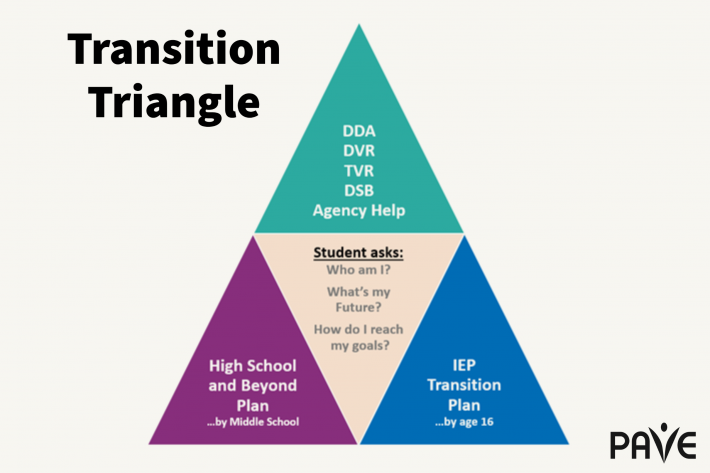
The transition triangle talks about the relationship between the High School and Beyond Plan , the IEP transition plan and Agency supports from DDA, DVR and DSB. within that triangle of support is the student asking themselves: Who they are, what is their future and their goals.

The planning process to support a student with disabilities toward their adult life plans requires coordination and organization. This graphic provides a visual overview of the work and who is responsible to help.

The center upside down triangle describes key questions for a student as they move through school and toward adulthood:

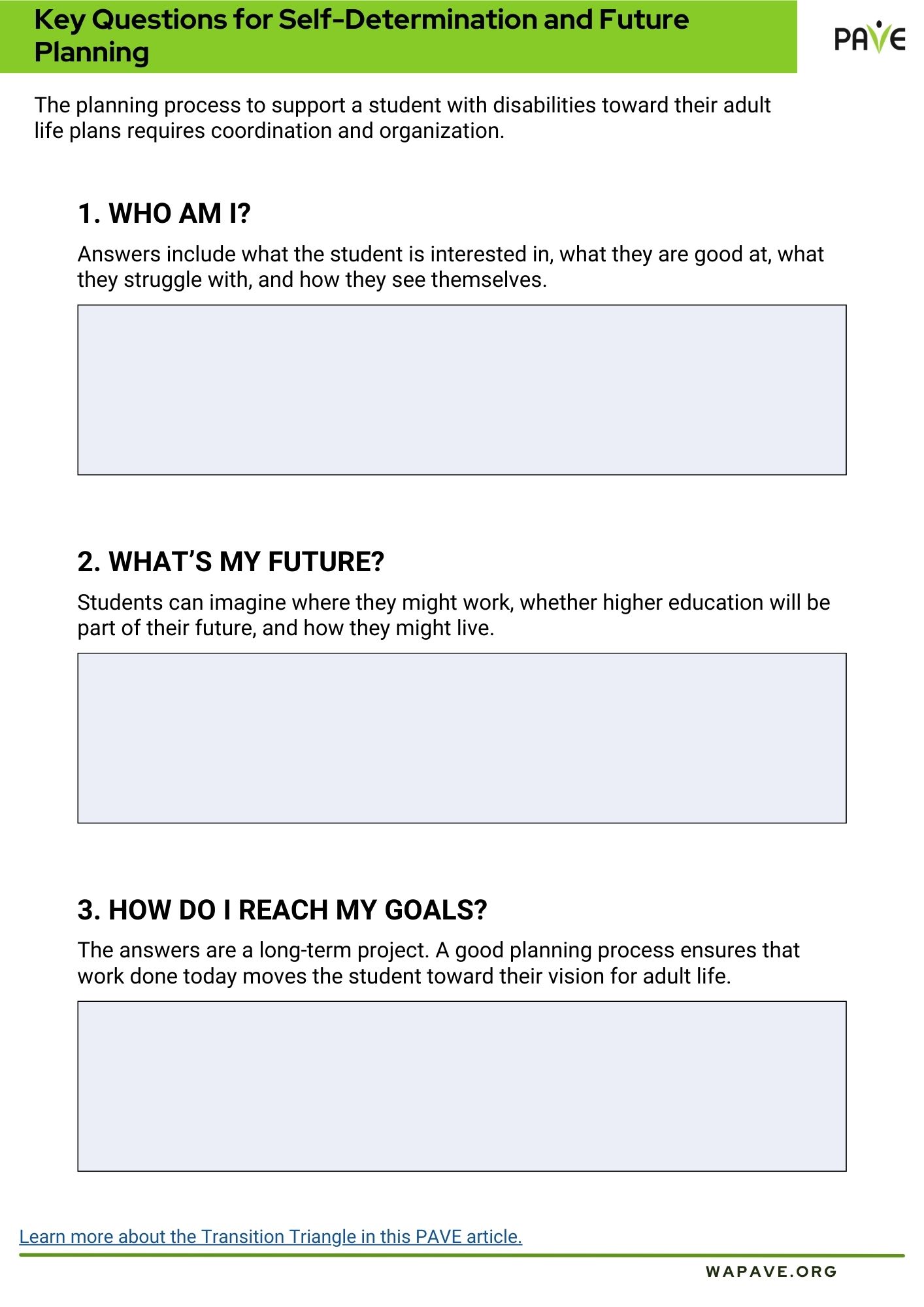
  1. Who am I? Answers include what the student is interested in, what they are good at, what they struggle with, and how they see themselves.
  2. What’s my future? Students can begin to imagine where they might work, whether higher education will be part of their future, and how they might live.
  3. How do I reach my goals? The answers are a long-term project. A good planning process ensures that work done today is moving the student toward their vision for adult life.

The three colored triangles on the corners of the graphic represent three tools that help students ask and answer these questions.

The purple triangle on the bottom left represents the High School and Beyond Plan. Washington State requires schools to begin supporting all students with a High School and Beyond Plan before they leave middle school. The plan includes questions to help the student think about where they might work someday and how much education they will need to get that job. The plan is designed to make sure time spent in school is moving the student toward adult goals. The High School and Beyond Plan addresses the same questions that are listed in the center of our triangle and is often managed by staff in a school’s counseling center.

The blue triangle on the bottom right represents the transition plan, which is required in a student’s Individualized Education Program (IEP) by the school year when they turn 16. Goals in the IEP Transition Plan include further education/training, employment, and independent living as parts of a student’s program. A student with disabilities has the right to a Free Appropriate Public Education (FAPE) until they earn a diploma or turn 21. The IEP includes a target graduation date, determined by the IEP team. The state requires the IEP Transition Plan to align with the High School and Beyond Plan. School staff and the family collaborate to make sure these two tools match up to best support a student’s progress.

The teal triangle on top of the pyramid represents agencies that might provide Vocational Rehabilitation (VR) services. The Developmental Disabilities Administration (DDA) has a variety of school-to-work programs for eligible students: A DDA case manager can provide information about options. The Division of Vocational Rehabilitation (DVR) provides Pre-Employment Transition Services (Pre-ETS) for students still in school as well as vocational rehabilitation services for adults with disabilities. As they transition out of school, members of some Native American tribes may access Tribal Vocational Rehabilitation (TVR) services. The Department of Services for the Blind (DSB) is a separate agency providing Pre-ETS for youth and vocational rehabilitation services for individuals who are blind or low vision. Staff from these agencies may work with an IEP team and counselors at school to make sure everyone is working together to support the student in the center.

Ideally a student with disabilities has people supporting all of the features on this transition triangle. Best practice is for all agencies and supporters to collaborate as they help a student move toward a successful adult life.

PAVE has made a fillable worksheet to help you answer these questions.

Key Questions for Self-Determination and Future Planning Fillable worksheet.

In addition, PAVE has a college readiness workbook ready for you to use. For direct assistance from PAVE, click Get Help. The Office of Superintendent of Public Instruction (OSPI) provides information about graduation requirements for a student in Washington State

School to Adulthood: Transition Planning Toolkit for High School, Life, and Work

Looking to the future can feel exciting, hopeful, confusing, overwhelming—or all emotions at once. For families supporting a young person with a disability, it’s never too soon to begin planning to ensure a smooth process from the teen years toward whatever happens next. This toolkit supports families as they organize this multiyear project.

Presenting our newest resource – the Planning My Path Practical Tips and Tools for Future Planning. This toolkit encompasses a collection of our informative articles, complemented by easy to understand timeline charts to provide you with a solid foundation as you navigate through this crucial transition period. Taking some time to look through it may answer some questions that pop up as you get closer to your high school graduation.

Learn the Words

A good place to begin is a Glossary of Key Terms for Life After High School Planning, which provides vocabulary building and an overview of topics relevant to this important phase of life. 

Earning a Diploma

To earn a high-school diploma in Washington State, students must:

OSPI provides a two-page summary of graduation requirements to support families and students. Included is this statement: “Students who receive special education services under an Individualized Education Program (IEP), also have an IEP Transition Plan, which begins by the school year when a student turns 16 or sooner. The HSBP is required to align with their IEP Transition Plan to ensure a robust planning process toward post-high school goals.”

Various state agencies collaborated to provide a guidebook: Guidelines for Aligning High School & Beyond Plans (HSBP) and IEP Transition Plans.

The state’s 2019 legislature changed graduation requirements (HB 1599). Students may earn a Certificate of Academic Achievement (CAA) or a Certificate of Individual Achievement (CIA) to graduate. How a student earns a CIA is determined by their IEP team.

Students with disabilities seeking a diploma through General Educational Development (GED) testing may be eligible for testing accommodations. A website called passged.com lists a variety of disability conditions that might make a person eligible for testing supports.

Commencement Access

Regardless of when a diploma is earned, a student can participate in Commencement at the end of a traditional senior year, with peers, under a Washington provision called Kevin’s Law. Families may want to plan well in advance with school staff to consider how senior year events are accessible to youth with disabilities.

The Big Picture

The right to a Free Appropriate Public Education (FAPE) includes the right to school-based services that prepare a young person with a disability for adult life.

Here are links to a training video, infographic, and article:

Various state agencies collaborated to provide a downloadable guidebook: Guidelines for Aligning High School & Beyond Plans (HSBP) and IEP Transition Plans. Included are career-planning tools and linkages to current information about Graduation Pathways, which changed in 2019 when the Washington State Legislature passed House Bill (HB) 1599.

Student Self-Advocacy

As they move toward adulthood, many students benefit from opportunities to practice skills of self-advocacy and self-determination. One way to foster those skills is to encourage youth to get more involved in their own Individualized Education Programs (IEPs). To support that, PAVE provides this article: Attention Students: Lead your own IEP meetings and take charge of your future. Included is a handout that students might use to contribute to meeting agendas.

The RAISE Center (National Resources for Advocacy, Independence, Self-determination and Employment) provides a blog with transition related news, information, ideas and opinions. Topics in 2020-21 include how to “Be the Best You,” how issues of race and disability intersect with equity, and how “The Disability Agenda Could Bring Unity to A Fragmented Society,” by RAISE Center co-director Josie Badger, who is a person living with disability.

Student Rights after High School

An Individualized Education Program (IEP) ends when a student leaves secondary education. The protections of the Americans with Disabilities Act (ADA) and of Section 504 of the Rehabilitation Act of 1973 are ongoing throughout the lifespan.

These laws provide for appropriate accommodations in public programs and facilities. To support these disability protections, The IEP accommodations page or a Section 504 Plan can travel with a student into higher education, a vocational program, or work. Often a special services office at an institution for higher learning includes a staff member responsible for ensuring that disability rights are upheld. PAVE provides an article with general information about Section 504 rights that apply to all ages: Section 504: A Plan for Equity, Access and Accommodations.

Universal Design supports everyone

Asking for rights to be upheld is not asking for special favors. A person living with disability, Kyann Flint, wrote an article for PAVE to describe how Universal Design supports inclusion. Her article can provide inspiration for young people looking for examples of what is possible, now as ever: COVID-19 and Disability: Access to Work has Changed.

Agencies that can help

Washington State’s Division of Vocational Rehabilitation (DVR) provides services for high-school students engaged in transition planning as well as adults seeking employment. PAVE provides an article that describes Pre-Employment Transition Services (Pre-ETS) and more: Ready for Work: Vocational Rehabilitation Provides Guidance and Tools.

DVR’s website includes a section with information about Tribal Vocational Rehabilitation (TVR), which is available for people with tribal affiliations in some areas of the state. Each TVR program operates independently. Note that some TVR programs list service areas by county but that sovereign lands are not bound by county lines. Contact each agency for complete information about program access, service area, and eligibility.

Services for individuals who are deaf or hard of hearing are provided by Washington’s Center for Deaf and Hard of Hearing Youth (CDHY), which was formerly called the Center for Childhood Deafness and Hearing Loss (CDHL). This statewide resource supports all deaf and hard of hearing students in Washington, regardless of where they live or attend school.

Services for individuals who are blind or living with low vision are provided by Washington’s Department of Services for the Blind (DSB). Youth services, Pre-Employment Transition Services (Pre-ETS), Vocational Rehabilitation, Business Enterprise Program, and mobility and other independent-living skills are served by DSB.

The Developmental Disabilities Administration (DDA) also has a variety of school-to-work and waiver programs that support youth. PAVE provides a video to support families through the DDA eligibility process. An article provides further detail: How to Prepare for a DDA Assessment.

Not all youth with disabilities are able to access employment-related services through DVR, TVR, DSB, or DDA. A limited additional option is Goodwill, which provides access to a virtual learning library. Students can take classes at their own pace for skills development. Employment skills, workplace readiness, interviewing skills and more are part of the training materials. To request further information, call 253-573-6507, or send an email to: library@goodwillwa.org.

Graduation’s over: Why is school calling?

Schools are responsible to track the outcomes of their special education services. Here’s an article to help families get ready to talk about how things are going: The School Might Call to Ask About a Young Adult’s Experience After High School: Here’s Help to Prepare

Benefits Planning

A consideration for many families of youth with disabilities is whether lifelong benefits are needed. Applying for social security just past the young person’s 18th birthday creates a pathway toward a cash benefit and enables the young person to access Medicaid (public health insurance) and various programs that depend on Medicaid eligibility.

The Washington Initiative for Supported Employment (gowise.org) provides benefit planning information and resources through a program called BenefitU.

When a person 18 or older has a disability, family members may want to stay involved in helping them make decisions. Supported Decision Making (SDM) is the formal name for one legal option. Washington law (Chapter 11.130 in the Revised Code of Washington) includes Supported Decision Making as an option under the Uniform Guardianship, Conservatorship, and Other Protective Arrangements Act. The law changed in 2020 when the state passed Senate Bill 6287. The changes took effect Jan. 1, 2022. PAVE’s article about Supported Decision Making has more information about this and other options for families to support an adult with a disability.

Life After High School: Tools for Transition

Helping a student with disabilities prepare for life after high school requires thoughtful organization and planning. This presentation describes three ways to support this important time of life:

  1. High School and Beyond Plan
  2. IEP Transition Plan
  3. Agency Support

Here are resources referenced in the video:

  • OSPI Model Forms: Scroll down to find and open the IEP Form with Secondary Transition
  • OSPI Graduation Requirements, including links to download the High School and Beyond Plan in various languages
  • DDA: Developmental Disabilities Administration
  • DVR: Division of Vocational Rehabilitation
  • TVR: Tribal Vocational Rehabilitation, for Native Americans with disabilities
  • DSB: Department of Services for the Blind, for people with blindness or low vision
  • WAC 392-172A-03090, including description of Age of Majority rights that transfer to the student at age 18
  • PAVE article about Supported Decision Making
  • OSPI: The Office of Superintendent of Public Instruction has a family liaison for special education
  • OEO: The Office of the Educational Ombuds provides online resources and 1:1 support
  • OCR: The Office for Civil Rights can help with questions about equity and access
  • ESD: Nine Education Service Districts; each has a behavioral health navigator, and some are licensed to provide behavioral health services
  • Developmental Disabilities Ombuds
  • PAVE School to Adulthood Toolkit

Families Who Receive In-Home Care Services: Take Note of 2022 Changes

A Brief Overview

  • Everyone who gets state-funded in-home care in Washington is affected by a new employment structure for Individual Providers (IPs).
  • The Consumer Direct Care Network of Washington (CDWA) is the new Consumer Directed Employer (CDE) for all individual providers of state purchased in-home care.
  • The CDWA website offers support in multiple ways by online live chat, email, phone, webinars, and in person. See below for direct links and phone numbers.

Full Article

Some individuals with disabilities need help at home for various reasons related to activities of daily living. People who are eligible receive those services as part of a state-funded benefit. A professional who comes to the home to provide that help is called an IP—an Individual Provider.

Washington IPs have historically worked under contracts with various social service agencies, such as Home and Community Services (HCS) and Developmental Disabilities Administration (DDA). Those contracts are changing.

A legal change that takes effect in 2022 means that these employment contracts are managed differently. Every Washingtonian who uses in-home personal care services provided by state agencies is affected, including children and adults with disabilities and people who need in-home help due to aging.

Here’s new vocabulary to describe the change:

Individual Providers (IPs) now work under the Consumer Direct Care Network Washington (CDWA). The CDWA operates as an independent Consumer Directed Employer (CDE).

CDWA will employ approximately 47,000 dedicated caregivers who provide in-home personal care and respite services. Providers are transitioning to this new organization of work in early 2022.  To see what’s happening in your area, check out the map on the CDWA website.  

For information and training materials, and to register for CDWA webinars, please visit the Resources page.

The CDWA website offers multiple ways families and providers can reach out for information:

Map Your Future with Person-Centered Planning

A Brief Overview  

  • Person-Centered Planning (PCP) is a method for helping a person map out a future with intention and support.
  • Read on for more information about what Person-Centered Planning is like.

Full Article  

Everyone dreams about what they might do or become. Individuals with disabilities might need additional support to design the plans, set the goals and recruit help. The Person-Centered Planning (PCP) process is a tool that works like a Global Positioning System (GPS) to help a person figure out where they are starting and how to navigate to a planned destination.   

A PCP session is a gathering that can happen in a specific physical location, such as a school or a community center, or in a virtual space online. The people who get together might include family members, friends, teachers, vocational specialists, coaches—anyone who might help brainstorm ways to plan an enriched, full life for a person of honor.

The first step is to celebrate the gifts, talents, and dreams of the person. Then the group develops action steps to help that person move closer to their dreams and goals.  

Throughout the gathering, the attendees listen, ask questions, and draw pictures or write down words that contribute to the process. Respect for the person’s goals and wishes is a priority, and participants withhold judgment to honor the individual completely.  

Person-Centered Planning explores all areas of a person’s life. All people experience various times in their lives that are transitions. High-school graduation is a major example. Job changes, moving to a new home, entering or leaving a relationship: Those transitions happen for individuals with and without disabilities.

Individuals with disabilities have some additional transitions. For example, when a person leaves the special education system of public education at graduation or after age 21, there is a change in disability protections. A student receiving special education is protected by the Individuals with Disabilities Education Act (IDEA). In adult life, the right to accommodations and non-discrimination is protected solely by the Rehabilitation Act of 1973 (Section 504) and the Americans with Disabilities Act (ADA).

There are specific transitions that occur for individuals who qualify for support from the Developmental Disabilities Administration (DDA), which in Washington is part of the Department of Social and Health Services (DSHS). Employment and workforce training programs often are part of the transition from high school into what happens next.

During major life transitions, many service agencies focus on a person’s inabilities or deficits.  Person-Centered Planning, on the other hand, focuses on what’s positive and possible, based on the dreams and goals of the individual.

A PCP session includes a set of maps where information is collected in words and pictures. Here are some examples:

People in my Life     

This map names important people and their roles in concentric circles. These are people that the individual trusts for help and support and may include paid and unpaid supporters. Those who are closest to the person are in the circles closest to the center of the map.

Who am I?  My Story, My History    

This map is built during the session to describe the person’s story from birth up until the gathering. This map reflects what is most important to the individual. The facilitator might ask:

  • What parts of your life are important for people to know?   
  • What are some stories of your life that would be helpful for a coworker or a friend to know? 
  • Are you a sibling? A spouse? A parent?
  • How old are you? 
  • What activities do you participate in? 
  • Have you had any jobs?
  • Where do you live? Go to school?  
  • Do you have a medical concern that someone spending time with you might need to know about? 

 Likes and Dislikes  

The “Likes” list includes favorites, things that make the person happy. Favorite colors, foods, activities, places, people are listed. 

The “Dislikes” list includes the opposite of all those things and might also list triggers (bright lights, loud noises, angry voices, bullies) or other sensitivities.

What Works/ Doesn’t work 

The first part of this map asks: When learning a new activity or skill, what are steps and learning tools or activities that work for you? Answers might look like these examples: frequent breaks, accommodations, a written schedule, a list of duties, instructions in larger print, a preferred time of day to start something…. 

The second part asks: When learning a new activity or skill what activities do not work for you? Answers might resemble these examples:  waiting in line, too many instructions, too many people barking out orders, standing or sitting for too long, verbal instructions, unclear expectations….  

Gifts, Talents and Strengths  

This map asks several questions: 

  • What are you good at?
  • What can you do that is easy for you? 
  • What are your best qualities? 
  • What do people like about you?   

Examples for answers:  best smile, cleaning, giving, caring, natural dancer, very social, great with computers, good with numbers, great at sports, good listener, good with animals, etc.   

Dreams /Nightmares 

The My Dreams map asks: Where you would like to see yourself in a few years?  Follow-up questions:

  • What will you be doing?
  • What would your dream job be?  
  • Where are you living? 
  • Do you live on your own or with family or a roommate?  
  • How are you keeping in touch with your friends?   
  • What is an action you can take to move toward your dream or goals?    

The Nightmare Map asks:  What do you want to avoid?  Follow-up questions might include this one: Where do you not want to be in a few years? This is not to make the person feel bad but to make an out-loud statement about what the person doesn’t want to happen. This can include actions or thoughts that someone wants to avoid.  

Needs 

The Needs map asks:  What do you need help with to avoid the nightmare?  A follow up question might include: What areas do you need support with? Answers might look like these examples: budgeting money, learning to drive, training to ride the bus, cooking lessons, looking for a job. The goal is to recruit support to help the person stay away from the nightmare and work toward the dream.   

Action Steps  

A map that show Action Steps includes the specific help that will assist the individual in moving toward the dream. This chart typically details what needs to be done, who will do it, and by when. 

Example:    

Goal: To Write a Resume     
Who: Michele 
What: Call Mark to ask for help.  
By When: Next Monday, April 6, 2020 

This process involves many support people in the person’s life and identifies, in a self-directed way, areas where help is needed to meet personal goals. The gathering involves the important people in someone’s life because they can help through the process and step up to offer support for the action steps. 

How to get a Person-Centered Plan  

Here are places that might help you find a PCP facilitator in your area:  

  • Developmental Disabilities Administration (DDA) 
  • Division of Vocational Rehabilitation (DVR)
  • School District 

Here are a few additional places to seek information about Person-Centered Planning:  

Inclusion.com: All My Life’s a Circle  

Inclusion.com: The Path Method 

Video from PAVE, Tools 4 Success  

Informing Families.org  

How to Prepare for a DDA Assessment

Here are tips for getting ready for an assessment with the Developmental Disabilities Administration (DDA), which is managed by the Washington State Department of Social and Health Services (DSHS). Be sure to send information to the DDA case manager ahead of time and keep a copy. If you save the assessment electronically in Word/Google Documents, it can be easily reviewed and updated any time.

Review

  • Take notes on last year’s assessment and email a list of your concerns to the DDA case manager. This provides the case manager time to prepare answers and check with a supervisor or central office staff if further information is needed to answer questions.

Notification

  • If the individual receiving DDA support is working or is looking for work, invite a job coach to the meeting. Provide details about the meeting day, time and location, with plenty of time for planning.
  • Notify personal care providers about the meeting so they can share information with the case manager about supports being provided.

Documentation   

  • Include full name, address and phone number for the individual with a disability
  • Other Contacts: name, phone, address, and email
    • Close family members, friends, siblings, grandparents.
    • Medicaid Personal Care provider.
    • Employment Vendor
    • Medical doctors and specialists
    • Dentist
  • List of all medications
    • Name, dose, reason: include vitamins and over-the-counter medicines
    • For prescriptions, include the name of the doctor or other prescriber
  • List all diagnoses
    • For example: autism, cerebral palsy, paraplegia, specific cardiac problems, hydrocephalus, Oppositional Defiant Disorder (ODD), depression, seizure disorder
    • A primary doctor at the annual checkup can describe diagnoses in a clinic note, required by some DDA case managers
  • Record the dates of the most recent doctor and dentist appointments
    • Include emergency room and hospital visits with or without an overnight
  • Therapies
    • Describe the kind of therapy, frequency of sessions and full contact information for each therapist.
  • The assessment will review what happened over the past seven days, so a journal, whiteboard or note file on a phone can help track events for the week prior to the assessment. The case manager will want to know everything caregivers do for or with the individual with the disability.
    • Note with detail each time you provide verbal prompting, physical guidance, weight-bearing assistance, monitoring for safety, etc. Include things like tying shoes and zipping jackets or advising about the weather and what to wear.
    • Think of everything for an accurate CARE Assessment that details what care was provided to the individual throughout the time period being reviewed,

This information can be printed in PDF form – How To Prepare for a DDA Assessment
Having trouble seeing this document? Please email us at pave@wapave.org for us to email you a different version.

We explain this document in Video form! Training Overview of DDA Assessments

Developmental Disabilities Ombuds

By Tim McCue
Self Advocacy Educator
Pronouns: he/him/his
Office of Developmental Disabilities Ombuds

The Developmental Disabilities Ombuds; what are they all about?

Are you frustrated with your DD services? We are here to help! An ombuds is a person who makes sure that people who are getting a certain type of service have protection and get treated the way that they deserve to be treated. There are ombuds for people who are elderly and live in nursing homes, and ombuds for kids who need some help at school. The Developmental Disabilities Ombuds, or DD Ombuds, help improve the lives of people who have intellectual or developmental disabilities that are getting services from the government.

We take complaints from individuals with disabilities, their friends, family, guardians and even staff. When you call us, we have to keep what you told us private unless you give us permission to tell other people. Even if you do not get any services but you have a developmental disability, we can offer you information to help you find the help you need. We call this “information and referral”. What are some reasons you might want to make a complaint? Well, maybe you do not like the way you were treated, or maybe you do not feel safe? Another reason could be that you do not get to have the privacy or get to make the decisions you want.

Our biggest goal is to stop abuse and neglect from happening. That is why we regularly visit, or monitor, the places where people with developmental disabilities live across Washington State. These places can be supported living, adult family homes, private residences, or state institutions. As we are monitoring, we collect information so that we can write reports to give to service providers and the Washington state legislature about how well the service system is working. These reports include recommendations for how to improve the services that people are getting.

The Office of the Developmental Disabilities Ombuds also believes that self-advocacy is important. Why? Self-advocacy is all about giving people with disabilities the tools they need let others what they want, including safety, privacy, choice, dignity and respect. We have a self-advocacy educator who works full time to develop advocacy materials and teach self-advocacy skills. At our advocacy trainings, we give presentations and lead activities on topics like problem solving, speaking up, and disability rights.

The DD Ombuds are looking for new places to give advocacy trainings, so if you would like us to come to your meeting or event, send us a message at info@ddombuds.org. If you would like to make a complaint about your developmental disability services, give us a call at 833-727-8900, or fill out a complaint form on our website. Remember, the Office of Developmental Disabilities Ombuds is your office!

About the author:
Tim McCue has lived his entire life in the cool, crisp climate of Washington State. In 2012, Tim graduated from Lincoln High School and entered the Tacoma Transition Program, where he worked at the Metro Parks’ Greenhouse near Point Defiance. During his time there, he met Mike Raymond and the team at Self Advocates of Washington (SAW), who inspired his interest in advocacy. As a result, he was hired on as an intern to teach students about a variety of topics relating to disability empowerment, later becoming SAW’s Project Manager/Executive Director. He has also spent a considerable amount of time volunteering at various Self Advocacy groups such as Self Advocates in Leadership (SAIL) and Allies in Advocacy, most notably supporting and learning from the Person Centered Planning movement. In 2017, Tim was hired as the Self-Advocacy Educator for the Office of Developmental Disabilities Ombuds at Disability Rights Washington, where he works to provide disabled individuals with the most powerful tool of all; knowledge.