

Help for Military Families: Tips to Navigate Special Education Process in Washington State

For families new to Washington State, this article includes state-specific information about special education systems. PAVE wants to extend a warm welcome to your entire family and to let you know that we are ready to support you. If your family has moved here to fulfill a military role, we thank you for your service!  

The language of special education, school and support systems differ between States. Following is some basic information to help you navigate Washington systems.   

Brief overview 

  • The article provides state-specific information about special education and medical systems in Washington State. 
  • Children in Washington must begin attending school by age 8 and continue until age 18, with some special exceptions. Washington offers multiple pathways to graduation and requires a High School and Beyond Plan for all students. 
  • The Department of Children, Youth and Families (DCYF) administers the state early intervention services (EIS) program, called Early Services for Infants and Toddlers (ESIT) for infants and toddlers with disabilities or delays. 
  • Washington school districts must respond to special education evaluation requests within 25 school days and complete evaluations within 35 school days. IEPs must be implemented within 30 days of eligibility determination, with transition plans required by age 16. 
  • Welcome to Washington! 

Welcome to Washington!

Whether your family is newly stationed in Washington or returning after time away, we welcome you! Moving to a new state is a big change, and it can be confusing when programs and services are called different names than they were in your last location. We’re here to help you learn how Washington’s education and medical systems work, so you can find the right support for your child. 

This video shares key facts to help you get started in Washington with a child who has exceptional needs. 

The School System 

The State Education Agency (SEA) is the Office of Superintendent of Public Instruction (OSPI). Local Education Agencies (LEAs) are organized as 295 Districts that operate independently and include a school board governance structure. School boards are responsible to follow the Open Public Meetings Act. There are nine Educational Service Districts (ESDs) that partner with OSPI to provide services for school districts and communities and to help OSPI implement legislatively-supported education initiatives. 

Charter schools, as public schools, have the same responsibilities as all public and non-public entities when serving students with disabilities. This includes developing and implementing Individualized Education Programs (IEPs) or Section 504 Plans for eligible students.  

Washington has adopted the Interstate Compact on Educational Opportunity for Military Children (commonly known as “MIC3”), which addresses certain school transition issues for military children consistently, from State to State. Each Member State has a MIC3 State Commissioner to oversee compliance and coordinate with other commissioners as needed. Parents of military-connected children may contact their School Liaison or MIC3 State Commissioner directly for support with Compact-related issues. PAVE has prepared a MIC3 Step-by-Step Checklist to Resolve Issues with the Interstate Compact

Washington’s Purple Star Award Program recognizes school districts that go above and beyond to support military families. Districts with this award provide a webpage with resources, have a trained staff member to help, and make sure teachers understand school transition rules under the Interstate Compact. Families can look for the Purple Star designation when choosing schools—it’s a sign the district is committed to welcoming military-connected students. To see which districts have the award, visit OSPI’s Purple Star page

Washington’s compulsory attendance law requires that children begin attending school full-time at the age of 8 and continue attending regularly until the age of 18 (RCW 28A.225.010). A child must have turned 5 years old by August 31 to enroll in kindergarten, and 6 years old to enroll in first grade. Military-connected children who are covered by the provisions of MIC3 may continue kindergarten or first grade, despite the school’s age requirement, if they were already enrolled and attending at the sending school in their previous state. This PAVE article explains how MIC3 supports children in military families with enrollment-related issues. 

Washington has multiple Pathways to Graduation and requires a High School and Beyond Plan (a career and college exploration experience that students begin in seventh grade) for all students. Under MIC3, schools must place military children in courses and programs based on placement and assessments performed by the sending school. Schools and districts may waive course requirements for placement and/or graduation of military-connected children, if a child has met the sending school’s requirements for grade advancement, placement, or graduation. Learn more about how MIC3 protects academic progress toward graduation in this PAVE article. 

Early Learning Programs (ages 0-5) 

Families concerned about a child’s development can call the Family Health Hotline at 1-800-322-2588, with support in multiple languages, or complete a free developmental screening online at ParentHelp123. The Department of Children, Youth and Families (DCYF) administers the state early intervention services (EIS) program, called Early Services for Infants and Toddlers (ESIT). After evaluating a child for eligibility and developing a family-focused plan, ESIT provides services to help infants and toddlers with disabilities or delays to learn and catch up in their development. Planning for the child’s transition out of ESIT by their third birthday includes coordination with the local school district to evaluate the child for school-aged services and supports. PAVE’s toolkit for family caregivers of infants and toddlers, From Birth to Three, outlines the educational rights of children and families in early intervention services. 

The Early Childhood Education and Assistance Program (ECEAP) is Washington’s no-cost prekindergarten program, aimed at preparing 3- and 4-year-old children from families facing more significant challenges for success in school and life. Families with children aged 3 or 4 by August 31st may be eligible for ECEAP. Children are eligible for ECEAP and Head Start based on their age and family income. Up to 10 percent of ECEAP and Head Start children can be from families above the income limit if they have certain developmental factors or environmental factors such as homelessness, family violence, chemical dependency, foster care, or incarcerated parents. PAVE’s 3-5 Transition Toolkit includes more information and resources to support families of children with disabilities in this age range. 

Special Education Information (School age) 

Every student with a disability is protected from discrimination under Section 504 of the Rehabilitation Act of 1973, including each student with a 504 Plan and each student with an Individualized Education Program (IEP). OSPI provides fact sheets about Section 504 in multiple languages that describe the evaluation process and state requirements. Parents may contact the Section 504/Civil Rights compliance officer assigned to their student’s school district. 

Washington Administrative Code (WAC), implements the provisions of the Individuals with Disabilities Education Act (IDEA) in WAC Chapter 392-172A. Parents’ rights and responsibilities in special education, known as procedural safeguards, are described in a short handbook available for download in multiple languages on OSPI’s website. 

A child’s right to a timely evaluation and the school district’s responsibility to seek out and serve students with disabilities, referred to as Child Find, is described on OSPI’s website. A school district has 25 school days to respond to a referral/request for special education evaluation. Once a parent/caregiver signs consent to evaluate, the district has 35 school days to complete the evaluation. A parent can request an evaluation any time there are concerns about whether services match the student’s present levels of performance and support needs. PTI provides a sample letter for requesting evaluation. 

Areas of evaluation are associated with 14 eligibility categories. Developmental Delay is a category for children ages 0-9 years old. The category of Emotional/Behavior Disability is unique to Washington – it is known as Emotional Disturbance under IDEA. Washington law requires that schools screen children in kindergarten through second grade for signs of dyslexia and to provide reading support for those who need it. 

School districts must write and implement an IEP within 30 calendar days after eligibility is determined. Decisions about the provision of special education services are made by an IEP team, which includes parents and specific required staff members (WAC 392-172A-03095). 

For a student with an IEP, there must be a transition plan in place by the beginning of the year in which they turn 16 years of age, unless the IEP deems it appropriate to begin earlier. Students “age out” of special education when they graduate from high school with a diploma or at the end of the school year in which they turn 21 years of age. If the student’s birthday is after August 31 of the current school year, they may continue special education until the end of that school year.  

In 2019, the Washington State Legislature provided students with multiple pathways to graduation by passing House Bill (HB) 1599. PAVE provides an on-demand webinar on this topic: Life After High School: A Two-Part Training to Help Families and Young People Get Ready

OSPI offers both informal and formal dispute resolution processesIEP facilitation is available at no cost through Sound Options Group as a voluntary and informal process where a neutral facilitator helps parents and schools resolve special education concerns collaboratively. Washington State Governor’s Office of the Education Ombuds (OEO) acts as a neutral guide to help parents and schools resolve disagreements about special education services, without providing legal advice or advocacy. OSPI provides three formal special education dispute resolution processes: mediation, special education community complaint, and due process hearing. 

In addition to educational resources, families often need healthcare support. Washington offers options that work alongside TRICARE benefits to meet your child’s needs. 

Medical Supports and Services 

Washington’s Medicaid, which includes the Children’s Health Insurance Program (CHiP), is called Apple Health. Applications are managed through the Health Care Authority (HCA), which oversees various Managed Care Organizations (MCOs) to provide health plan options. Open enrollment for Medicaid and Medicare starts on November 1st, 2025 and ends on January 15th, 2026. This is the annual opportunity to sign up, renew, or change coverage to best suit your family’s situation. Washington Health Plan Finder has step-by-step instructions for applying and navigators to help with the application process. Help is available for those who are having trouble navigating the health insurance landscape.  

Eligible dependents of military families can benefit from both TRICARE and Medicaid. When a military family member is dually enrolled in TRICARE and Medicaid, TRICARE is the primary payee and Medicaid covers remaining costs. When a service member leaves the military and TRICARE benefits change, Medicaid can provide services similar to those of TRICARE Extended Care Health Option (ECHO).  

TRICARE allows beneficiaries to make changes to their health coverage when a Qualifying Life Event (QLE) occurs, such as a move to a new city, region, or zip code. When a QLE happens, you generally have 90 days from the date of the move to update your enrollment. 

In addition to QLEs, TRICARE offers an annual open season for making changes to health coverage. Open season starts on the second Monday in November and ends on the second Monday in December each year. Any changes made during this period take effect January 1 of the following year. During open season, families can: 

  • Stay in their current plan – no action required. 
  • Enroll in a new plan. 
  • Switch between plans. 
  • Change enrollment type from individual to family coverage, or vice versa. 

PAVE provides more information about TRICARE’s basic plans, ECHO, and the Autism Care Demonstration in the TRICARE’s Big Three on-demand module. For this and more personalized learning at your own pace, check out our PAVE Learning Library.  

Learn More

PAVE offers downloadable toolkits filled with fact sheets, worksheets, sample letters, and practical tips to guide you through every stage of your child’s education and care. These resources are designed to make complex systems easier to understand and navigate. 

Celebrate your military child all year long with social stories, activities, and tools that help families stay connected and ease transitions. The PAVE article, Purple Up! Celebrating the Month of the Military Child, includes free downloads in the top five languages spoken in military households. 

Want to know what makes a military family “exceptional”? Explore PAVE’s two-part series on the Exceptional Family Member Program (EFMP) to learn how enrollment works and what supports are available to help your family thrive. 

STOMP (Specialized Training of Military Parents) workshops and webinars offer military families the opportunity to access valuable information and resources while fostering connections and knowledge-sharing to create a collaborative environment that strengthens partnerships between families and professionals. STOMP events are free to military-connected families from all branches of services, including all service statuses and all installations worldwide. 

Need personalized help? Military families can access one-on-one support, training, information, and resources through PAVE’s Get Support request form — wherever the military takes you! 
Beyond School Walls: A Guide to Homeschooling in Washington State 

Homeschooling is a popular and flexible educational option for many families. “Home-based instruction” (HBI), as it’s referred to in Washington State law, must meet specific required subjects and instructional hours (or school days) annually. If you’re considering homeschooling, it’s important to understand the legal requirements and steps involved, including the qualifications that make a parent or guardian eligible to provide home-based instruction. Homeschooled students can access public school resources like extracurricular activities, part-time classes, and even special education services. By understanding and adhering to these guidelines, you can ensure a successful and enriching homeschooling experience for your child.

A Brief Overview

  • Homeschooling or home education programs are called “home-based instruction (HBI)” in Washington state.
  • A parent or guardian must meet one of four qualifying criteria to homeschool, or register through an approved private school extension program.
  • Homeschooling must cover 11 required subjects and at least 1,000 instructional hours annually (or 180 school days), but Washington law (RCW 28A.200.020) allows for flexibility in teaching methods and curriculum selection, emphasizing a personalized approach.
  • Beginning on their eighth birthday, your child must be enrolled in a school or home-based instruction, in accordance with Washington’s compulsory attendance law (RCW 28A.225.010).
  • If your student was enrolled in school prior to homeschooling and they are 8 years of age or older, they must be withdrawn by written and signed statement, and you must file a Declaration of Intent with your local public school district. The Declaration of Intent must be filed by September 15th annually, or within two weeks of the beginning of the public school year.
  • Homeschooled children must complete yearly assessments, either through standardized testing or an evaluation by a certificated educator. Parents and guardians must keep the results in their homeschooling files as a permanent record.
  • Families can request a special education evaluation from the public school district regardless of whether their child is enrolled in public school. If the child is eligible, the district must provide ancillary services unless the family declines them (RCW 28A.150.350).
  • Homeschooled students can participate in public school resources, including part-time enrollment in virtual or in-person classes, extracurricular activities, and sports.
  • PAVE provides a downloadable Annual Checklist for Home-Based Instruction to help families maintain compliance with Washington’s homeschool statutes.

Introduction

Whether you are looking for an alternative to public school or continuing a home education program you began before moving from out of state, there are some things you need to know before homeschooling your student in Washington State. Homeschooling, referred to as “home-based instruction (HBI)” in the state statutes, comes with specific guidelines and requirements.

To homeschool, a parent or guardian must:

  1. Meet the qualifications for homeschooling under state law (RCW 28A.225.010(4))
  2. Provide 180 school days or 1,000 instructional hours annually in the 11 required subjects
  3. Formally withdraw the student from public school
  4. Notify the school district of annually with a Declaration of Intent
  5. Have the student complete an annual test or assessment
  6. Maintain homeschool records

What qualifications must a parent or guardian meet to homeschool?

A parent or guardian has to meet one of the following qualifications to homeschool their child:

  1. Hire a certified teacher to supervise the instruction.
  2. Complete 45 college quarter credits or the equivalent in semester credits.
  3. Complete a course in home-based education, sometimes referred to as a parent qualifying course, at a postsecondary or vocational-technical institute.
  4. Gain approval from the superintendent as “sufficiently qualified to provide home-based instruction.” Those who have homeschooled in another state and move into Washington may be more successful with this by demonstrating a documented history of homeschooling.

If you do not meet these qualifications, you may homeschool through a private school extension program. Locate an approved private school that allows the homeschooling option and contact the school directly.

What do homeschool students learn?

Washington law mandates that homeschooled children receive at least 1,000 instructional hours annually (or 180 school days), similar to the public school system. There are 11 required subjects, although parents do not have to teach every subject daily, weekly, or even yearly. Some subjects, like social studies, are for younger grades, while others, like history, are for older grades. The homeschool curriculum must include the following subjects:

  • Occupational education
  • Science
  • Math
  • Language
  • Social studies
  • History
  • Health
  • Reading
  • Writing
  • Spelling
  • Art and music appreciation

You have full control over your homeschooling curriculum, allowing you to tailor the education to your child’s needs and interests. You are responsible for decisions related to educational philosophy, selection of books, teaching materials, curriculum, and methods of instruction (RCW 28A.200.020).

Washington law acknowledges that “home-based instruction is less structured and more experiential than the instruction normally provided in a classroom setting.” As a result, the nature and quantity of instructional and educational activities are “construed liberally”. This flexibility gives you the freedom to create a personalized educational experience. (RCW 28A.225.010(5))

When and how can I withdraw my student from public school?

Children living in Washington must be enrolled in a school or home-based instruction starting on their eighth birthday. The law requires compulsory attendance from age eight until eighteen (RCW 28A.225.010). Any educational programs your child participates in before age eight are not subject to state requirements for home-based instruction.

If your child is enrolled in a public or private school and you decide to homeschool, you must first formally withdraw your student. This process involves submitting a withdrawal form provided by the school or a written statement including the student’s name, school name, date of withdrawal, your signature, and the date of signing.

If your child is 8 years of age or older, notify the school district of your intent to homeschool on the same day that you withdraw them from public school, even if they have not yet begun classes or an educational program at the school.

How do I notify the school district that I am homeschooling my child?

For every school year that your child is homeschooled, you must file a written statement, called a Declaration of Intent, with the district superintendent. The address of the superintendent is usually the district office, which you can find on the school’s website or by calling your local school. You may retain a district-stamped copy of the Declaration of Intent by including a second copy and a self-addressed envelope with prepaid postage in your mailer. The deadline to file is September 15th or within two weeks of the beginning of the public school year.

A Declaration of Intent is not required for children who begin school before age 8. For example, a 5-year-old who has started kindergarten may be withdrawn for home-based instruction. The child started going to school before compulsory attendance applied. As a result, the parent is not required to file a Declaration of Intent. If you intend to start your student’s educational career in homeschool, submit your first Declaration of Intent when your child turns 8 years old and compulsory education begins.

The Office of Superintendent of Public Instruction (OSPI) has provided a Sample Declaration of Intent that includes all of the required information: the child’s name, age, address, and parent’s name. This documents that the parent is complying with compulsory education requirements, and the student is receiving an education. The Declaration of Intent must also specify whether a certified teacher will supervise the instruction.

What are my options to complete the required annual assessments?

There are two options for the required annual assessments:

  1. Standardized Test: Administered annually by a qualified individual approved by the test publisher. The test must be a standardized academic achievement test recognized by Washington State Board of Education (SBE). For a list of examples of tests, see the SBE Home Instruction FAQs page.
  2. Annual Assessment: Conducted by a certificated person currently working in the field of education. The evaluation must be written. Washington law does not provide as much detail about the criteria for evaluations, but it should include “statements and documents that reflect the child’s progress, or lack thereof” (OSPI).

The purpose of the annual test or evaluation is to provide an external metric to measure a student’s progress. The results are for the parent’s use only, unless the child is later enrolled at a public or private school. Parents can choose either option each year based on what works best for their child. Keep the test results in your permanent homeschool record.

Homeschooled students may take part in standardized testing at the public school. The testing dates for the year are usually available at the school office by late September and parents can call the assessment coordinator at the school district to register their student for these tests. Be sure to request a copy of the test scores for your homeschooling file during registration for the standardized test.

If a homeschooled student performs poorly on a test or assessment and the results indicate that they are “not making reasonable progress consistent with his or her age or stage of development,” the parent or guardian is expected to “make a good faith effort to remedy any deficiency”. (RCW28A.200.010(1)(c))

What records do homeschooled students have?

Maintaining good records is an essential part of homeschooling in Washington state, serving as proof of education and compliance with state laws. While the law does not specify the exact form records should take, there are several types of documentation that are meaningful for homeschooled students:

  • Attendance records tracking the 180 school days or 1,000 instructional hours required
  • Curriculum information documenting the textbooks and workbooks used
  • Student work samples and portfolios demonstrating application of what they’ve learned
  • Communication with school officials, including the annual Declaration of Intent and proof of mailing, such as the Certified Mail-Return Receipt
  • Test results, such as annual standardized tests and assessments
  • Immunization records

These records can be requested by school administrators if your child later enrolls in a traditional school setting. You should permanently keep proof of compliance with home education laws, including the Declaration of Intent and results of the annual assessments. Homeschool Legal Defense Association (HSLDA) recommends keeping all records from your student’s high school years because they may be requested as proof of education by a post-secondary education program, upon joining the military, or as part of an employment-related background check.

Does the public school have to provide special education and related services to homeschooled students?

Families have the right to request an evaluation for special education from the public-school district regardless of whether a child attends public school. If the child is found eligible, the local district is responsible for providing services unless the family does not want them. In some cases, families arrange to have a child attend private or home-based school but receive special-education services through the public school. These special education services are known as “ancillary services” and they are defined in Washington Administrative Code (WAC) as “any cocurricular service or activity, any health care service or activity, and any other services or activities, except ‘courses,’ for or in which preschool through twelfth grade students are enrolled by a public school” (WAC 392-134-005).

Ancillary services include but are not limited to:

  • Therapies, such as counseling, speech and hearing therapy
  • Counseling and health services
  • Testing and assessments
  • Supplementary or remedial instruction
  • Tutorial services, which may include home or hospital instruction
  • Sports activities

According to The Pink Book: Washington State Laws Regulating Home-Based Instruction, available on OSPI’s Home-Based Instruction page, the definition of “course” specifies that a service or activity meets all of the requirements of an ancillary service but is instructional in nature.

Can homeschooled students take part in public school classes or activities?

Students homeschooled in Washington have access to public school resources, including standardized testing, extracurricular activities, and specialized programs. Families can enroll their children as part-time students to access specific classes or services that complement their home-based instruction (RCW 28A.150.350(d)). Homeschooled students can attend virtual and online public school programs on a part-time basis without losing their homeschool status.

Access to extracurricular activities includes participation in sports and other interscholastic competitions through the Washington Interscholastic Activities Association (WIAA). Homeschooled students are considered “regular members” as long as they have met the State’s home-based instruction requirements, and –

  • Annually file a WIAA Rule 18.6.3 form with the principal’s office where the student is enrolled part-time. This form is available on the WIAA website, on the Student Eligibility Center page in multiple languages.
  • Do not receive assistance from the school district, and the school district does not receive funding for the student.
  • Meet both WIAA and the local school district eligibility requirements.
  • Follow transfer rules if they change schools after registering as a homeschool student.
  • Provide acceptable documentation of any interscholastic eligibility standards required of all other student participants.
  • Comply with WIAA and local school district regulations during participation.
  • Adhere to the same team responsibilities and standards of behavior and performance as other team members.
  • Participate as a member of the public school in the service area where they reside.

Final Thoughts

Homeschooling in Washington State provides families with a flexible and personalized approach to education while adhering to the state’s legal requirements. By understanding and meeting the necessary qualifications, maintaining proper records, and fulfilling annual assessment obligations, parents and guardians can ensure their child’s education remains compliant and effective. The wide array of resources, from specialized classes to extracurricular activities, further supports a well-rounded learning experience. Whether you are new to homeschooling or continuing from another state, Washington’s supportive framework allows for a rich and adaptable educational journey tailored to each child’s unique needs.

Starting School: When and How to Enroll a Student in School

A Brief Overview

  • Compulsory attendance begins at 8 years of age and continues until the age of 18 unless the student qualifies for certain exceptions.
  • Infants and toddlers receiving early intervention services may be eligible to start preschool as early as 3 years old to continue receiving specialized instruction and related services.
  • A student aged 4 years old by August 31 may be screened for Transition to Kindergarten (TK), a state program designed for students who need additional support to be successful in kindergarten the following year.
  • A child must have turned 5 years old by August 31 to enroll in kindergarten, and 6 years old to enroll in first grade.
  • When registering your student for school, contact the school to find out what documents are required in addition to those listed in this article.
  • Students with a condition that may require medication or treatment

Full Article

If your child has never enrolled in school, back to school season can be a confusing time. This article answers frequently asked questions about school entrance age, compulsory education, and the enrollment process.  Note that “enrollment” and “registration” are used interchangeably regarding the steps leading up to a student starting school and within the OSPI (Office of Superintendent of Public Instruction) website.

At what age are children required to attend school?

Federal law protects the rights of children and youth to receive a publicly funded education. This is called compulsory education, or compulsory attendance. The age at which a child must begin school varies by state. In Washington state, children must begin attending school full-time at the age of 8 and continue attending regularly until the age of 18 (RCW 28A.225.010).

There are some exceptions to compulsory attendance, including if a child is –

  • enrolled in a private school, extension program, or residential school operated by the Department of Social and Health Services (DSHS) or the Department of Children, Youth, and Families (DCYF).
  • enrolled in home-based instruction that meets State supervision requirements.
  • excused by the school district superintendent for physical or mental incapacity.
  • incarcerated in an adult correctional facility.
  • temporarily excused upon the request of the parents when the excused absences meet additional requirements under Washington state law (RCW 28A.225.010).

Compulsory attendance is required in Washington until the age of 18, unless the student is 16 years or older and meets additional criteria for emancipation, graduation, or certification (RCW 28A.225.010).

At what age can a student begin attending school?

Students with special needs or disabilities may qualify for early education programs. An infant or toddler with a disability or developmental delay receiving early intervention services may be eligible to start preschool between the ages of 3-5 to continue receiving specialized instruction and related services through the public school district until they reach the minimum enrollment age for kindergarten. Washington’s Transition to Kindergarten (TK) program screens 4-year-olds with a birthday by August 31st to identify those in need of additional preparation to be successful in kindergarten.

Parents may choose to enroll a child in kindergarten at 5 years old, if the birthday occurred before August 31st of the same year, but kindergarten is not required under compulsory education. Similarly, a child must be 6 years of age to enroll in first grade.

Families have the right to choose whether to enroll their students in school until the child turns 8 years old and compulsory attendance applies.

How do I enroll my student in school?

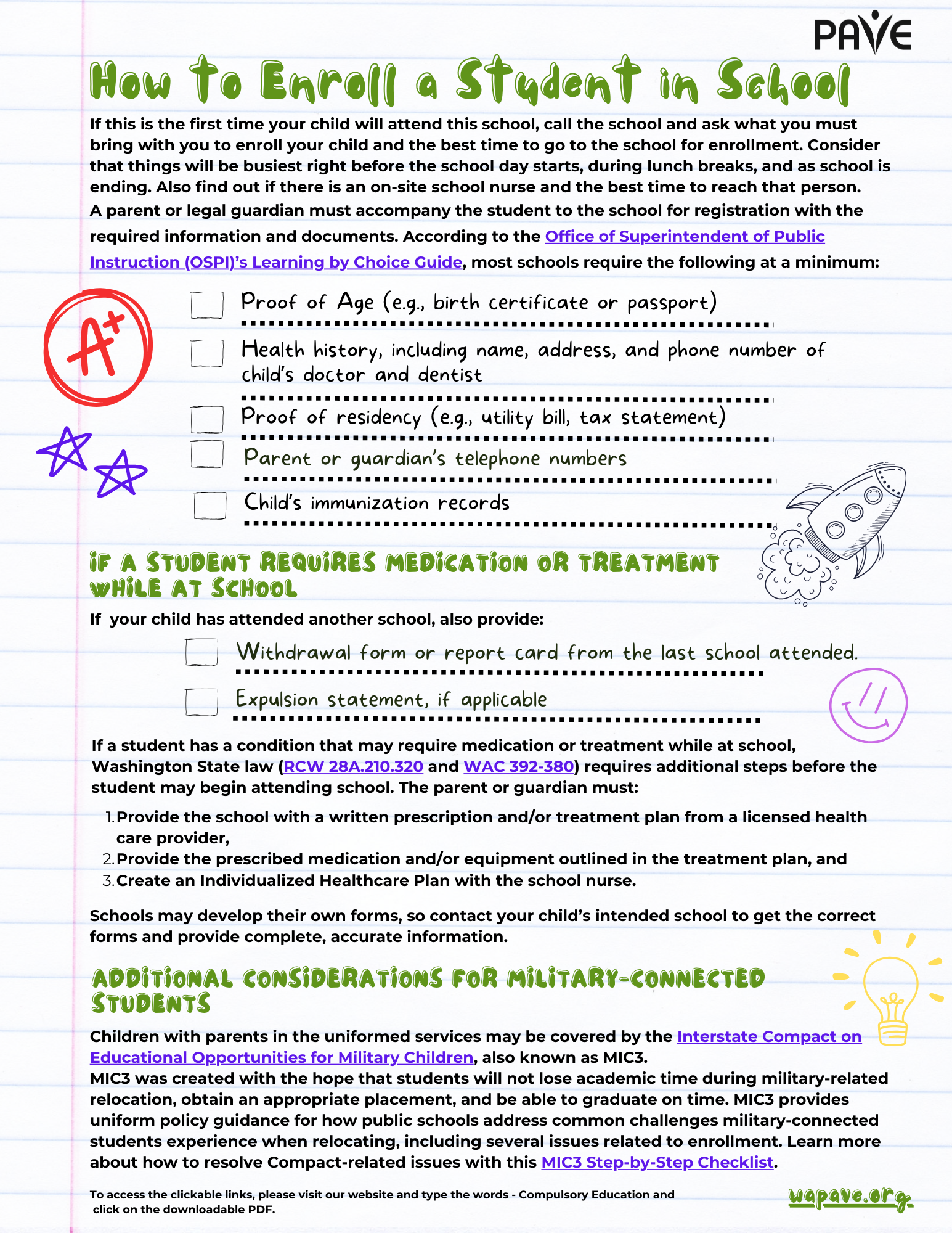
If this is the first time your child will attend this school, call the school and ask what you must bring with you to enroll your child and the best time to go to the school for enrollment. Consider that things will be busiest right before the school day starts, during lunch breaks, and as school is ending. Also find out if there is an on-site school nurse and the best time to reach that person.

A parent or legal guardian must go with the student to the school for registration with the required information and documents. According to the Office of Superintendent of Public Instruction (OSPI)’s Learning by Choice Guide, most schools require the following at a minimum:

  • Proof of age (e.g., birth certificate or passport).
  • Health history, including name, address, and phone number of child’s doctor and dentist.
  • Proof of residency (e.g., utility bill, tax statement).
  • Parent or guardian’s telephone numbers.
  • Child’s immunization records.

If your child has attended another school, also provide:

  • Withdrawal form or report card from the last school attended.
  • Expulsion statement.

Enrollment for Military-Connected Students

A Washington law passed in 2019 (HB 1210-S.SL, School Enrollment-Nonresident Children from Military Families) allows advance enrollment of children of active-duty service members with official military orders transferring or pending transfer into the state. This means that qualifying children must be conditionally enrolled in a specific school and program and registered for courses. The parent must provide proof of residence within fourteen days of the arrival date listed in the military orders before the school will finalize the enrollment. The address on the proof of residency may be a temporary on-base detailing facility; a purchased or leased residence, or a signed purchase and sale or lease agreement; or military housing, including privatized and off-base housing. The child will be conditionally enrolled and registered for courses.

Schools are responsible for the health and safety of students during all school-related activities. If a student has a condition that may require medication or treatment while at school, Washington state law (RCW 28A.210.320 and WAC 392-380) requires additional steps before the student may begin attending school. The parent or guardian must:

  1. Provide the school with a written prescription and/or treatment plan from a licensed health care provider,
  2. Provide the prescribed medication and/or equipment outlined in the treatment plan, and
  3. Create an Individualized Healthcare Plan with the school nurse.

Schools may develop their own forms, so contact your child’s intended school to get the correct forms and provide complete, accurate information.

Download How to Enroll a Student in School Handout

How to Enroll a Student in School Checklist To download the fillable form and get access to the clickable links, download the PDF

Additional Considerations for Military-Connected Students

Children with parents in the uniformed services may be covered by the Interstate Compact on Educational Opportunities for Military Children, also known as MIC3, was created with the hope that students will not lose academic time during military-related relocation, obtain an appropriate placement, and be able to graduate on time. MIC3 provides uniform policy guidance for how public schools address common challenges military-connected students experience when relocating, including several issues related to enrollment. Learn more about how to resolve Compact-related issues with this MIC3 Step-by-Step Checklist.

Families who are new to Washington can learn more about navigating special education and related services in this article, Help for Military Families: Tips to Navigate Special Education Process in Washington State.

Additional Information